A Comprehensive Guide to India’s Current Air Defence Systems

Introduction: The Crucible of Operation Sindoor
The landscape of modern warfare is no longer confined to trenches and borders as it is increasingly fought and decided in the skies, evident from the brief but intense India-Pakistan conflict in May 2025, triggered by a terror attack in Pahalgam. During the skirmish, India’s retaliatory precision strikes were met with a dense barrage of drones and missiles from Pakistan.
This conflict also exposed a stark new reality mentioned by the former military chiefs, that India is now facing combat situations on multiple fronts. The seamless integration of Chinese intelligence and hardware, comprising 81% of Pakistan’s arsenal, demonstrated a conjoined threat.
To protect its airspace from such sophisticated and multi-domain collusive threats, India relies on a multi-tiered, overlapping Air Defence network. From rogue drones to ballistic missiles, India’s air-defence shield ensures that if one layer misses a target, the next one eliminates it. Here is a detailed breakdown of the current operational components of the Indian Air Defence System.
Point Air Defence & Counter-UAS Systems
Point defence systems are the last line of defence and have proven to be significant in protecting highly strategic and localized assets like airbases, command centres and parliament buildings.
- L-70 and ZU-23-2 Guns: The Bofors L-70 (40mm) and Russian ZU-23-2 (23mm) are legacy anti-aircraft guns. They fire a massive curtain of flak and explosive shells into the air to shred incoming low-flying aircraft or drones. Upgraded recently with electro-optical tracking and thermal imaging, they remain highly effective at ranges of 2.5 to 4 km. The enhanced ZU-23 and L-70 anti-aircraft guns proved highly effective during Operation Sindoor and acted as a cost-effective, rapid-fire and precise point-defence shield against Pakistani drone swarms.
- Counter-UAS Systems: Drone warfare took centre stage during Operation Sindoor. India employs a mix of kinetic (hard kill) and electronic (soft kill) systems. The DRDO Anti-Drone System uses lasers to burn targets or jams their communication links, while Indrajal is an autonomous and AI-driven wide-area anti-drone dome developed by Grene Robotics, which provides 360-degree protection over large areas.
Very Short-Range Air Defence Systems & MANPADS
The Man-Portable Air-Defence Systems are shoulder-fired, lightweight missiles used by infantry troops to take down low-flying helicopters and jets. The mobile Very Short-Range Air Defence Platforms bridge the gap between infantry MANPADS and larger mobile missile batteries.
- Igla-S: A Russian-origin, heat-seeking missile capable of engaging targets up to 5-6 km, which locks onto the infrared heat signature of an aircraft’s exhaust and is highly battle-proven globally.
- Mistral: A French-origin, highly agile missile often mounted on Indian military helicopters like the LCH Prachand and on ground tripods. It boasts an exceptionally high kill probability of up to 96% against fast-manoeuvring targets.
- Legacy Russian Systems: Platforms like the Strela, OSA-AK, Pechora, Shilka, and Tunguska are heavily armoured, mobile platforms tracking targets up to 10-15 km. The Shilka and Tunguska are Self-Propelled Anti-Aircraft Guns that combine rapid-fire cannons with surface-to-air missiles to escort moving tank formations. The Pechora is an older, static missile system, famous globally for shooting down a US F-117 stealth fighter in 1999.
- SAMAR (Surface to Air Missile for Assured Retaliation): An Indian innovation, using repurposed and expired Russian R-73 and R-27 air-to-air missiles by launching them from the ground, featuring a range up to 10-12 km. The following has proven to be highly cost-effective, showcased in the recent IAF exercises.
Short-Range Air Defence Systems
- Akash Air Defence System: It is considered to be one of the most prominent indigenous weapon systems for India, which uses a ramjet-propulsion system, maintaining supersonic speeds until it makes contact with its target. It has a range of 25-30 km. Akash is battle-proven, heavily exported, tracking upto 64 targets simultaneously and can launch multiple missiles autonomously. During Operation Sindoor, the Akash missile system was pivotal in repelling waves of drones and missile attacks launched by Pakistan along the western-front. Integrated into India’s multi-layered air defence network, Akash batteries successfully intercepted hostile aerial targets, preventing enemy breaches and protecting critical infrastructure. Military officials highlighted its “stellar performance,” with the system engaging multiple targets simultaneously and demonstrating a high kill probability.
- Spyder SR: An Israeli-made, quick-reaction missile system that uses a mix of Derby (radar-guided) and Python-5 (heat-seeking) missiles, featuring a range up to 15-20 km. It boasts a spectacular 360-degree engagement capability and can fire within seconds of detecting a threat.
Medium-Range Systems
- MRSAM / Barak-8: Developed jointly by India’s DRDO and Israel Aerospace Industries (IAI). It uses a state-of-the-art active radar seeker and a two-way data link. If an aircraft tries to deploy flares or jam the missile, Barak-8 dynamically recalculates its path to guarantee a hit. Barak 8 features a dual-pulse rocket motor as well as thrust vector control and possesses high degrees of manoeuvrability at a target interception range of 70 to 100 km. A second motor is fired during the terminal phase when the active radar seeker is activated to home in on the enemy track. Barak 8 has been designed to counter a wide variety of airborne threats such as anti-ship missiles, aircraft, UAV drones and supersonic missiles. When coupled with a modern air-defence system and multi-function surveillance track and guidance radars such as the EL/M-2248 MF-STAR AESA on board Kolkata-class destroyers, Barak 8 enables the capability to simultaneously engage multiple targets during saturation attacks forming a crucial middle layer of the air defence shield.
Long-Range Air Defence Systems
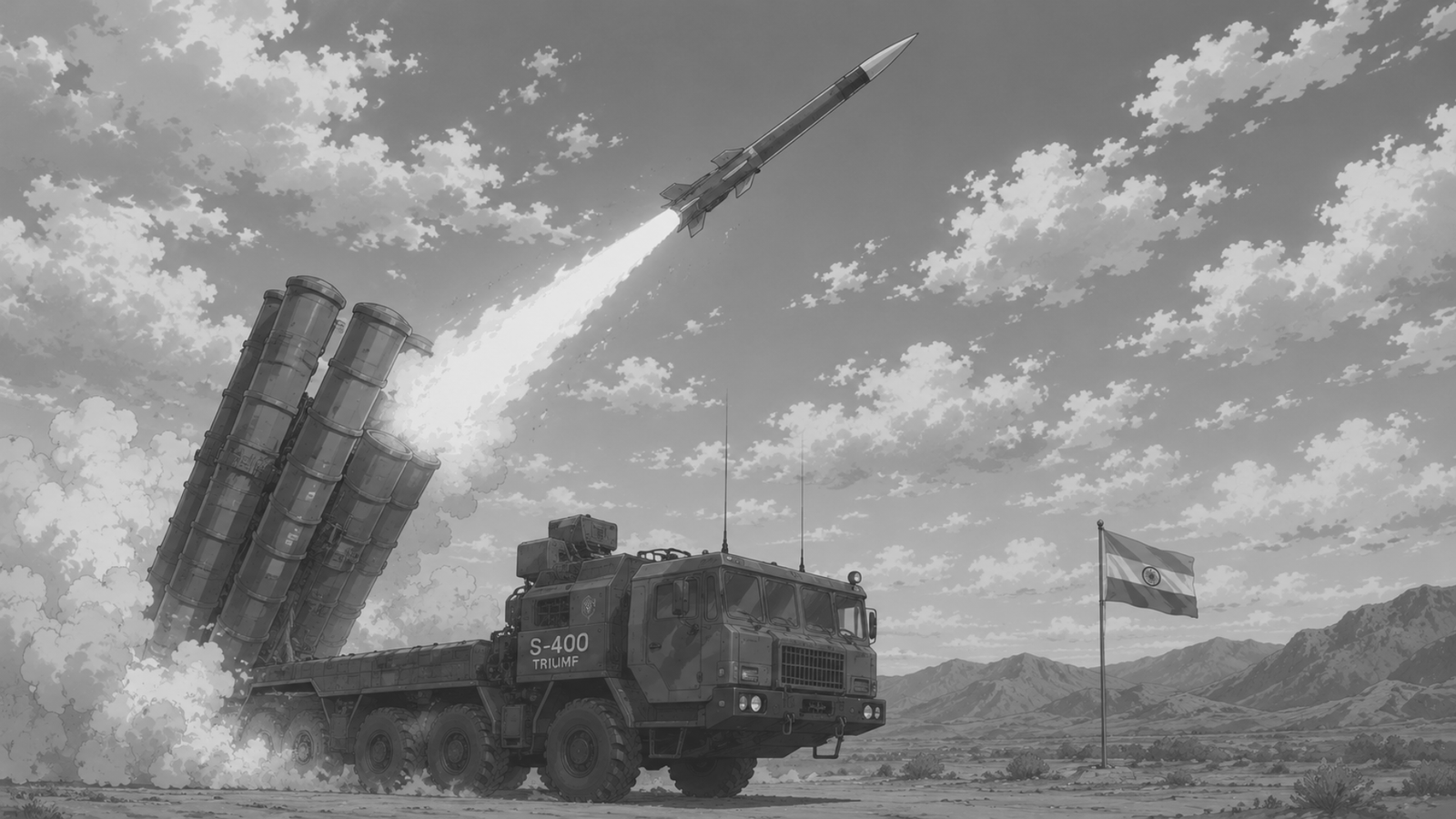
- S-400 Triumf: One of the most significant elements of India's air defence, sourced from Russia. The S-400 is a massive complex of advanced radars, command posts and mobile launchers. It fires four different types of missiles to cover various ranges up to 400 km. It can track up to 300 targets simultaneously including stealth fighters, bombers and cruise missiles. The Indian S-400 also reportedly secured the longest kill by a SAM by hitting an aerial target at 314 kilometres, striking a force multiplier of the Pakistan Air Force’s Saab Erieye-2000 flying radar.
Ballistic Missile Defence (BMD) Shield
While standard AD systems target planes and cruise missiles (which fly parallel to the ground), ballistic missiles fly into space and rain down at hypersonic speeds. India is one of the few nations with a dedicated, indigenous two-tier Ballistic Missile Defence shield.
- PAD (Prithvi Air Defence): Also known as the Pradyumna Ballistic Missile Interceptor, PAD is an anti-ballistic missile developed to intercept incoming ballistic missiles outside the atmosphere (exo-atmospheric). Based on the Prithvi missile, PAD is a two-stage missile with a maximum interception altitude of 80 km. It is guided by an internal navigation system with mid-course updates from LRTR and active radar homing in the terminal phase. PAD has the capability to engage the 3000 km class of ballistic missiles at a speed of Mach 5. The improved missile will utilise a gimbaled directional warhead, a technology also used by Israel, US and Russia, allowing for a smaller warhead to destroy the target missile.
- AAD (Advanced Air Defence): Also known as the Ashwin Ballistic Missile Interceptor. The AAD is an anti-ballistic missile designed to intercept incoming ballistic missiles in the endo-atmosphere at an altitude of 40 km. The guidance is similar to that of a PAD with an indigenous radio frequency seeker. It supports an inertial navigation system (INS) and mid-course updates from ground-based radar and active radar homing in the terminal phase.
Anti-Satellite (ASAT) System
- Modern warfare relies on GPS and satellite communications. In 2019 India launched Mission Shakti, a modified ballistic missile interceptor that flew into the Low Earth Orbit and destroyed a live satellite using pure kinetic force (Hit-to-Kill). This demonstrated India’s capability to blind an adversary’s spy satellites, serving as a massive strategic deterrent in the militarization of space.
The IACCS: The Central Command Hub of Indian Air Force Air Defence
- The Integrated Air Command and Control System (IACCS) functions as the overarching digital brain and central command hub of the Indian Air Force’s air defence network. Acting as a fully automated, network-centric “nervous system”. The IACCS seamlessly integrates data from a vast array of civilian and military sensors ranging from ground-based radars and aerostats to airborne AWACS (Airborne Warning and Control System) to generate a single, real-time, comprehensive “Air Picture”. During the intense, high-stakes engagements of Operation Sindoor, the IACCS successfully orchestrated the tracking and interception of hundreds of hostile Turkish and Chinese-origin drones, loitering munitions and missiles launched by Pakistan. By instantly fusing data across the Integrated Counter-UAS Grid and working in tandem with the Army’s automated Akashteer system, the IACCS empowered air-defence commanders to rapidly verify incoming threats and autonomously allocate them to the most appropriate weapon systems, whether that was the S-400 Triumf, Akash batteries or point-defence guns. This coordination ensured zero self-sabotages while neutralizing complex, multi-domain aerial assaults.
Addressing Strategic Vulnerabilities: Gaps and Capability Lags
India’s contemporary air-defence architecture represents one of the most sophisticated layered defensive ecosystems in the developing world. However, the strategic utility of any air-defence network is ultimately measured not during peacetime demonstrations or controlled exercises, but during sustained, high-intensity combat against a technologically adaptive adversary. Operation Sindoor exposed several structural vulnerabilities that require urgent doctrinal, technological and industrial correction if India seeks to maintain credible deterrence against a collusive China–Pakistan threat environment.
The foremost challenge is no longer merely interception capability, but interception sustainability. India possesses several high-end systems capable of neutralizing advanced aerial threats, yet the future battlespace will increasingly be defined by mass, persistence and economic exhaustion rather than isolated high-value engagements. Adversaries have recognized that modern air-defence systems can be strategically saturated through the simultaneous employment of large numbers of inexpensive drones, loitering munitions, decoys and cruise missiles launched in coordinated attack waves. In such an environment, even technologically superior air-defence systems can be overwhelmed if their magazine depth, replenishment cycle and interceptor production capacity remain limited.
This challenge becomes particularly acute under a two-front war scenario. India’s geography imposes a unique air-defence burden extending from the deserts of Rajasthan and Punjab to the mountainous Himalayan frontier and the Indian Ocean littoral. Protecting metropolitan centres, strategic command nodes, nuclear infrastructure, airbases, logistics hubs, ports, oil refineries and forward military formations simultaneously requires an enormous density of layered air-defence assets. Presently, India retains pockets of exceptional protection around select strategic zones, but lacks the nationwide saturation coverage required for prolonged, simultaneous multi-axis conflict.
The gradual retirement of ageing Soviet-origin systems such as Pechora, OSA-AK and legacy Strela variants further exacerbates this temporary vulnerability window. Although these systems are technologically outdated against fifth-generation threats, they nonetheless provided numerical depth and broad-area coverage. Their retirement without immediate large-scale replacement risks creating exploitable coverage gaps, particularly in rear-area defence and low-priority sectors that adversaries may deliberately target to stretch Indian resources.
The indigenous transition toward systems such as Akash-NG, VL-SRSAM and Project Kusha is strategically necessary, but the critical issue lies in production scale and deployment tempo rather than technological ambition alone. India’s defence-industrial ecosystem has historically struggled with rapid wartime manufacturing surge capacity. Modern conflicts, particularly lessons emerging from Russo-Ukrainian War and West Asia, demonstrate that air-defence inventories are depleted at rates far exceeding peacetime assumptions. A future high-intensity conflict may consume interceptor stocks within days unless supported by robust industrial mobilization, decentralized manufacturing and resilient supply chains.
Equally concerning is the growing challenge posed by low-observable and unconventional aerial threats. Traditional air-defence doctrines were designed around the detection and interception of fast-moving aircraft operating at medium or high altitudes. However, the modern threat spectrum has shifted dramatically toward low-signature systems operating close to terrain, often below conventional radar envelopes. Small FPV drones, loitering munitions and autonomous swarm platforms possess extremely small radar cross-sections, irregular flight paths and low thermal signatures, making them difficult to detect using legacy radar architectures.
This vulnerability is particularly dangerous because inexpensive drones are no longer merely reconnaissance assets; they have evolved into precision-strike weapons capable of destroying radars, ammunition depots, parked aircraft and critical infrastructure at disproportionately low cost. The global diffusion of commercially available drone technologies means that even non-state actors increasingly possess capabilities once restricted to advanced militaries. The threat is therefore both military and sub-conventional simultaneously.
Furthermore, India faces an emerging vulnerability in the domain of hypersonic warfare. Existing air-defence systems are optimized for either aerodynamic threats such as aircraft and cruise missiles or ballistic trajectories with predictable flight paths. Hypersonic glide vehicles fundamentally compress decision-making timelines by combining extreme velocity with manoeuvrability. This reduces interception windows from minutes to seconds and places extraordinary strain on sensor fusion, command networks and interceptor responsiveness. Current Indian capabilities remain limited in this domain, particularly regarding space-based early warning infrastructure and persistent tracking systems capable of monitoring hypersonic trajectories throughout flight.
Another major structural concern lies in sensor survivability and network resilience. Modern air-defence systems are critically dependent on uninterrupted data fusion networks, satellite communications and radar connectivity. Adversaries increasingly seek to neutralize these systems not by destroying interceptors directly, but by blinding the network itself through cyber warfare, electronic warfare, anti-radiation missiles and anti-satellite operations. In a future conflict, India’s air-defence network will likely face simultaneous cyber-electromagnetic attacks designed to paralyze command-and-control architecture before kinetic strikes even begin.
This raises important questions regarding redundancy, decentralization and autonomous battle-management capabilities within the Integrated Air Command and Control System (IACCS). While the IACCS represents a major technological leap in network-centric warfare, future conflicts will require the ability to continue operating effectively even under degraded communications environments. India must therefore move toward distributed and AI-assisted command architectures capable of localized autonomous engagement decisions when central connectivity is disrupted.
The issue of cost asymmetry also demands immediate doctrinal reassessment. Using multi-million-dollar surface-to-air missiles to intercept low-cost drones creates an economically unsustainable exchange ratio during prolonged conflicts. Adversaries can deliberately exploit this imbalance through attritional swarm warfare designed to deplete expensive interceptor inventories. The future of air defence will therefore depend not only on kinetic interception, but on scalable and affordable non-kinetic solutions.
India has begun exploring Directed Energy Weapons (DEWs), high-energy lasers, microwave systems and advanced electronic warfare jamming suites, but these technologies must transition rapidly from experimental programs into deployable operational systems. Directed-energy systems offer the strategic advantage of deep magazines and negligible per-shot costs, making them particularly suitable against drone swarms and saturation attacks. Similarly, AI-enabled electronic warfare systems capable of simultaneously identifying, spoofing and neutralizing multiple autonomous drones will become indispensable.
Finally, India’s air-defence modernization must increasingly be viewed through the lens of integrated national deterrence rather than service-specific procurement. The distinction between air defence, missile defence, cyber warfare, electronic warfare and space security is rapidly collapsing. Future wars will involve simultaneous attacks across all domains designed to create cascading systemic paralysis. Consequently, India’s long-term strategic priority should not merely be acquiring more missile batteries, but constructing a fully integrated, multi-domain defensive ecosystem linking space assets, airborne sensors, cyber resilience, electronic warfare, artificial intelligence and kinetic interceptors into a unified combat architecture.
The lessons emerging from Operation Sindoor are therefore profound. India demonstrated that it possesses the technological foundation for a credible layered air-defence shield. However, future survivability will depend less on possessing elite platforms in isolation and more on achieving scale, resilience, affordability, industrial endurance and network survivability under sustained combat conditions. The next generation of warfare will reward states capable of sustaining defensive attrition over time, not merely winning the opening exchange.
Conclusion:
The tactical realities of Operation Sindoor vividly exposed the cost-asymmetry and magazine depth lag. While the integrated grid successfully neutralized saturated drone barrages, achieving this required expending highly expensive kinetic interceptors against cheaply produced expendable UAVs. This unsustainable cost-exchange ratio highlights a critical operational vulnerability. To maintain resilience during prolonged conflicts India’s air defence architecture must rapidly transition from finite kinetic missiles to widespread, deep-magazine soft-kill deployments such as Directed Energy Weapons (DEWs) and electronic warfare jammers to ensure economic sustainability against continuous swarm attrition.
The strategic lessons are clear. Air superiority in the twenty-first century will no longer depend solely on advanced fighter aircraft or offensive strike capabilities, but increasingly on the ability to defend national airspace against continuous, layered and economically exhausting aerial assaults. India’s evolving air-defence architecture represents a major step toward that objective, but the next phase of modernization must focus on resilience, scale, affordability and technological adaptability. In an era defined by swarm warfare, hypersonic weapons and network-centric combat, the nation that can absorb, sustain and outlast aerial attrition will ultimately hold the strategic advantage.
The views expressed are those of the authors and do not represent the views of CNAWS.
Image Source: ChatGPT