Beyond the Joke: Memes, Visual Symbols, and the New Language of Information Warfare
In the 1780s, British political cartoonists published satirical caricatures of George III. They were running an asymmetrical campaign against centralized, concentrated ruling powers using the only available weapons: ridicule and humour. Even after so long, the main logic behind such ridicule has not changed at all; though the mechanism for its delivery has vastly changed.
The internet meme- a long dismissed internet transience now functions as one of the primary units of political communication in active armed conflict. From ISIS to the Russian military to Ukraine’s civic networks, memes were deployed as coordinated instruments of ideological conflict. Russia’s Foreign Ministry even released official responses to many cartoon dog avatars. ISIS internally classified propaganda and media production as a digital equivalent to combat and warfare.
Volodymyr Zelenskyy’s styling and clothing choices were also studied in peer-reviewed research as a calculated visual counter-propaganda tool. Each of these mentioned scenarios belong to important and operational core parts of informational warfare cases happening around the world which influence international relations. Examining Jacques Derrida’s theories of floating signifiers and binary oppositions to understand how memes and visual symbols function as weapons in modern information warfare will help to explain and understand why states remain structurally ill-equipped to counter them.
The Derridean Foundation
Derrida wrote about the instability in consistent definitions of words contingent upon the context and in doing so, described the operating logic of memes with high amounts of precision. His concept of the floating signifier- a sign that can attach to different concepts contingent upon the context and audience but carries no real/fixed meaning; is the structure that Attardo(2024) directly refers to in the peer-reviewed journal Brno Studies in English. Attardo coined a term ‘memetic-drift’: the shift in a meme’s meaning as it is recirculated and remixed, moving from specific information slowly becoming generic and then completely unpredictable. These memes are like a weapon in this information warfare- but whoever deploys this weapon can no longer aim. It can be captured, remixed and fired back. Attardo describes memes as ‘jetsam’- cultural debris no one can claim and is seizable by any community for any purpose. This inconsistency and instability is not a flaw but rather, a mechanism which can be weaponised.
The second Derridian structure running through this meme warfare is binary opposition: a term depends on its paired contrast for the existence of its meaning. “Irrational” requires the word “rational” and “civilised” requires “barbaric”. Munk 2025, wrote in the European Journal on Criminal Policy and Research that conflict-era parlance and memes operate almost entirely through binary logic, simply dividing people into two factions: truth V/S. propaganda, resistance V/S. opposition and many more.
What makes Derrida’s framework analytically useful is that it predicts how these binary oppositions fail. Each of these carry their own Achilles heel. Russia’s invasion framing rested on the term ‘denazification’ but this term fell apart the moment contradictions became legible given that Ukraine’s president is Jewish and the word was borrowed from an entirely different era and war- over 70 years ago. Any basic policy brief follows the construct of “Us V/S. Them”. A meme can portray this within 2 seconds. In this attention deficit economy , that gap is structurally decisive.
Case Study 1: ISIS and the engineering of meaning
ISIS’s media mission is a huge propaganda success. A more exact description is that it is a system built around manipulating floating signifiers- one that western governments did not catch up to until years later. Yarchi 2019, in the Communication and the Public, establishes the operational scale: at peak output in 2015, ISIS released an average of 18 pieces of media content per day across, video, print, audio social platforms. An internal ISIS document stated that “media weapons can actually be more potent than atomic bombs.”
This was not rhetoric and this was weaponised as intended, leaving a grave effect on the minds of people in affected regions for it was their doctrine, meant for those involved in media production, not for outside audiences. Ingram (2014) pointed out three main traits that propelled ISIS's media outreach. They targeted both supporters and opponents at the same time, customizing their messages for various audiences drawn from the same events. Their media releases were timed with military actions, creating narratives that aimed to pull in recruits and funding. All of this was tied together under one recognizable brand-flexible enough to engage diverse audiences yet consistent enough to be easily identified.
This adaptability showed up particularly in how ISIS redefined the term 'jihad.' They bypassed 14 centuries of theological debate to reshape it around specific needs like migration, military service, martyrdom, and even media production. This clever move allowed them to attract a range of individuals, from engineers and fighters to financiers and propagandists, all through one powerful term. Their magazine, Dabiq, even promoted creating ISIS content as a form of jihad. The broad nature of the term worked as an effective recruitment tool. ISIS also created a clear binary distinction for its audiences. While Western perspectives often framed the situation as 'terrorist versus civilian,'
ISIS opted for 'believer versus apostate.' This more loaded distinction justified their military actions against other Muslims as necessary. By defining their own binary, ISIS gained control over the big-picture narrative. Bail (2025) described how distribution mechanics work: audiences don’t have to agree with something to share it-they just need to find it emotionally compelling enough to react. Feelings like outrage, fascination, and horror can drive shares, turning the audience itself into a distribution network much larger than any government could create.
Case Study 2: Russia, Ukraine, and the Sign as Terrain
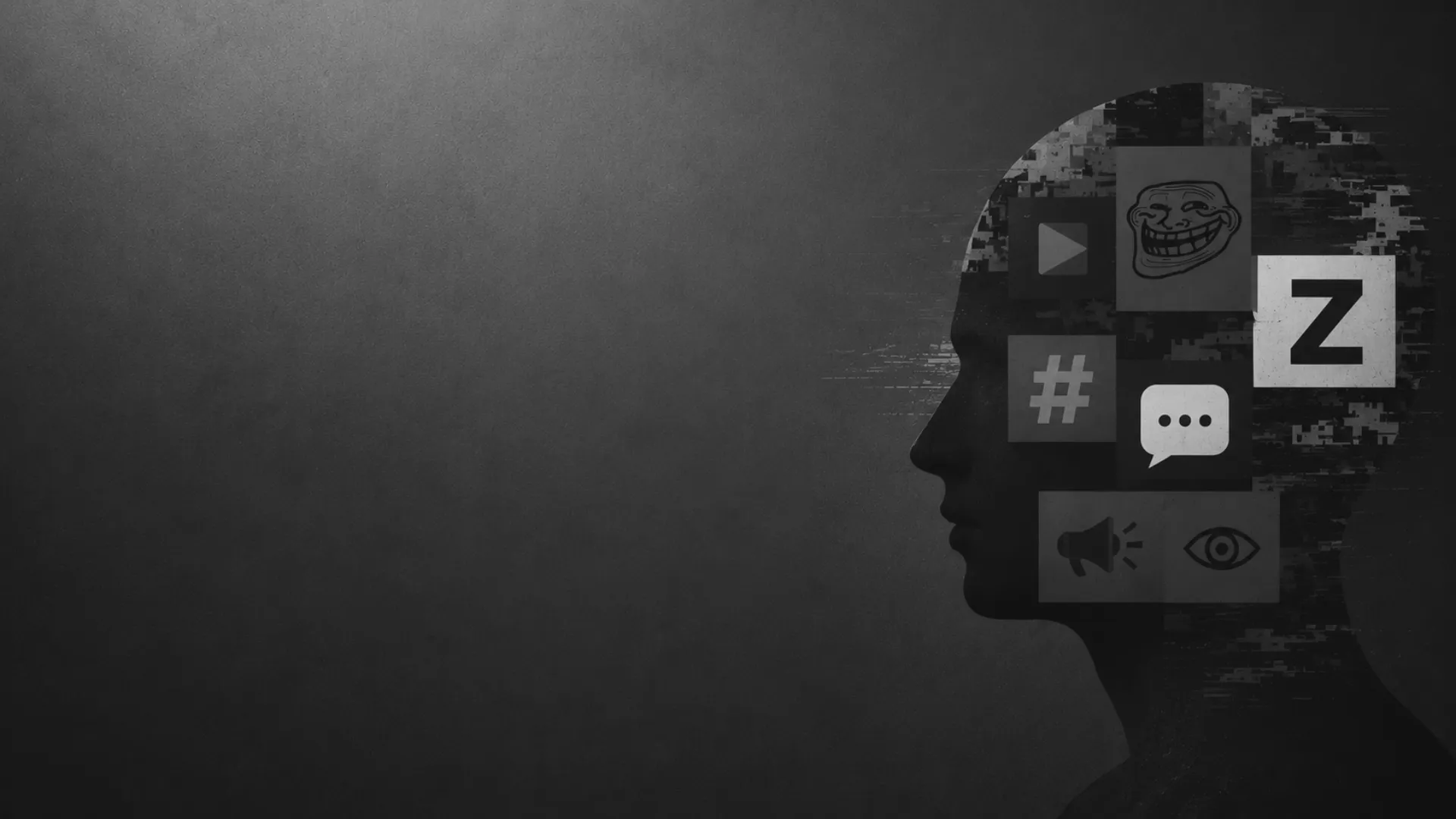
The Russia and Ukraine Conflict stands out as the first major case where both a state and a decentralized civilian movement engaged in meme warfare as a cohesive strategy. It also shows clearly how attempts to control a symbol's meaning can backfire when audiences push back and redefine it themselves. The Russian Z symbol, originally just a logistical marker to prevent friendly fire, stands out as an example of a state trying to turn a signifier into propaganda and losing control of its meaning in the process. TIME (2022) found that Russian propagandists expanded its meaning, with the Ministry of Defense giving it various interpretations like 'Za pobedu' (For Victory), 'Za mir' (For Peace), and 'Za pravdu' (For Truth).
This strategy aimed for maximum flexibility without a fixed meaning, so different audiences could interpret it accordingly and choose a national loyalty that spoke to them. But this backfired pretty quickly. Critics started calling it the 'Zwastika' due to its resemblance to Nazi symbols, prompting several European nations to ban its display. Russia tried to weaponize a symbol but lost all control over its implications-showing how meaning can drift dramatically at a national level.
On Ukraine’s side, Syvak (2025) categorized the country’s civic meme efforts into three types: promoting heroism, mocking Russian forces, and employing self-reflective irony. Each of these served different purposes like boosting morale, delegitimizing the enemy, and fostering unity within Ukraine. The Ukrainian Meme Forces account, created in February 2022, quickly gained over 300,000 followers and reached global audiences consistently.
NAFO, or the North Atlantic Fella Organisation, illustrates how decentralized ridicule can delegitimize a state actor and takes that approach even further. Munk (2025) noted that when Russia’s Foreign Ministry spokesperson criticized NAFO in July 2023, NAFO had already emerged victorious. This grassroots network operated without a budget, central leadership, or fixed membership, and it had managed to elicit a response from the Russian government, thereby legitimizing the opposition simply by being acknowledged.
While Russia had plenty of offensive capabilities, it couldn’t handle ridicule. Trying to deny it only validated the opposition; mockery undermined the very authority of those denying it, making them seem exaggerated. Tokariuk (2023) remarked that Ukrainian wartime humor showcased bravery, creating emotional connections with international audiences far more effectively than just straightforward news reports could. Corneliu Bjola, an Associate Professor of Diplomatic Studies at Oxford, highlighted that humor serves as a form of soft power, fostering global empathy toward Ukraine’s position without needing audiences to dive too deep into the geopolitical background.
A study by Frontiers in Psychology (2024) found that Zelenskyy's olive green clothing symbolizes the Ukrainian army, militias, and civilians, collapsing the visual barriers between president and soldier. Zelenskyy’s outfit blurred many binaries before they could even take shape, challenging the opponent’s entire narrative without needing a press statement.
Why States Cannot Counter This
States often struggle in information warfare because viral content spreads faster than any government approval process can respond. Their hierarchical structures, institutional legitimacy, and formal approval processes-great for traditional conflicts but can make them slow and out of touch against decentralized and amateur content. A ScienceDirect study (2024) on information disorders highlights this imbalance: autocratic regimes can leverage ‘strategic narrative coherence’ because of their centralized messaging, while democracies often end up with a diffusion of counter-narratives that fragment rather than unify.
The open media environments democracies try to protect are the very landscapes that adversaries exploit. This isn’t merely a policy mis implementation; it’s a structural issue tied to the freedoms being defended. RAND (2021) determined that the US response to foreign disinformation is still 'ad hoc and uncoordinated,' with the State Department’s Global Engagement Center lacking the needed political clout and institutional authority for a coordinated response. This is a fundamental design flaw, not a funding problem: the institution was created for a different type of conflict, and throwing more money at it won't change that. DiResta (2025), speaking at Georgetown University, stressed that the media-audience divide is disappearing: 'There’s no difference between media and audience. Followers are co-creating, remixing, and making memes.' When the audience itself becomes the distribution channel, state-produced counter-content often comes off as institutional and gets treated with the same skepticism directed at official communications. In such an environment, authenticity can't be trusted or manufactured.
The Reuters Institute (2026) found that the most effective counter-disinformation strategies still depend on grassroots credibility-direct sourcing, maintaining a presence, and gaining trust. But even this necessitates an understanding of how meanings circulate in digital spaces, and not just recognizing the content that surfaces. Attardo’s (2024) research into memetic drift reveals a deeper issue: states often see information warfare as just a content problem, focusing on spotting false narratives and countering them with the truth.
However, the real battle revolves around how meaning is framed. Once a meme embeds a particular interpretation of an event, no amount of correcting can completely wipe that interpretation clean. Afterall, humans are natural pattern-seeking machines, wired to effortlessly extract meaning, trends, and order from their environment. Once a meaning has been embedded, people will recognise the pattern no matter how much the government tries to stop it.
The Sign As Battlefield
The three cases trace a clear shift away from state control over meaning. ISIS showed that a non-state entity could build a centralized media framework capable of competing with government messaging by turning its own aesthetic standards against it: high-quality production, multilingual outreach, and professional editorial structures. At least in this case, the Russia-Ukraine conflict illustrated how even a fully centralized state can lose the meme war to an unstructured, leaderless movement with no budget whatsoever. Those who found success in these instances understood that meaning is fluid and intentionally played with that variability. ISIS kept the term 'jihad' semantically open to draw a diverse range of recruits. NAFO sidestepped Russia’s chosen binary, undermining its authority simply by treating it as absurd. Zelenskyy preempted his opponent’s narrative framework through imagery rather than conventional arguments. If meaning can be constantly manipulated and changed, as ISIS, NAFO, and Zelenskyy each showed in different ways, then the real question is not just who wins the information war but who controls semantic stability, and the strategic focus shifts toward denying the adversary the fixed meanings they need to operate effectively.
References
- Attardo, S. (2024). Memetic drift, floating signifiers, and the jetsam of politics. Brno Studies in English, 50(1), 13–31. https://journals.phil.muni.cz/bse/article/view/40067
- Bail, C.A. (2025). Participatory propaganda and the intentional (re)production of disinformation around international conflict. Communication Theory. https://doi.org/10.1080/15295036.2025.2467433
- DiResta, R. (2025). How social media can shape public opinion. Georgetown University, McCourt School of Public Policy. https://www.georgetown.edu/news/ask-a-professor-renee-diresta-how-social-media-can-shape-public-opinion/
- Frontiers in Psychology. (2024). Cyber warfare: A study of Zelenskyy's social media political performance strategies and effects. PMC/NCBI. https://pmc.ncbi.nlm.nih.gov/articles/PMC11666356/
- Ingram, H.J. (2014). Three traits of the Islamic State's information warfare. RUSI Journal, 159(6), 4–11. https://doi.org/10.1080/03071847.2014.990810
- Munk, T. (2025). Digital defiance: Memetic warfare and civic resistance. European Journal on Criminal Policy and Research. Springer. https://link.springer.com/article/10.1007/s10610-025-09613-4
- RAND Corporation. (2021). Combating foreign disinformation on social media: Study overview and conclusions. https://www.rand.org/pubs/research_reports/RR4373z1.html
- Reuters Institute for the Study of Journalism. (2026). Trolling, memes and deepfakes: How AI is thickening the fog of war. University of Oxford. https://reutersinstitute.politics.ox.ac.uk/news/trolling-memes-and-deepfakes-how-ai-thickening-fog-war
- ScienceDirect. (2024). Memes, freedom, and resilience to information disorders: Information warfare between democracies and autocracies. Social Sciences & Humanities Open. https://www.sciencedirect.com/science/article/pii/S2590291124004443
- Syvak, N. (2025). Politics by other memes: Ukrainian memetic warfare after the Russian full-scale invasion. Journal of Information Warfare, 24(3), 65–87. https://www.jinfowar.com/journal/volume-24-issue-3/politics-other-memes-ukrainian-memetic-warfare-after-russian-full-scale-invasion
- TIME. (2022). How the letter Z fits into the history of Russian propaganda. https://time.com/6156411/letter-z-russian-propaganda-history-ukraine/
- Tokariuk, O. (2023). Humour as a strategic tool against disinformation: Ukraine's response to Russia. Reuters Institute for the Study of Journalism, University of Oxford. https://reutersinstitute.politics.ox.ac.uk/memes-morale-decoding-ukraines-comedy-arsenal-against-disinformation
- Yarchi, M. (2019). ISIS's media strategy as image warfare: Strategic messaging over time and across platforms. Communication and the Public, 4(1), 53–67. https://journals.sagepub.com/doi/10.1177/2057047319829587
The views expressed are those of the authors and do not represent the views of CNAWS.
Image Source: ChatGPT