BRI, IMEC, INSTC and PGII: The Weaponisation of Connectivity in Geopolitics

Introduction: From Globalisation to Geopolitical Connectivity
During the Post-Cold War era, economic interdependence emerged as a stabilizing force in international politics. Infrastructure projects and trade corridors were perceived as tools of economic development and integration that would facilitate trade, commerce and promote cooperation among wars reducing likelihood of wars due to supply disruptions and cost of war.[i] However, the recent geopolitical developments have challenged these assumptions. The Russia-Ukraine conflict has exposed Europe's dependence on Russian energy networks, while Iran-Israel-US war (2026) and blockade of strait of Hormuz, disruptions in the Red Sea (2023)[ii] and global supply chains reiterated the strategic significance of transportation corridors. Simultaneously, the growing competition between US and China has demonstrated that economic networks can generate geopolitical leverage.
Thus, connectivity has become increasingly securitized. Infrastructures are no longer neutral. Port’s connectivity provides access to global trade, Rail-Road’s linkage and shipping lanes determine trade routes; Digital Connectivity ensures uninterrupted information flows and energy corridors shape strategic relationships. The control of connectivity networks increasingly affects the strategic choices available to states and act as a weapon to ensure national interests and security.
This article argues that connectivity has evolved from merely an economic instrument to a strategic one. Infrastructure initiatives are increasingly designed not only to facilitate trade but also to shape the geopolitical outcomes through interdependence. The article examines how major powers employ connectivity as an instrument of competition, compares contemporary connectivity initiatives, analyses the political influence created, evaluates risks for the recipient states, and assesses how India navigates competing connectivity initiatives.
Geoeconomics and the Weaponisation of Connectivity: A Theoretical Framework
The concept of geoeconomics provides an apt lens to understand contemporary connectivity politics. Edward Luttwak in his work ‘From Geopolitics to Geoeconomics: Logic of Conflict, Grammar of Commerce" had argued that economic measures can be used to achieve geopolitical objectives historically associated with military power.[iii][iv]More recently, scholars such as Joseph Nye, Henry Farrell, and Abraham Newman have explained how interdependence and global network connectivity can be used to gain strategic leverage and weaponize connectivity in post-cold war era.[v]
Traditionally geopolitics focused on controlling territory but Contemporary competition has shifted on controlling networks and projecting influence. Connectivity initiatives create pathways through which goods, energy, technology, finance, and data flows. Consequently, states that shape these networks gain influence over states dependent upon them.
To explain this process, this article proposes a Connectivity Power Cycle:
Investment → Dependency → Influence → Strategic Leverage
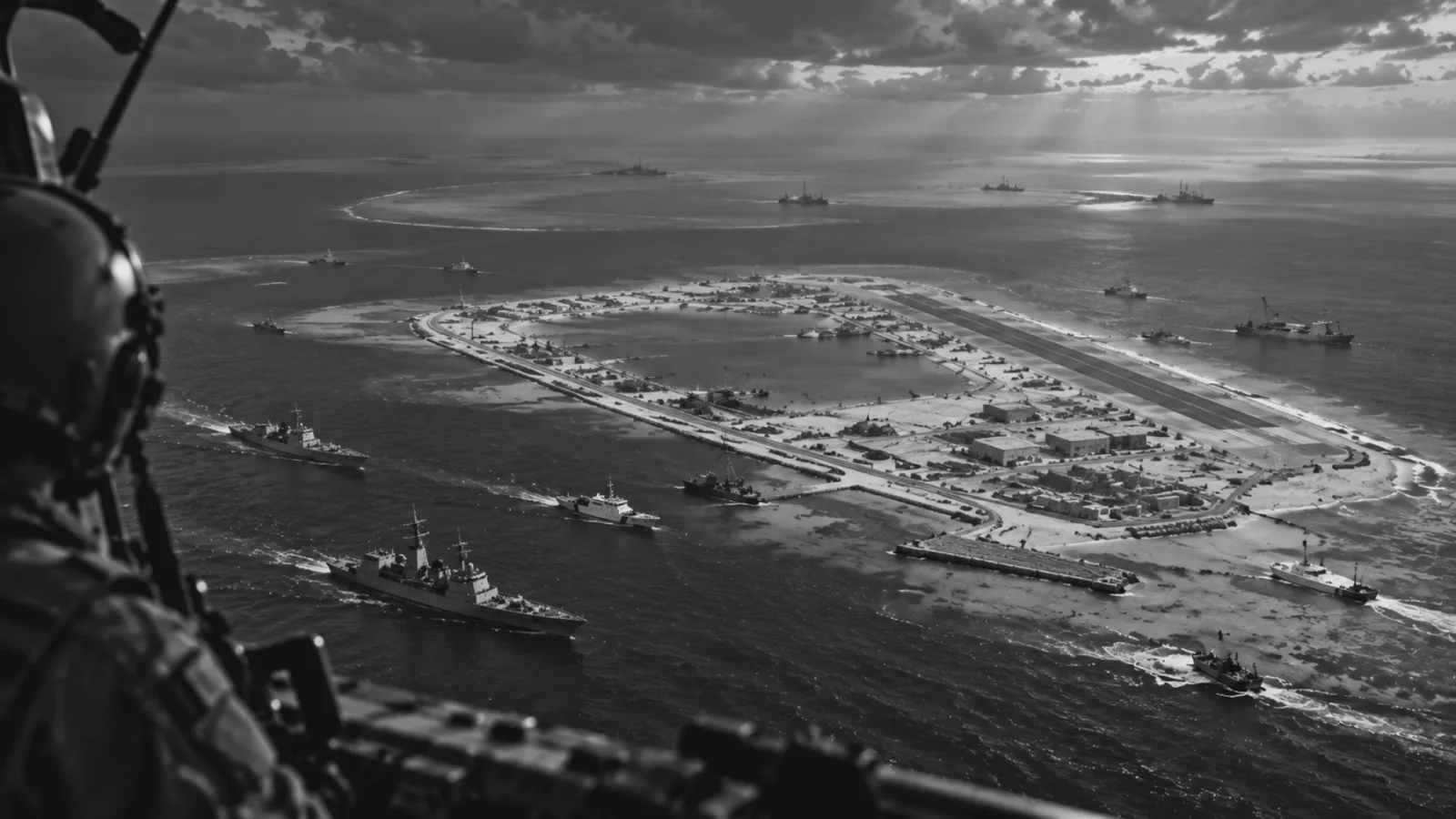
Infrastructure investments generate economic dependence through financing gradually developing influence to dependence that further translates into weaponized strategic leverage. One such striking example is Sri Lanka where China invested over $12 billion under BRI in several infrastructure projects that fostered deep economic dependence. These investments provided Beijing a significant leverage most visibly through 99-year lease of Hambantota port[vi] an important cornerstone of BRI. This serves not only as a vital logistics node and maritime presence but helps secure energy shipping lane, countering India’s String of Pearl and deep water offering dual use concerns i.e. docking of Chinese research and tracking vessels complexing security calculations for India.
The significance of this framework relies on explaining why connectivity infrastructure has become central to contemporary geopolitical competition. Rather than conquering territory, major powers are investing in connectivity initiatives and weaponizing it to gain strategic leverage.
Connectivity as a Strategic Tool: From Interdependence to Leverage
In the 21st Century, power projection has evolved from military and economic tools to capacity to create, control, and shape the cross-border flow of data, energy, goods, and infrastructure.[vii] These connectivity infrastructure projects are increasingly viewed as strategic assets which has been famously described as the ‘Weaponisation of Connectivity’.[viii] The weaponisation of connectivity reflects a broader transformation in the nature of globalization. Once Economic interdependence was seen to reduce conflict due to mutual costs of war. However, states increasingly recognize that interdependence can generate asymmetrical vulnerabilities.
Europe's dependence on Russia for natural gas and oil offers a notable example. Before the outbreak of Russia-Ukraine War in 2022, Nord Stream pipelines was a strategic asset supplying over 40-45% of gas imports to Europe.[ix] The 2022 explosions that ruptured the Nord Stream 1 and 2 pipelines in the Baltic Sea[x] dramatically severed Europe's reliance on Russian energy and they became geopolitical liabilities. What appeared to be mutual interdependence proved to be an asymmetric relationship that generated strategic vulnerability.
A similar scenario exists in critical minerals supply chains, semiconductor production, and digital infrastructure. Thus, States increasingly seek access and influence over them.
Infrastructure therefore performs three strategic functions. First, it directs economic flows. Trade corridors influence which markets connect and which stay isolated. Second, infrastructure sets standards and institutions that create long-term dependencies. Third, infrastructure provides strategic access. Ports, railways, and logistics hubs can have both commercial and geopolitical importance.
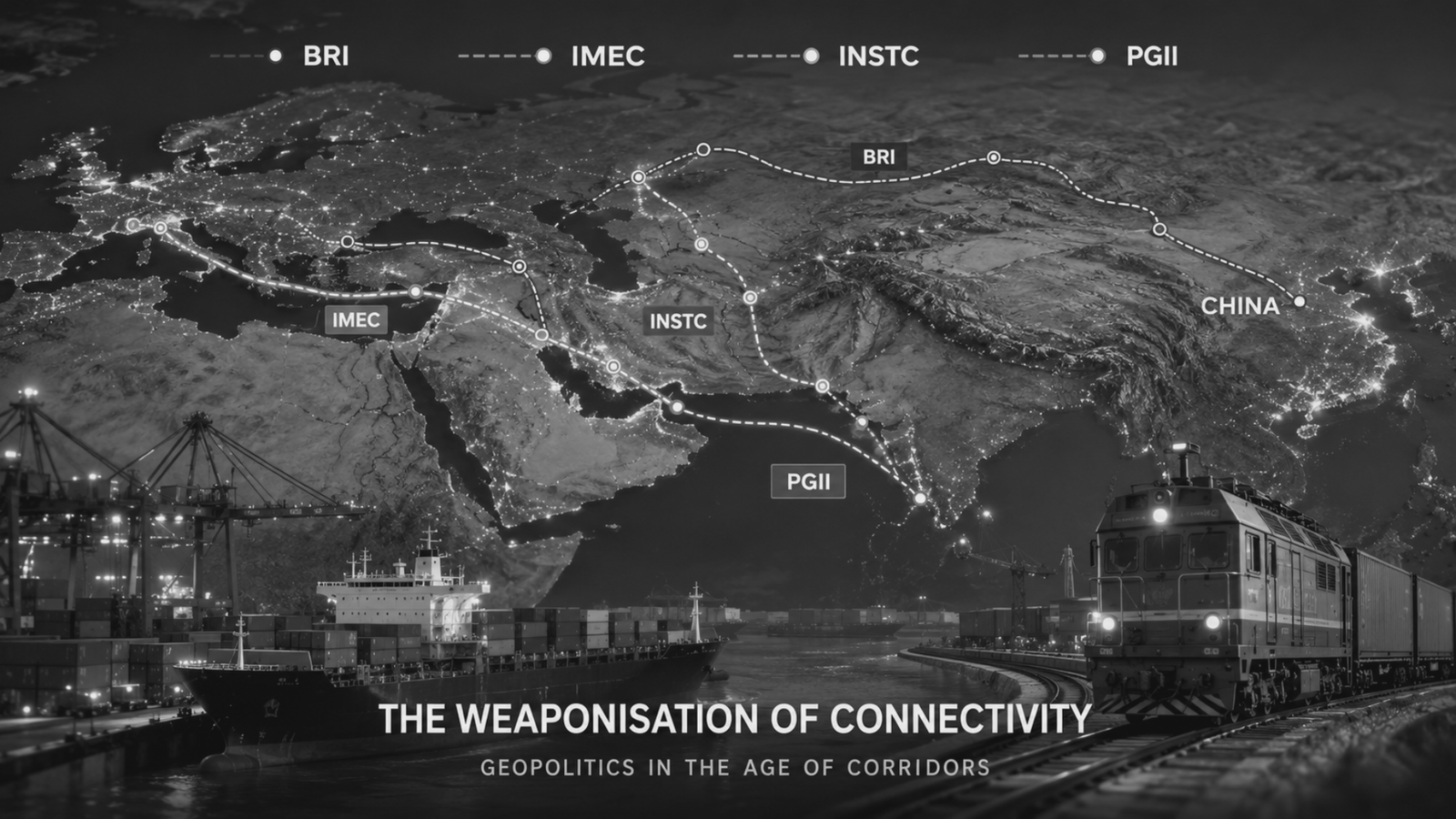
Competing Connectivity Orders: BRI, IMEC, INSTC, and PGII
Contemporary connectivity competition is most visible through four major initiatives.
China's Belt and Road Initiative (BRI)
The BRI was launched by China in 2013 involving nearly 140 countries with over an estimated $1 trillion in projects related to energy, transportation, digital networks, and trade. as an ambitious plan to develop two new trade routes connecting China with the rest of the world. BRI deals with China’s Malacca Dilemma as half of its oil imports come from MENA nations and by reviving old silk route provided an alternative[xi]. China's engagement strategy, which consists of turnkey construction, quick finance, and little political conditionality, has enabled it to establish a complex network of economic ties[xii].Also, China makes participating nations interdependent with Chinese economy through Debt-trap policy gaining political leverage.
BRI has emerged as a prime example of weaponisation of connectivity. It represents a strategic shift from pure infrastructure development to an interconnected network of economic leverage, technological surveillance, and dual-use military assets. Rather than seeking outright conquest, Beijing leverages asymmetric financial and legal dependencies to build global structural dominance. Through the Digital Silk Road and the BRI Space Information Corridor, Beijing is extending access to its Beidou Satellite network, building digital networks, and offering tech like surveillance, comms, and "Smart Cities". This enhances Beijing's intelligence and surveillance abilities, and gathers "big data" beneficial for military planning too[xiii]. The debate surrounding Sri Lanka's Hambantota Port illustrates this dynamic.
Similarly, Gwadar Port in Pakistan provides China with strategic access in Indian Ocean and provide an alternate route in case of Malacca disruptions. China is effectively creating strategic flexibility through infrastructure investments.
IMEC: Connectivity as Coalition Building
IMEC is a visionary initiative reshaping global trade, connectivity, and cooperation across three continents conceived during G-20 Summit in New Delhi[xiv]. This ambitious multimodal initiative was conceived to diversify global supply chains and enhance resilience against critical maritime chokepoints such as the Red Sea and Gulf of Aden. Initially perceived as a strategic counter to China’s BRI, at its core it links India’s vital western ports (Mundra, Kandla, JNPA, and Vadhavan) to the Arabian Gulf, with onward overland connections (via UAE, Saudi Arabia, Jordan, Israel) before crossing by sea to Europe’s gateways in Marseille and Trieste and potentially Genoa.[xv]
Its deeper strategic purpose lies in coalition building among India, the United States, European partners, and Gulf states. The corridor offers short and safe alternative connectivity architecture to Suez Canal. Thus, IMEC represents geoeconomic balancing rather than traditional military alliance.
Its success hinges less on engineering challenges than on geopolitical stability across the Middle East and normalization of relation among Israel and Gulf states. The future of IMEC is inseparable from regional diplomatic developments.
INSTC: Connectivity Under Geopolitical Constraints
The 72000 km INSTC is a multimodal transport corridor connecting India with Eurasia, bypassing the Suez Canal and Pakistan and involving Russia, Iran, and India. The INSTC seeks to reduce dependence on traditional routes and provide access to Central Asian markets.[xvi]
The corridor's importance has decreased because of sanctions and geopolitical tensions that have disrupted trade. However, INSTC remains a cornerstone connectivity corridor for India amid existing politically constrained routes. This connectivity requires constant manoeuvring around severe geopolitical and infrastructural bottlenecks.[xvii]
The strategic value of INSTC lies in diversification. For India, it reduces vulnerability by creating additional access points to Eurasian markets and resources with reduced distance and short delivery span.
PGII: Normative Competition:
In 2022, the U.S. and the other members of the G7 launched the Partnership for Global Infrastructure and Investment (PGII), a collaborative initiative that aims to raise $600 billion for global infrastructure projects in emergent nations. The PGII reflects the G7's attempt to provide an alternative model of infrastructure development. Unlike the BRI, PGII promises transparency, sustainability, and governance standards.[xviii]
Its strategic aim is not simply to fund infrastructure but to compete with China's model of connectivity. However, PGII currently lacks the coherent and centralized vision compared to BRI. These initiatives are more than just competing transportation projects; they represent rival views of global order.
Infrastructure and the Production of Long-Term Political Influence
The states that rely on vital nodes of connectivity, such as ports, railroads, energy pipelines, or digital networks, are influenced by the stakeholder that finances, constructs, or manages these infrastructures because it shapes future choices.[xix]
There are several ways to see this dynamic in action: When countries borrow funds for infrastructure often becomes politically aligned and economically reliant on the lender. The Creditor might use civilian ports or infrastructure as military logistics hubs. Also, they control over data and tech through owning satellite systems and telecom infrastructure. The influence on regulations as top connectivity providers mould supply chain guidelines and trade standards.[xx]
This process can be understood as political lock-in. The Greek port of Piraeus, Nepal’s Pokhara International Airport and Sri Lanka’s Hambantota illustrates this dynamic.[xxi][xxii] Connectivity investments often used for political leverage, lowering trade barriers and ensuring security interests.
Digital infrastructure makes this even bigger. Telecom systems, cloud computing, data centres, and AI platforms create long-lasting dependencies. With economy stuff moving online more, controlling tech ecosystems could matter just as much as controlling transport routes.[xxiii] The next phase of connectivity competition is therefore likely to focus on digital networks as much as physical ones.
Risks for Recipient States: Beyond the Debt Trap Debate
There lie several risks associated for recipient states in infrastructure connectivity projects especially where contribution is unequal. The principal risk is usually debt trap which intensifies when investing state strictly supplies raw material and labour for the project and the host country bears the cost entangling it into Debt cycle. [xxiv] Cost overruns and unrealistic projections of commercial feasibility further complicate the situation.
Apart from financial risk the recipient states face risk of strategic dependence. Long-term dependence on financed infrastructure often limits strategic autonomy. For example, Hambantota Port highlight how such dependency can increase the political leverage of investing state over time.
Another risk that persists is network lock-in, where states get stuck into particular telecommunication networks, payment systems, or logistical systems that are costly to switch. China's digital infrastructure and 5G networks shows how technological ecosystems can create long-term dependencies going beyond physical infrastructure with risks persists of covert espionage.[xxv]
Recipient states also face geopolitical entrapment as competing powers increasingly view connectivity projects as a strategic move and participation in any other connectivity is seen with suspicion from rival powers.[xxvi] For example, Countries in Southeast Asia, often balance between Chinese investments and Western-led alternatives to avoid excessive alignment with either side.
Security concerns also arise because many infrastructure projects possess dual-use characteristics. Ports, telecommunications systems, and logistics hubs can serve both commercial and strategic purposes.[xxvii] There’s also significant risk during wars where these connectivity corridors are targeted first inflicting damage to hosting country.
India's Strategic Dilemma: From Balancing Powers to Balancing Corridors
India occupies a central position is global maritime trade routes. Its key central location provides it opportunity to simultaneously engage in different connectivity initiatives. India lacks funds to solely invest in any projects like China’s BRI single handedly so it relies on strategy of multi-alignment simultaneously maintaining relationships with the United States, Europe, Russia, Iran, and Gulf states and investing in projects as per its capacity.
In an increasingly fragmented geopolitical environment, rather than choosing between competing corridors the best move is to balance corridors and become a network hub by upgrading ports, domestic logistics, digital infrastructure and connectivity in the Indian Ocean which is evident through SAGAR and MAHASAGAR[xxviii] policies and become the node through which multiple corridors intersect.[xxix]
Aligning with any single connectivity initiative reduces strategic flexibility. Therefore, India should continue corridor pluralism. India's strategic objective should be to occupy the centre of emerging connectivity networks rather than the periphery of any single initiative.
Conclusion
One of the defining geopolitical developments of the 21st century is the weaponisation of connectivity. Infrastructure projects are increasingly becoming instruments of influence rather than simply tools for economic development. States can shape political outcomes without direct military coercion, through investment, dependence and control of networks.
The comparative analysis of BRI, IMEC, INSTC and PGII indicates that current connectivity projects are expressions of contrasting visions of regional and global order. Infrastructure has become a tool for the major powers to exert influence, strategic access and geopolitical leverage.
The key difficulty for the recipient states is not the debt management but the strategic autonomy in a world of competing connectivity ecosystems. Still, diversification is the best protection against excessive dependence.
The best approach for India is not to be aligned exclusively or be a passive player. Rather, India should focus on corridor pluralism, while simultaneously investing in its emergence as a major connectivity hub.
In the end, future geopolitical competition will likely be less about control of territory and more about control of the networks through which trade, technology, finance, energy and information flow. Connectivity has become both a source of power and a tool of statecraft in the new age of geoeconomics.
Endnotes:
[i] Hover, Romaeus, Gertrud Buchenrieder, and Joel Sokolsky. 2025. “Economic Interdependence and the Likelihood of War – a Systematic Literature Review.” Cogent Social Sciences 11 (1) https://doi.org/10.1080/23311886.2025.2488114
[ii] Bragagni Esq Obe, Maurizio & Xhaferraj, Lorenc. (2024). Red Sea Route Disruption and Supply Chain. 10.13140/RG.2.2.22142.97603. https://www.researchgate.net/publication/377656680_Red_Sea_Route_Disruption_and_Supply_Chain
[iii] Luttwak, Edward N. “From Geopolitics to Geo-Economics: Logic of Conflict, Grammar of Commerce.” The National Interest, no. 20 (1990): 17–23. http://www.jstor.org/stable/42894676
[iv] Col. Dheeraj Kumar.2024. Relevance of Geoeconomics: Emergence of India as a Geoeconomic Power, Challenges, Opportunities and the Way Ahead. USI, New Delhi https://usiofindia.org/pdf/Relevance_of_Geoeconomics.pdf
[v] Henry Farrell, Abraham L. Newman; Weaponized Interdependence: How Global Economic Networks Shape State Coercion. International Security 2019; 44 (1): 42–79. doi: https://doi.org/10.1162/isec_a_00351
[vi] Anjelina Patrick.2017. CHINA – SRI LANKA STRATEGIC HAMBANTOTA PORT DEAL.NMF, New Delhi https://maritimeindia.org/8813-2/
[vii] Johan Burger, “BRI and IMEC: Cooperation Opportunities and Regional Impact”, TRENDS Research & Advisory, 22 May 2024, accessed 4 June 2026, https://trendsresearch.org/insight/bri-and-imec-cooperation-opportunitiesand-regional-impact/
[viii] Vansh Bhojwani. 2026. “The Geopolitical Weaponisation of Connectivity: India’s Stakes in the India Middle East-Europe Economic Corridor–Belt and Road Initiative Competition in Middle East and North Africa’. USI https://usiofindia.org/pdf/VANSH_BHOJWANI_SP1_USI_CS3.pdf
[ix] https://www.consilium.europa.eu/en/infographics/where-does-the-eu-s-gas-come-from/
[x] Al-Jazeera. 2023.Nord Stream sabotage one year on: What to know about the attack accessed on 4 June 2026 https://www.aljazeera.com/news/2023/9/23/what-we-know-about-the-nord-stream-sabotage-one-year-on
[xi] Jon Wallace, Dr. Yu Jie. 2021. What is China’s Belt and Road Initiative (BRI)? Chatham House, London https://www.chathamhouse.org/topics/chinas-belt-and-road-initiative-bri
[xii] Vansh Bhojwani. “The Geopolitical Weaponisation of Connectivity: India’s Stakes in the India Middle East-Europe Economic Corridor–Belt and Road Initiative Competition in Middle East and North Africa’. 2026. USI https://usiofindia.org/pdf/VANSH_BHOJWANI_SP1_USI_CS3.pdf
[xiii] Daniel R. Russel and Blake H. Berger. “Weaponizing the Belt and Road Initiative”. 2020. Asia Society Policy Institute, US https://asiasociety.org/policy-institute/weaponizing-belt-and-road-initiative
[xiv] https://www.imec.international/
[xv] Abhishek Agarwal. “An Indian Perspective: Bridging Continents Through IMEC”. 2026.CSEP
https://csep.org/blog/an-indian-perspective-bridging-continents-through-imec/
[xvi] Ayjaz Wani. 2025.INSTC Eastern Corridor: India’s Gateway to Central Asia” Expert Speak, ORF https://www.orfonline.org/expert-speak/instc-eastern-corridor-india-s-gateway-to-central-asia
[xvii] Emil Avdaliani.2025. “The International North-South Transport Corridor”. Commentary and Analysis. GRC, Jeddah https://www.grc.net/single-commentary/302
[xviii] Bernardo Mariani.2023. “The Partnership for Global Infrastructure and Investment (PGII) and the Belt and Road Initiative (BRI): Meeting the World’s Infrastructure Gaps amid Geopolitical Competition”. Global Transition Series, PeaceRep, Edinburgh https://peacerep.org/?sdm_process_download=1&download_id=19804
[xix] Daniel R Russel and Blake H Berger, “Weaponizing the Belt and Road Initiative”, Asia Society Policy Institute, 08 Sep 2020, accessed 4 June 2026, https://asiasociety.org/policy-institute/weaponizing-belt-and-road-initiative
[xx] Vansh Bhojwani. “The Geopolitical Weaponisation of Connectivity: India’s Stakes in the India Middle East-Europe Economic Corridor–Belt and Road Initiative Competition in Middle East and North Africa’. 2026. USI https://usiofindia.org/pdf/VANSH_BHOJWANI_SP1_USI_CS3.pdf
[xxi] Jonathan E. Hillman.2018. “Game of Loans: How China Bought Hambantota”. CSIS Briefs https://www.csis.org/analysis/game-loans-how-china-bought-hambantota
[xxii] EFSAS Commentary(n.d.) 2023 https://www.efsas.org/commentaries/pokhara-international-airport-has-all-the-exploitative-bri-aspects/
[xxiii] ‘Digital sovereignty – new empires, big tech and geopolitics. 2025, FAU news accessed on 5 June 2026 https://www.diplomacy.edu/blog/digital-sovereignty-stack-infrastructure-services-data-and-ai-knowledge/
[xxiv] Singh, S. (2019). The awakening of the giant: Is China using the Belt and Road Initiative as a neo-colonial tool in the Indo-Pacific region? Confluence: Journal for Interdisciplinary Studies, Volume III, 40-71
[xxv] Ayyapan Rajesh. ‘A Strategic Framework for Mitigating Electronic Hardware-Related National Security Risks in India’. 2026. Occasional papers, ORF https://www.orfonline.org/research/a-strategic-framework-for-mitigating-electronic-hardware-related-national-security-risks-in-india
[xxvi] Abdul Moiz Khan, The Geopolitics of Global Infrastructure Projects: Challenges and Opportunities for Health and Wellbeing, Oxford Open Infrastructure and Health, Volume 2, 2024, ouae006, https://doi.org/10.1093/ooih/ouae006
[xxvii] Ryan C. Berg. ‘Combating Chinese Dual-Use Infrastructure: Bringing in the Private Sector’ 2022. Commentary. CSIS https://www.csis.org/analysis/combating-chinese-dual-use-infrastructure-bringing-private-sector
[xxviii] Tanya Singh Yadav. ‘From SAGAR to MAHASAGAR: India’s Strategic Evolution in the Indian Ocean Region’. 2025. Commentaries, IPSC https://www.indo-pacificstudiescenter.org/commentaries/india-mahasagar-initiative
[xxix] Jianbo Wu. ‘Navigating Connectivity: India’s Strategic Autonomy in a Changing World’. 2026. The Diplomatist https://diplomatist.com/navigating-connectivity-indias-strategic-autonomy-in-a-changing-world/
The views expressed are those of the authors and do not represent the views of CNAWS.
Image Source: ChatGPT