

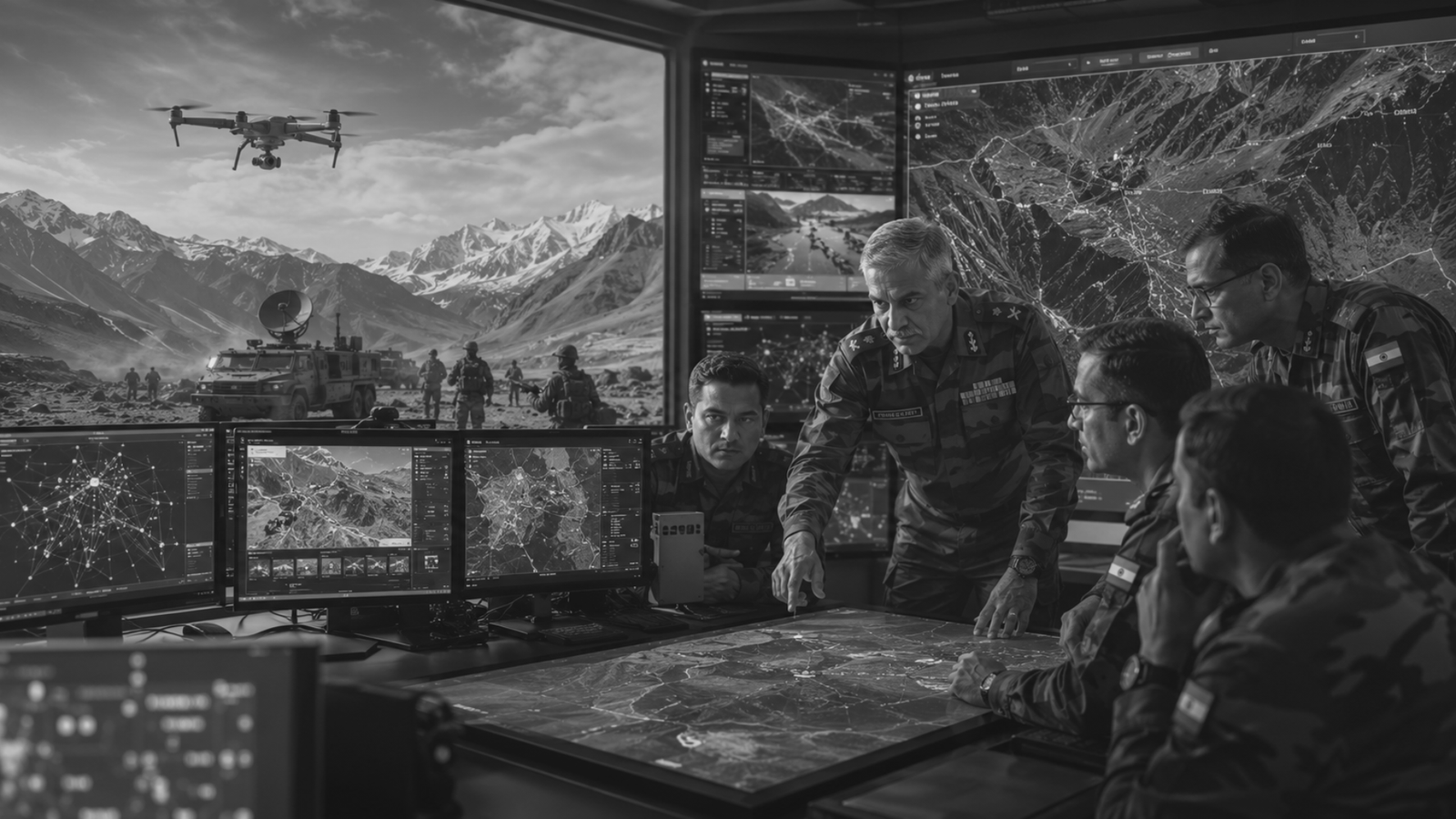
Innovation as Survival: Why Future Wars Will Be Won by Those Who Adapt Faster

The New Logic of Warfare
Military history often creates an impression of continuity even when conditions are changing. States traditionally measured power through force size, industrial production, geography and the capacity to sustain operations over time. Military institutions evolved at a pace broadly aligned with technological change, and doctrine generally had time to absorb innovation before conflict tested its effectiveness. The industrial age reinforced the belief that military superiority could be accumulated before war began and converted into strategic advantage once war started.¹
The contemporary environment appears less predictable. Technology is not simply changing military capability. It is changing the pace at which adaptation itself becomes necessary. Information now moves faster than decision cycles, commercial innovation reaches operational use before procurement systems react, and tactical lessons increasingly emerge during conflict rather than after it. Military organisations therefore face a challenge that earlier generations encountered less frequently. The issue is no longer limited to possessing advanced systems. Increasingly, it is whether institutions can recognise change quickly enough to remain effective.
Recent conflicts illustrate this shift. Commercial drones, satellite-enabled battlefield awareness, electronic warfare and digitally enabled coordination have become familiar features of contemporary operations. Yet concentrating only on these technologies risks missing the larger lesson. Warfare has always been influenced by technology. What appears distinctive today is the compressed cycle through which military organisations are required to absorb change and respond to it.² Lawrence Freedman observed that major changes in warfare rarely arrive as clean breaks with the past. More often, existing assumptions gradually become insufficient until they no longer explain unfolding realities.³
Historically, militaries learned from war after campaigns ended. Increasingly, they are being required to learn while campaigns continue.
Why Innovation Matters More Than Technology Alone
Innovation is frequently treated as though it were synonymous with technology. Military history suggests otherwise. Organisational culture, doctrinal flexibility and the ability to absorb ideas have often determined whether military advantages endure.
For much of the industrial era, military innovation followed structured pathways. Governments identified requirements, industries developed solutions and armed forces introduced capabilities through formal acquisition processes. That model remains necessary because military power still depends on reliability and scale. At the same time, recent experience suggests that adaptation is becoming more distributed and less predictable.
Operational users, engineers, software communities and commercial ecosystems increasingly influence military outcomes. Some of the most meaningful battlefield changes emerge not through revolutionary inventions but through continuous modification and rapid experimentation. Christian Brose argues that military competition increasingly rewards the speed with which organisations integrate capabilities rather than the possession of isolated technologies.⁴
History repeatedly demonstrates that advanced capability alone does not guarantee military advantage. Cohen and Gooch showed that military failure frequently emerges not from insufficient resources but from institutional inability to learn and adapt.⁵ New capabilities may enter service while old assumptions remain untouched.
The challenge confronting modern militaries is therefore not technological acceleration alone but institutional absorption. Digital systems evolve rapidly. Organisational change moves more slowly. Military effectiveness in the coming decades is likely to depend less on isolated technologies and more on the ability to connect information, command systems, logistics and operational learning into adaptive ecosystems.⁶
What Recent Conflicts Are Teaching Militaries
Recent conflicts have demonstrated that military advantage remains more complex than inventory comparisons suggest. Numerical superiority and industrial depth continue to matter, but they increasingly operate alongside variables that traditional planning often treated as secondary.
Future crises may not begin with visible mobilisation. Strategic pressure may emerge through cyber disruption, information operations, economic coercion and attempts to influence decision-making before conventional force is employed. Hoffman anticipated many of these developments through his work on hybrid conflict and the blending of conventional and non-conventional methods of competition.⁷
Information has become strategically consequential because influence now operates at unprecedented speed and scale. Public perception affects decision-making, alliance behaviour and operational freedom more rapidly than in earlier eras. Singer and Brooking describe this development as the weaponisation of information ecosystems rather than communication itself.⁸
Artificial intelligence may intensify these trends further. Faster processing and machine-enabled analysis create opportunities, yet military history repeatedly cautions against assuming that technical efficiency automatically produces strategic wisdom. Horowitz argues that emerging technologies reshape military competition unevenly because institutions absorb them differently rather than because the technologies themselves determine outcomes.⁹
Technology can improve decisions, but it cannot replace judgment.
India’s Strategic Imperative
For India, these changes carry immediate significance. India’s security environment combines continental pressures, maritime responsibilities, technological competition and persistent security challenges. Future crises are unlikely to replicate historical patterns, and preparedness cannot depend solely on extending familiar models of military modernisation.
Capability acquisition remains necessary, but capability alone does not create resilience.
Indian strategic thinking has long recognised that national preparedness emerges from aligning military power with broader state capacity. Karnad and Behera both point towards the importance of institutional adaptation rather than material acquisition alone.¹⁰
India possesses substantial strengths in its engineering base, digital ecosystem, and expanding technological capabilities. Yet these strengths often operate in parallel rather than as integrated contributors to national security. This creates an opportunity to connect military institutions, industry, academia and operational users in ways that accelerate adaptation.
This argument aligns with recent Indian military writing. The author’s work on multi-domain transformation argues that future combat effectiveness will increasingly depend on integration, agility and institutional learning rather than on platform-centric thinking.¹¹ His later work on future warfare similarly emphasises that strategic preparedness must account for technological acceleration without reducing war to technology alone.¹²
Preparing for future conflict, therefore, requires more than modern systems alone. It requires institutions capable of remaining effective even as conditions change faster than plans can.
Conclusion
Military history rarely rewards certainty for long. Strategic advantage has always depended partly on capability and resources, but it has also depended on recognising when inherited assumptions no longer explain emerging realities.
India enters this period with considerable strengths. Whether those strengths become durable strategic advantage will depend less on possessing every emerging technology and more on building institutions capable of continuous adaptation.
Innovation should therefore be understood not as an accessory to military power but increasingly as one of the conditions that sustain it.
The strongest states of the coming decades may not necessarily be those that begin with the most advanced systems. They are more likely to be those that continue learning after events have already begun and imbibe innovation, resilience and adaptation as core strengths.
Footnotes
- Williamson Murray and Allan R. Millett, eds., Military Innovation in the Interwar Period (Cambridge: Cambridge University Press, 1996).
- Jack Watling and Nick Reynolds, Meatgrinder: Russian Tactics in the Second Year of Its Invasion of Ukraine (London: Royal United Services Institute, 2023), https://www.rusi.org.
- Lawrence Freedman, The Future of War: A History (New York: PublicAffairs, 2017).
- Christian Brose, The Kill Chain: Defending America in the Future of High Tech Warfare (New York: Hachette Books, 2020).
- Eliot A. Cohen and John Gooch, Military Misfortunes: The Anatomy of Failure in War (New York: Free Press, 1990).
- Thomas G. Mahnken, “Innovation in the Pentagon,” Journal of Strategic Studies 34, no. 6 (2011): 869–908.
- Frank G. Hoffman, “Hybrid Warfare and Challenges,” Joint Force Quarterly 52 (2009): 34–39.
- P. W. Singer and Emerson T. Brooking, LikeWar: The Weaponisation of Social Media (Boston: Houghton Mifflin Harcourt, 2018).
- Michael C. Horowitz, “Artificial Intelligence and International Security,” Survival 60, no. 5 (2018): 7–32.
- Bharat Karnad, India’s Nuclear Policy (Westport, CT: Praeger Security International, 2008); Laxman Kumar Behera, “India’s Defence Modernisation and Preparedness,” Strategic Analysis 39, no. 3 (2015): 243–260.
- Lt Gen A. B. Shivane (Retd), “Transforming Armour for the Multi-domain Digital Battlespace,” CLAWS Issue Brief, October 17, 2025, https://claws.co.in/transforming-armour-for-the-multi-domain-digital-battlespace/
- Lt Gen A. B. Shivane (Retd), “The Future of Warfare: Will Tomorrow’s Enemy be Human?” Centre for Joint Warfare Studies Issue Brief, January 2026, https://cenjows.in/publications/the-future-of-warfare-will-tomorrows-enemy-be-human/
The views expressed are those of the authors and do not represent the views of CNAWS.
Image Source: ChatGPT


