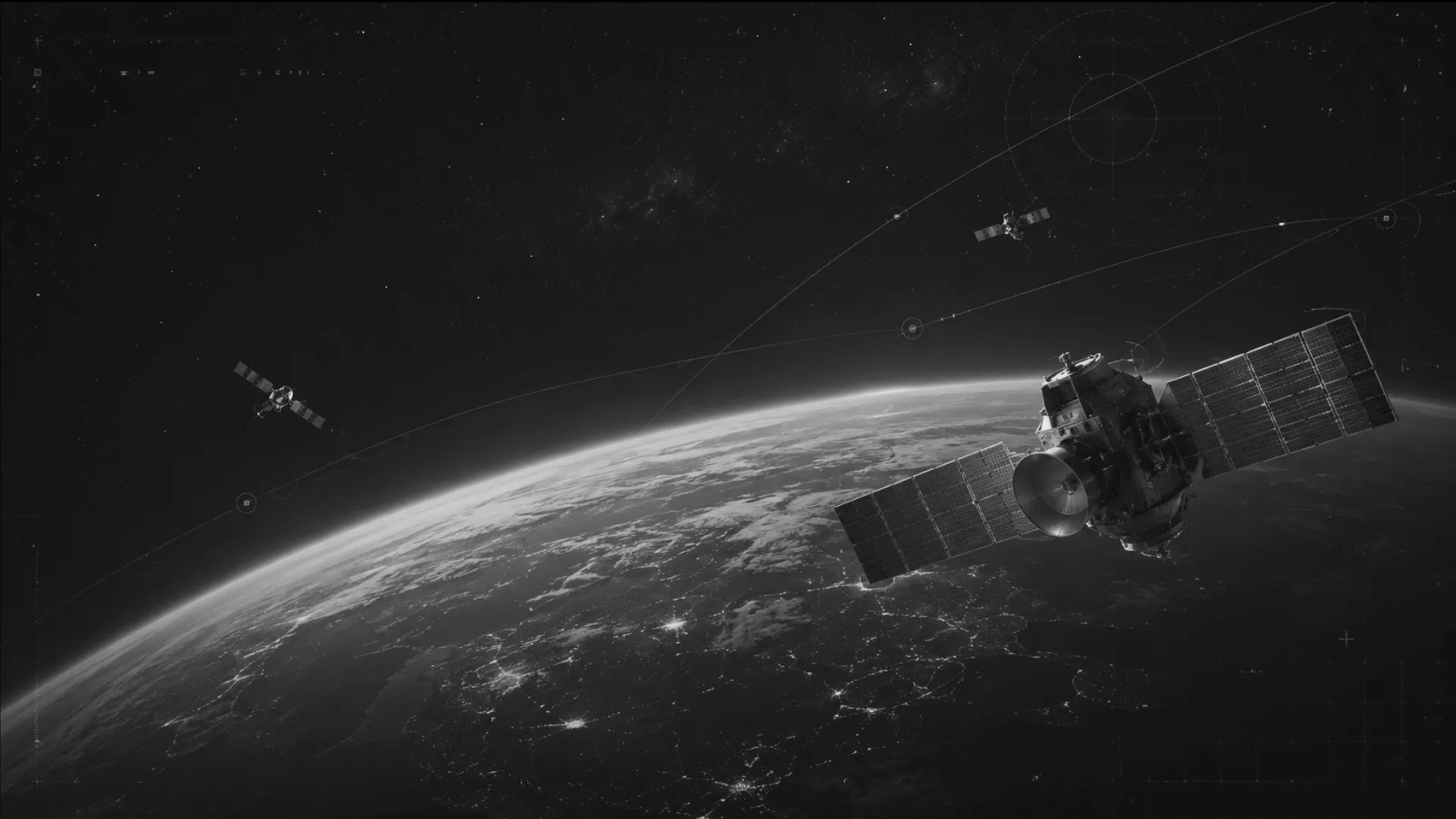
Orbital Frontlines: Great-Power Rivalry and the Militarization of Space

1. Introduction
Outer space has occupied a peculiar place in international affairs since the beginning of the space age: nominally set aside for peaceful purposes, yet entangled with military competition from its very first satellite launch. The Outer Space Treaty of 1967 was itself a Cold War artifact, drafted amid fears generated by intercontinental ballistic missile programmes and by the Soviet Union's 1957 launch of Sputnik , an event that made plain how closely space access and military reach were bound together. The treaty banned weapons of mass destruction from orbit and reserved celestial bodies for peaceful use, but said nothing about conventional weapons, dual-use satellites, or the broader family of counter-space capabilities that now define the field. Almost sixty years on, that unaddressed space has become the arena for an increasingly open arms competition.
By 2026, the language used by senior officials of the major space powers had converged on a single point: orbit was being spoken of the way land, sea, and air have long been spoken of, as a domain to be contested and, if necessary, fought over. India's Chief of Defence Staff, General Anil Chauhan, put the stakes bluntly, warning that failure to secure the country's interests in space would leave its forces “fighting blind.” The U.S. Space Force's own doctrine has moved in the same direction, now formally describing “orbital warfare” , the application of fires, movement, and maneuver to secure space superiority , as a core warfighting mission rather than a support function. What follows traces how space shifted from a legally shielded commons to a contested strategic theatre, catalogues the doctrinal and technological shape that shift is taking among the major powers, and situates India within that transformed landscape.
2. The Laws and its Limits
2.1 The Outer Space Treaty
The Outer Space Treaty remains the bedrock instrument of international space law, counting 118 states parties by late 2025, including every major spacefaring nation. Its substantive commitments are limited but significant: a ban on placing nuclear weapons or other weapons of mass destruction in orbit, a requirement that the Moon and other celestial bodies be used only for peaceful purposes, a guarantee of free exploration and use of space by all states, and a prohibition on national appropriation of celestial territory. These provisions succeeded in heading off the most catastrophic variant of space weaponization, but they were never drafted with the dual-use, software-defined, and often deniable forms of military space competition that characterise the present moment.
2.2 Prevention of an Arms Race in Outer Space (PAROS) Treaty
The United Nations has tried, without success, to close that gap. Since the 1980s, the General Assembly has pursued a Prevention of an Arms Race in Outer Space (PAROS) treaty through the Conference on Disarmament, aimed at barring weapons from orbit altogether and prohibiting the threat or use of force against space objects. The effort has gone nowhere: an ad hoc committee formed in 1985 was disbanded in 1994 once Washington withheld a negotiating mandate, and the United States has since held the position that it has identified no workable multilateral arms-control measure for space. A 2008 joint Chinese-Russian draft treaty proposing a ban on orbital weapons, complete with verification provisions, met the same fate, and subsequent UN resolutions on transparency and confidence-building have repeatedly passed over American objection or abstention. What remains is a familiar pattern: annual diplomatic rituals of restraint sitting atop an operational competition that shows no sign of slowing because of them.
2.3 The Artemis Accords
A different kind of instrument has partly filled the space PAROS could not. The Artemis Accords, signed by eight founding states in October 2020 and now counting 68 signatories as of June 2026, set out non-binding principles meant to translate Outer Space Treaty obligations into practice on transparency, debris mitigation, and “safety zones” for lunar and cislunar activity. Neither China nor Russia has joined. Critics note that as a political commitment rather than a treaty, the Accords carry no enforcement, dispute-resolution, or liability mechanism , leaving them open to the charge that they function as a U.S.-centred parallel structure rather than a genuinely multilateral one negotiated through the UN Committee on the Peaceful Uses of Outer Space. India's own signature on the Accords reflects its broader tilt toward Western-aligned space governance, even as New Delhi continues to build an independent military space programme alongside it.
3. How the Major Powers Are Arming Orbit
3.1 China: Scale and Doctrine Together
China's 2007 test of a direct-ascent ASAT weapon against its own defunct Fengyun-1C weather satellite remains the defining demonstration of kinetic counter-space capability , it generated over 3,500 pieces of trackable debris and an estimated 150,000 untrackable fragments that still threaten traffic in a crowded orbital band nearly two decades on. Beijing has since moved well past that single test. Its operational satellite fleet passed 1,060 spacecraft by mid-2025, with hundreds devoted to intelligence, surveillance, and reconnaissance work that U.S. assessments describe as the backbone of a PLA “kill mesh” built to fuse targeting data against American forces. China has also fielded co-orbital tools, most notably the grappling arm carried by the Shi Jian-21 satellite , widely read as a dual-purpose capability that could relocate or disable an adversary's spacecraft , alongside ground-based lasers and jamming systems. Long-range U.S. Space Force projections, set out in its “Future Operating Environment 2040” report, forecast a Chinese fleet of roughly 21,000 satellites by 2040, up from about 1,602 today, backed by an integrated space warfare force combining directed energy, AI-assisted targeting, and even brain-computer interface technology meant to compress decision cycles from minutes to milliseconds. This is doctrinally explicit: the PLA's “Three Warfares” concept , psychological, public-opinion, and legal warfare , extends into orbit through what Chinese military writing describes as a drive toward “full-spectrum dominance” by 2049, the centenary of Communist Party rule.
3.2 Russia: Asymmetry Over Parity
Russia has taken a different path. U.S. Space Force planners judge that Moscow is more likely to pursue “asymmetric counterspace capabilities” than to compete for broad parity with Washington or Beijing. It has demonstrated co-orbital ASAT capability through satellites able to manoeuvre near adversary spacecraft, deployed GPS jammers extensively during its war in Ukraine, and been accused by U.S. authorities of moving toward a nuclear-armed space-based weapon , a step that, if realised, would be the first operational breach of the Outer Space Treaty's central prohibition. That concern is sharpened by the fact that Russia's declared nuclear doctrine sets the lowest threshold for nuclear use of any major power, raising the possibility that Moscow could be willing to employ a nuclear ASAT capability other powers would treat as unthinkable.
3.3 The United States: Doctrine Backed by Budget
Washington's response has taken the form of a formal doctrinal overhaul. The Space Force's April 2025 publication, “Space Warfighting: A Framework for Planners,” marked the shift from a support role to an explicit treatment of space as a contested warfighting domain, organising counter-space operations across orbital, link, and terrestrial segments in pursuit of “space superiority.” That doctrine has come with money behind it: the Space Force's fiscal year 2026 budget approached $40 billion once reconciliation funding for the Golden Dome missile defence shield is folded in. The investment portfolio includes electronic satellite jammers, a Geosynchronous Space Situational Awareness Program acting as an orbital neighbourhood watch, experimental manoeuvring satellites built to explore both offensive and defensive uses, and a National Space Test and Training Complex for realistic threat simulation and wargaming.
4. India's Approach
4.1 A Doctrinal Shift
For most of its history, India's space programme was defined almost entirely by civilian application, in keeping with the country's broader non-aligned and peace-oriented foreign policy. That has changed markedly over the past decade, driven by friction with China and Pakistan and by the recognition that adversaries dependent on satellites now treat space assets as legitimate military targets. One recent Indian defence-industry assessment described the change as a move “from simply ‘using space’ to ‘operating in space,’” a transition India's Chief of Defence Staff has labelled a “Space-First” defence posture.
4.2 Building the Institutions
The institutional build-out has been incremental. A “Space Cell” was set up within the Integrated Defence Staff around 2008 to coordinate satellite-derived intelligence, surveillance, and reconnaissance requirements. That evolved into the tri-service Defence Space Agency (DSA), headquartered in Bengaluru and fully operational since 2019, which runs India's space warfare and satellite intelligence assets with personnel drawn from the Army, Navy, and Air Force. A companion Defence Space Research Agency, approved the same year, focuses on developing space-warfare technology. India demonstrated its own ASAT capability in March 2019 through Mission Shakti, making it the fourth nation with proven anti-satellite capacity , a capability that traces its technical lineage to the ballistic missile defence programme launched in 1999 in response to Pakistani and Chinese missile threats.
4.3 Watching and Protecting the Fleet
India's largest current investment is the Space-Based Surveillance Phase-III (SBS-III) programme, approved to field a constellation of 52 military communication and surveillance satellites between 2025 and 2029 at a cost of roughly ₹27,000 crore (about $2.8 billion) , with nearly half the satellites to be built by private industry, a marked departure from the state-dominated model that has traditionally governed India's space sector. Alongside this surveillance buildup sits a Satellite-Protection Project, launched after a mid-2024 incident in which a satellite belonging to a neighbouring country closed to within roughly one kilometre of an Indian military-mapping satellite. The project envisions a layered defensive architecture, including manoeuvrable “bodyguard satellites” designed to counter cyberattack, jamming, and physical interference, positioned to protect high-value military satellites and potentially able to identify and counter threats from hostile spacecraft at close range. India's space situational awareness effort , built around the Network for Space Objects Tracking and Analysis (Project NETRA) and supplemented by ISRO's System for Safe and Sustainable Space Operations & Management , now tracks more than 34,000 orbital objects, though as of 2025 India still lacked continuous twenty-four-hour in-orbit tracking, a gap that further deployments, including a Digantara-operated monitoring constellation linked to NETRA, are intended to close.
4.4 What Operation Sindoor Exposed
The Indian armed forces' dependence on satellite-based intelligence, surveillance, and reconnaissance during the 2025 India-Pakistan conflict, Operation Sindoor, hardened a view already forming within India's strategic community: that space-based ISR is now indispensable to national security rather than a peacetime convenience. Structural constraints remain substantial, however. A Parliamentary Standing Committee review found 2,383 vacant posts within the Department of Space that need filling to sustain the programme's expansion, and noted that expenditure utilisation stood at only 78.23 percent of revised budgetary allocation as of January 2026 , evidence of persistent implementation delays.
Analysts have also pointed to the strategic exposure created by India's continued reliance on dual-use satellites i.e. assets that deliver peacetime cost efficiency but become potential single points of failure in conflict, since damage to a satellite serving both civilian governance and military functions carries outsized strategic consequences. India's answer has increasingly leaned on distributed, proliferated Low Earth Orbit constellations, deliberately echoing the resilience logic pursued by the U.S. Space Force, on the premise that losing any single node should not produce a strategic blackout. Policy analysts have urged the Ministry of Defence to draft a comprehensive National Military Space Doctrine setting out clear principles for deterrence, space security, and crisis management , an articulation that, like India's broader information and cognitive-domain posture, remains a work in progress rather than settled policy.
5. Conclusion
Space has completed its passage from a legally protected commons to an actively contested warfighting domain , a shift now openly acknowledged in the doctrinal literature of the United States, China, and India alike. The existing legal order, resting on the 1967 Outer Space Treaty and loosely supplemented by the non-binding, geopolitically partial Artemis Accords, has managed to prevent the most extreme form of space weaponization , orbital nuclear deployment , but has proven structurally unable to restrain the broader spread of ASAT, co-orbital, electronic, and cyber counter-space capability that now defines great-power competition in orbit.
For India, its own defence leadership increasingly frames the choice in binary terms: dominate the domain, or risk “fighting blind” in a future conflict where satellite-dependent command, navigation, and surveillance functions come under contest from the opening hours. The institutional response so far , the Defence Space Agency, Mission Shakti, the Space-Based Surveillance and Satellite-Protection programmes, and the anticipated move toward a tri-service Space Command , reflects a genuine, if still incomplete, effort to build indigenous deterrent capability. The policy challenge for the coming decade is to pursue that capability without tipping into an unconstrained arms race that no spacefaring power, India included, has a genuine interest in accelerating.
References
- Albon, C. (2025, November 24). Report: Space force needs more funding, training to counter China. Air & Space Forces Magazine. https://www.airandspaceforces.com/report-space-force-funding-training-counter-china/
- Artemis accords. (2023, July 21). NASA. https://www.nasa.gov/artemis-accords/
- Bhatt, A. K. (2026, May 12). Strengthening India’s defence capabilities through space. Indian Aerospace and Defence Bulletin - News for aerospace and defence in India. https://www.iadb.in/2026/05/12/strengthening-indias-defence-capabilities-through-space/
- Choudhary, S. (n.d.). India’s space defence architecture: ASATs, satellites, and strategic surveillance. CeSCube. https://www.cescube.com/vp-india-s-space-defence-architecture-asats-satellites-and-strategic-surveillance
- India's space Odyssey. (2026, June 21). Press Information Bureau. https://www.pib.gov.in/PressReleasePage.aspx?PRID=2276117®=3&lang=1
- India’s strategic shift: Building sovereign space power for defence. (2026, May 12). Indian Defence News. https://www.indiandefensenews.in/2026/05/indias-strategic-shift-building.html
- Lele, D. A. (2025, July 15). SBS-3: Testing private industry’s defence role. raksha-anirveda.com. https://raksha-anirveda.com/indias-sbs-3-programme-a-test-case-for-private-industrys-active-engagement/
- Novelly, T. (2026, April 15). Space force’s 2040 vision: A larger force to contend with larger Chinese, Russian threats. Defense One. https://www.defenseone.com/policy/2026/04/space-forces-2040-vision-larger-force-contend-larger-chinese-russian-threats/412885/
- PAROS Treaty. (n.d.). NTI. https://www.nti.org/education-center/treaties-and-regimes/proposed-prevention-arms-race-space-paros-treaty/
- Suthar, R. (2026, July 5). Space militarisation: Strategic challenges policy responses. IMPRI Impact and Policy Research Institute. https://www.impriindia.com/insights/policy-update/space-militarisation-and-challenges/
- Trevithick, J., & Altman, H. (2026, February 26). China's growing Armada of spy satellites is pushing space force to go on the offensive. TWZ. https://www.twz.com/space/chinas-growing-armada-of-spy-satellites-is-pushing-space-force-to-go-on-the-offensive
The views expressed are those of the authors and do not represent the views of CNAWS.
Image Source: ChatGPT