

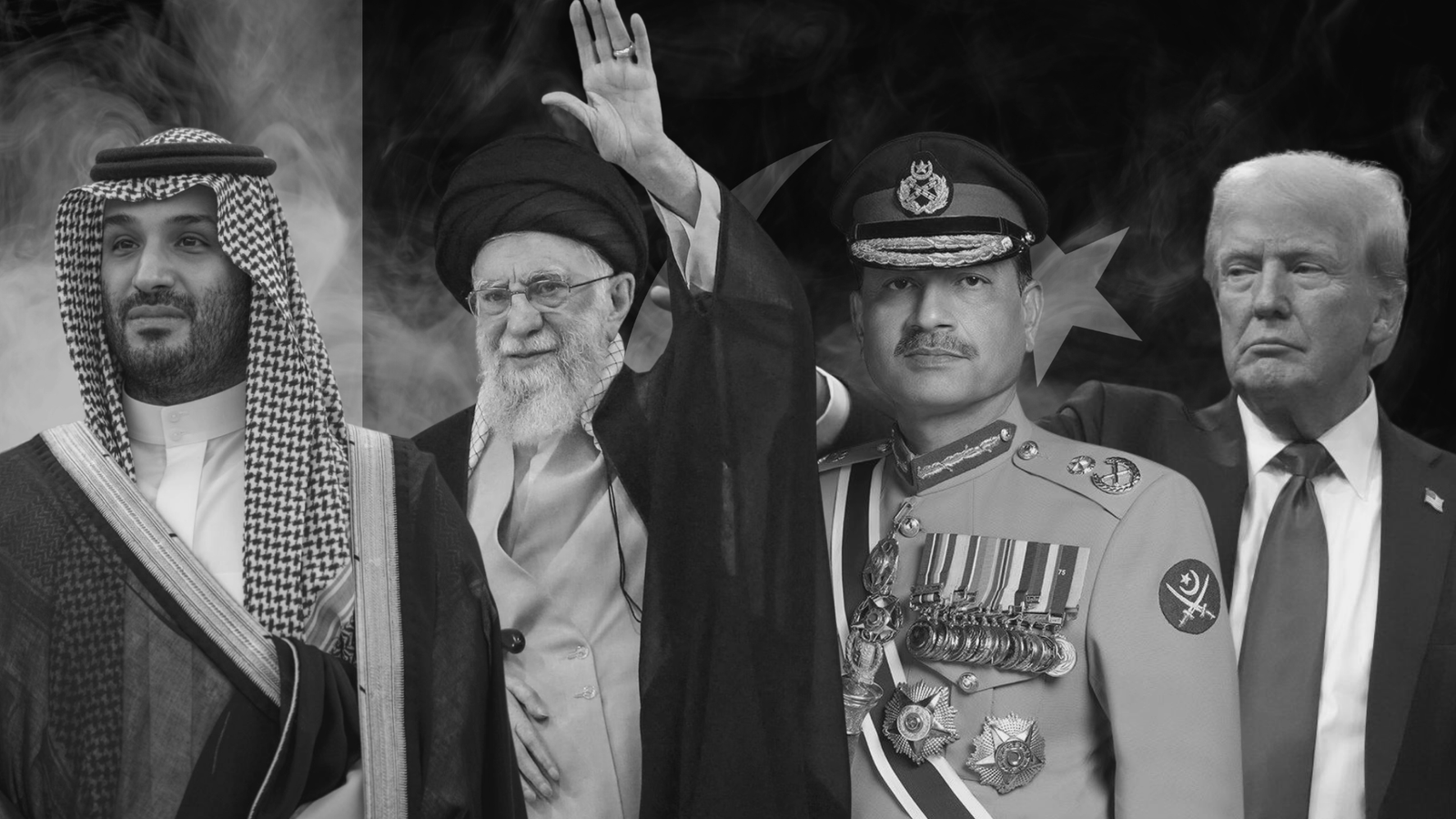
Regional Risk Assessment: The Limits of Pakistan’s Balancing Strategy Between Riyadh, Tehran, and Washington

In periods of relative stability, strategic ambiguity can function as a source of leverage. It allows states to engage competing power centres, hedge risks, and extract benefits without committing fully to any single alignment. However, as regional fault lines harden and conflicts intensify, the same ambiguity begins to lose its utility. What once enabled manoeuvrability can quickly turn into a source of pressure, as external actors demand clarity and domestic constraints narrow the space for calibrated responses.
For states positioned at the intersection of multiple geopolitical axes, this transition is particularly consequential. The shift from a permissive to a restrictive strategic environment does not always force immediate realignment, but it steadily raises the cost of maintaining flexibility. The real challenge, therefore, is not choosing sides in a binary sense, but sustaining strategic coherence when competing expectations, internal vulnerabilities, and regional instability begin to converge simultaneously.
1. Strategic Shock and the Collapse of Pakistan’s Diplomatic Comfort Zone
The U.S.-Israeli strike on Iran on 27 February 2026 not only altered the regional military equation. It also exposed the structural limits of Pakistan’s long-standing attempt to preserve working relations simultaneously with Saudi Arabia, Iran, and the United States. For Islamabad, the crisis is not merely external. It has become a test of whether Pakistan can still sustain a multi-vector regional policy amid acute geopolitical polarisation.
For years, Pakistan sought to avoid making definitive strategic choices in the Gulf. It maintained close security and financial ties with Saudi Arabia, kept an open channel with Tehran to prevent instability along the shared border, and continued to view its relationship with Washington as useful, even if it was increasingly narrow and more transactional. The current conflict, however, has sharply reduced the space for ambiguity. Once confrontation escalates into direct interstate war, balancing becomes far more difficult to maintain. What had previously been framed as diplomatic flexibility now risks appearing as indecision, inconsistency, or even strategic weakness.
This is the core problem now facing Islamabad: not whether it prefers neutrality in principle, but whether neutrality remains sustainable in practice when each of its key interlocutors expects clearer alignment.
2. The Domestic Constraint: Why Pakistan Cannot Treat Iran as a Distant Crisis
Pakistan’s room for manoeuvre is constrained not only by foreign policy considerations but also by domestic realities. Iran is not a distant theatre for Pakistan. It is a neighbouring state with religious, political, and borderland relevance, and developments inside Iran can quickly reverberate in Pakistan’s internal arena.
This is especially important in light of Pakistan’s sectarian composition and its long history of managing Sunni-Shia tensions. Any major regional escalation involving Iran risks generating domestic mobilization, protest activity, and renewed sectarian friction. Even where the Pakistani state succeeds in preventing large-scale unrest, the political cost of appearing overly aligned with a U.S.-Saudi position against Iran could be significant. This is particularly true at a time when anti-American sentiment can easily be reactivated and when the legitimacy of the civilian leadership remains fragile.
For that reason, Pakistan cannot calibrate its Iran policy solely through the lens of interstate diplomacy. It must also consider the domestic consequences of being seen as complicit, passive, or strategically indifferent toward developments affecting a major neighbouring Muslim state. This internal dimension does not force Pakistan into alignment with Tehran, but it does narrow the political space in which openly pro-Riyadh or pro-Washington moves can be made.
3. The Saudi Connection: Strategic Dependence Without Full Strategic Freedom
At the same time, Pakistan cannot afford a rupture with Saudi Arabia. Riyadh remains too important economically, politically, and symbolically. Saudi financial support, labour-market absorption for Pakistani workers, and broader security ties give the kingdom enduring leverage over Pakistani strategic calculations. This creates a familiar but increasingly difficult pattern: dependence without full policy convergence.
Pakistan has long tried to benefit from its partnership with Saudi Arabia without becoming fully entrapped in Gulf rivalries. That approach was visible in previous regional crises and remains visible now. Islamabad appears reluctant to translate formal defence understandings into direct military involvement, particularly where such involvement could trigger domestic backlash or worsen relations with Tehran. Yet restraint also carries risks. The more exposed Saudi Arabia feels in a period of regional war, the stronger the expectation that close partners will demonstrate tangible political or security support.
This is where the limits of Pakistan’s balancing strategy become evident. It seeks the benefits of proximity to Riyadh without bearing the full costs of alignment. But in a high-intensity regional confrontation, that middle position becomes harder to defend. Saudi Arabia may tolerate ambiguity in peacetime; it is less likely to do so under sustained threat.
4. Washington and the Shrinking Utility of Transactional Ambiguity
Pakistan’s relationship with the United States adds another layer of pressure. For Islamabad, ties with Washington still matter, but they no longer provide the strategic insulation they once did. The bilateral relationship has narrowed, and U.S. expectations have become more selective and more instrumental. In parallel, Washington’s deepening partnership with India has reinforced the perception in Pakistan that it is no longer a central pillar in American regional strategy.
This matters because Pakistan can no longer assume that limited diplomatic cooperation with the United States will suffice to preserve its strategic relevance while it hedges elsewhere. In previous periods, ambiguity itself could generate utility: Pakistan could remain useful to Washington precisely because it occupied a complex geopolitical position. Today, that formula is weaker. U.S. decision-makers increasingly value reliability, issue-based alignment, and operational clarity. In that context, Pakistan’s balancing posture may be read not as sophistication, but as an absence of strategic commitment.
The result is a narrowing of diplomatic manoeuvrability. Islamabad still wants to avoid confrontation with Washington, but it is also aware that overt cooperation with a U.S.-led regional posture against Iran could produce domestic and regional blowback. Thus, Pakistan is not choosing among equally attractive options. It is managing a hierarchy of risks, each of which carries a different strategic cost.
5. Border Security and the Risk of Strategic Overstretch
The crisis also sharpens Pakistan’s western security dilemma. Its border with Iran cannot be treated separately from its border with Afghanistan. Any serious deterioration in Iranian state control, especially in the Sistan-Balochistan region, could create new operational challenges for Pakistan at a time when militant threats linked to the Afghan frontier remain unresolved.
This does not necessarily mean immediate regional spillover on a dramatic scale. But it does mean that Pakistan faces the prospect of cumulative strategic overstretch. A state already preoccupied with the Tehreek-e-Taliban Pakistan, cross-border militancy, and internal insurgent dynamics cannot easily absorb additional instability along the Iranian front. The concern is less a sudden collapse than the gradual multiplication of pressure points: smuggling networks, militant movement, local unrest, border insecurity, and resource diversion.
From Islamabad’s perspective, this is precisely why the Iran crisis cannot be viewed only through the prism of Gulf geopolitics. A prolonged confrontation would increase the cost of balancing by linking foreign policy restraint to concrete security burdens on the ground. The more unstable Iran’s periphery becomes, the less viable Pakistan’s passive neutrality will be.
6. Economic Fragility and the Political Cost of Strategic Hesitation
Pakistan’s balancing problem is also economic. The country’s fragile economy leaves little margin for absorbing regional disruption. Borderland trade, energy insecurity, inflationary pressure, and wider disruptions linked to Gulf instability all increase the cost of indecision. Even when Pakistan avoids direct entanglement, it still pays an indirect price for regional escalation.
This is especially important because economic fragility affects strategic credibility. A state under severe fiscal and social strain has less capacity to sustain prolonged diplomatic ambiguity. Economic weakness makes every foreign policy choice more politically combustible: support Riyadh too openly, and Tehran-related tensions rise; distance Pakistan from Washington, and external confidence weakens further; move closer to Iran, and Gulf partners may reassess their commitments. In that sense, the economic arena does not sit in the background of Pakistan’s balancing strategy. It is one of the main reasons that strategy is becoming harder to maintain.
7. The Real Issue: Pakistan’s Balancing Strategy Is Not Collapsing, but It Is Reaching Its Limits
The central issue, then, is not whether Pakistan has abandoned balancing. It has not. Nor is it accurate to argue that Islamabad has already decisively chosen one side. The more important analytical point is that the conditions that once made balancing effective are eroding. Pakistan still seeks to preserve ties with Riyadh, prevent rupture with Tehran, and avoid alienating Washington. But the regional environment is becoming less permissive of that approach.
In a lower-intensity environment, Pakistan could convert ambiguity into leverage. In the current one, ambiguity increasingly generates exposure. Riyadh may interpret caution as insufficient support; Tehran may read distance as concealed alignment; Washington may see hedging as unreliability. Under these conditions, balancing does not disappear, but it becomes less efficient.
That is why the present moment should be understood as a stress test of Pakistani statecraft. The challenge is no longer simply to maintain relations with competing actors. It is to do so in an environment where each relationship increasingly affects the others, and where domestic fragility reduces the state’s ability to absorb the consequences of miscalculation.
Conclusion
The U.S.-Iran conflict has exposed the narrowing strategic space within which Pakistan operates. Islamabad still seeks to manoeuvre between Riyadh, Tehran, and Washington, but the regional and domestic conditions that once enabled such maneuvering are becoming less favourable. Pakistan’s dilemma is therefore not one of abstract neutrality, but of diminishing strategic elasticity.
For Pakistani decision-makers, the immediate objective is unlikely to be alignment in the full sense. Rather, it is the preservation of a workable equilibrium. Yet that equilibrium is becoming more difficult to sustain as geopolitical confrontation deepens, domestic sensitivities intensify, and border insecurity persists. The real risk is not that Pakistan will suddenly abandon its balancing strategy, but that it will continue trying to preserve it under conditions in which the costs rise faster than the benefits.
In that sense, the current crisis is not only a regional security shock. It is a revealing test of the outer limits of Pakistan’s multi-vector foreign policy.
The views expressed are those of the authors and do not represent the views of CNAWS.
ImageSource: ChatGPT


