

Shockwaves Across the Middle East: A Quest for New Alliances

1. Introduction
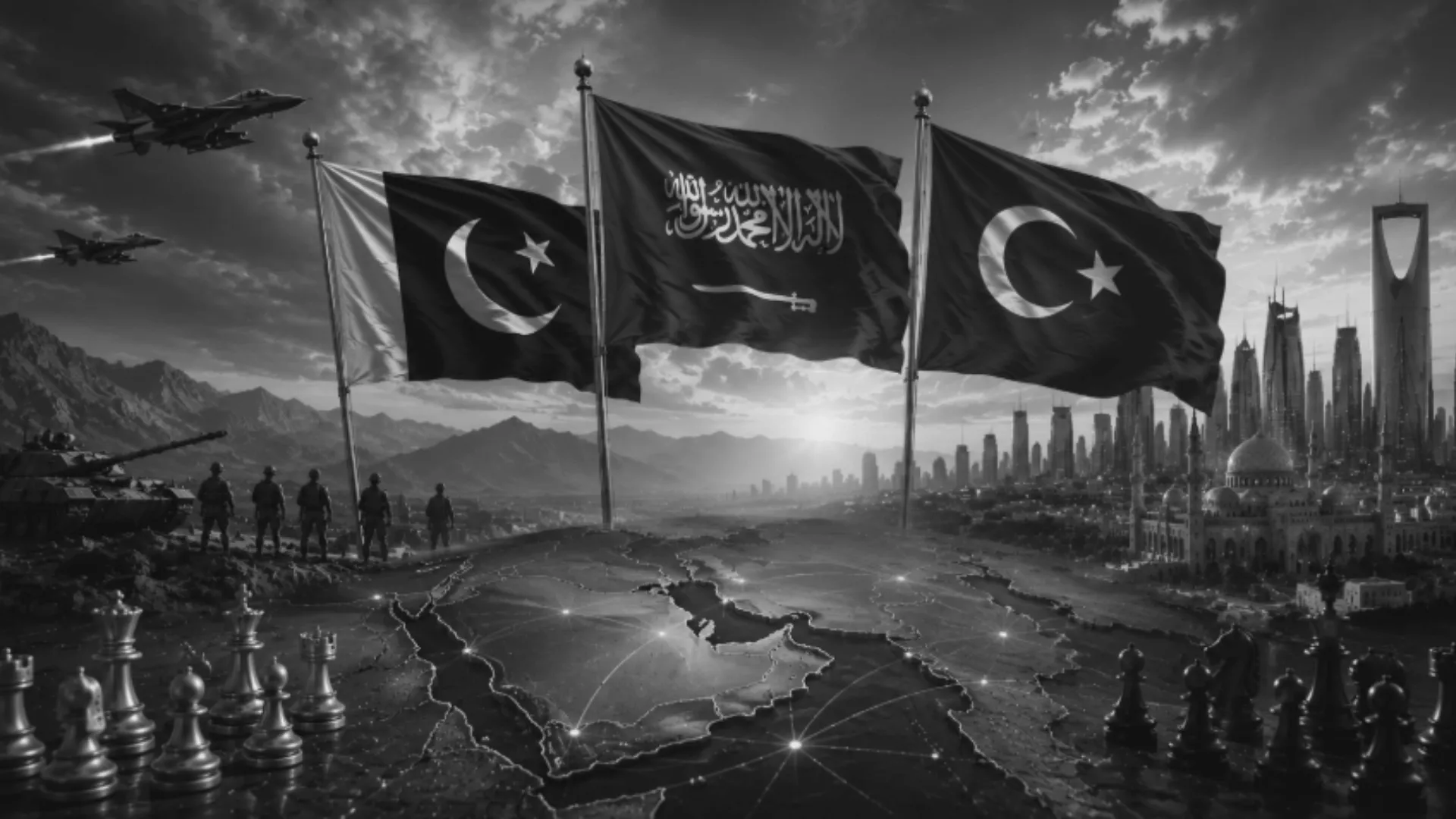
The Mecca Joint Defence Agreement, which was signed on 7 August 2026 between Saudi Arabia, Pakistan and Turkey, is a result of the evolving geopolitics of the Middle East. The recent crisis in the Middle East has raised some tumultuous questions involving the presence of the US in the region, future conflict in the region, and the role of regional actors. While peace remains elusive in the Middle East, the instability persists, and the complexities of the geopolitical arena continue to shape alliances and rivalry. The relations between Saudi Arabia, Pakistan and Turkey can be seen as a redo of what was earlier MEDO, in which Saudi Arabia provides capital, Pakistan provides human resources, and Turkey brings in a strong defence industrial base. The signing of this agreement in Islam’s holiest city clearly specifies the intention behind it. The clause of collective security reflects the collective security bloc.
2. Understanding the Dynamics of the Agreement
For over four decades, the US has been the primary security guarantee in the region; the relationship between Saudi Arabia and the US dates back to the Cold War Era. However, the dependency of Saudi Arabia on the US for security was tainted in 2019 when the US did not respond to the 2019 Abqaiq attack; this uncertainty of security was further extended in Sep 2025 by the Doha strikes by Israel, in which the US was unable to protect its allies from Israel. Because of this, in September 2025, a Strategic Mutual Defence Agreement between Pakistan and Saudi Arabia was signed, which assured that an attack on one will be considered an attack on both. The situation escalated even more by Feb 2026 when the US and Israel launched major strikes on Iran. And in retaliation, Iran also launched major strikes on allies of the US, in the Middle East.
The failure of the US in protecting its allies created a vacuum in the Middle East, which they are trying to fill with this agreement. On 7 August 2026, Shehbaz Sharif arrived in Jeddah and performed Umrah in Mecca, Erdogan met Mohammed bin Salman, and at Al-Safa Palace, the three leaders signed the Mecca Joint Defence Agreement, folding Turkey into the SMDA framework. Its core clause states that "any armed attack against any one of the three states shall be regarded as an attack against them all," alongside a commitment to "the enhancement of all aspects of defence cooperation". Because of this clause, it is being compared with Article 5 of NATO.
Each signatory brings something that the other lacks. Pakistan brings a combat-tested army with strong capabilities, decades-long experience in the Gulf, while being the only nuclear-armed Islamic state. Pakistan, given its current strategic landscape, requires a strong economic backing to overcome its domestic challenges.
This agreement further embeds Pakistan in the emerging security architecture of the Middle East. Pakistani leaders want the world to view their country as a helpful and impactful global player, not as a home to a large level of repression and terrorism. The agreement can help Islamabad’s relationship with the United States. The Trump administration, which wants to see more burden-sharing from top US allies, will likely look favourably on a pact meant to advance collective regional deterrence with an eye toward Iran.
Saudi Arabia in this alliance brings a vital economic edge, a well-equipped air force and the political and religious legitimacy of guardians of the holy sites in Islam. This agreement helps both Saudi Arabia and the US. Saudi Arabia is looking for diversification in its security rather than depending on the USA, and recent US President Trump’s praise for these agreements highlights the limitations of US capabilities to be engaged in protracted conflicts across the world. This pact is consistent with US efforts to recalibrate its own role in the region and shift from a ‘security guarantor’ to an ‘integrator ’, bringing together Pakistan, Turkey, and Saudi Arabia covertly if not overtly. Turkey is the most important ally in this agreement as it supplies NATO's second-largest standing army and an increasingly self-sufficient defence-industrial base already exporting drones and air-defence systems to Saudi Arabia and Pakistan.
There are questions regarding compatibility with its NATO obligations, to which Turkish officials argue that the pact does not conflict with NATO, as Article 6 limits the geographical collective-defence commitments. But the main concern is strategic in nature rather than military-oriented. Since the agreement was signed, it has been termed ‘Islamic NATO’ or ‘Sunni NATO’. It cannot be called NATO as it is just a thin agreement and not a treaty with proper institutions, integrated command structures, standing forces, binding force-generation rules, and decades of operational experience.
There is no official response from Washington on this agreement; the silence can be understood as Washington is untroubled by this agreement, as this deal is between three close US allies for their own protection. On the other side, some interpret it as the end of US-led Middle East order. Regional powers are now shaping their own security order. The three signatories cannot replace the US, which remains central to their security. Saudi Arabia's own officials also insist that Washington remains their "primary strategic partner". US power remains irreplaceable, but its stature as a security provider has diminished; Saudi Arabia and 13 other countries have confirmed the creation of a maritime military coalition to safeguard freedom of navigation through the Bab al-Mandab Strait, the Red Sea and the Gulf of Aden, with more nations expected to join. The US and Saudi Arabia have also established a Nuclear Energy Pact, and the Mecca Joint Defence Agreement is a symptom of that erosion rather than proof of American collapse.
Egypt’s absence from the agreement is notable, as it was part of the informal "R4" or "STEP" quad security consultations with Saudi Arabia, Turkey and Pakistan and also co-hosted a meeting with them in June 2026. Egypt has strong reasons for caution: its peace relationship with Israel, tensions with Turkey, disputes in the Eastern Mediterranean, military priorities focused on Sinai and the Suez Canal, and a preference for mediation rather than bloc politics. Turkey’s links with Libya’s government also worry Cairo because Egypt backs a rival Libyan faction. Qatar’s former PM has urged all GCC states to join the agreement, and Qatar and Kuwait are the potential future members. UAE has criticised the agreement, concerned that it may enhance Saudi’s influence in the Gulf.
3. Implications on India
For India, we must understand this agreement through Operation Sindoor. After the terrorist attack on 22 April 2025 in Pahalgam, which killed 26 tourists, India retaliated on 7 May 2025 with strikes on nine major terror sites in Pakistan and POJK and described it as a focused, measured and non-escalatory attack targeting terrorist infrastructure. Pakistan also retaliated with 300-400 Turkish-made drones, which were all intercepted by India. Turkey supplied hundreds of drones and deployed personnel to assist Pakistan. In counter, India deepened ties with Armenia, Greece and Cyprus, while ensuring the Gulf states issued neutral statements. This makes Saudi Arabia’s defence pact with Pakistan and Turkey more uncomfortable for India than the September 2025 bilateral Saudi-Pakistan defence agreement.
India’s response on this trilateral agreement is “closely following” and “examining implications” for national security and regional stability. India’s strategic opinion is divided. Some say that the agreement had checkmated India by the alliance of Pakistan, Turkey and Saudi Arabia, with the support of China, which all supplied military to Pakistan during Operation Sindoor. The agreement constitutes the same Pakistani bloc with Chinese hardware, Turkish drones, and Saudi capital, all now bound into a single signed agreement, that Operation Sindoor had already previewed on the battlefield in May 2025. A situation which isn't foreign to India, but is now more prominent and on the face of it- more formal.
4. Conclusion
The Mecca Joint Defence Agreement is the beginning of a new multipolar strategic alliance in the Middle East. Each country has entered this agreement keeping in mind its strategic objectives, which are different from each other; what binds them together is the declining US dominance in the region and the need to forge an alliance with strategic partners to overcome geopolitical adversity. Similar agreements have been signed in the past as well; however, the lack of institutionalisation made them elusive. The agreement, however, does not resolve the existing fault lines such as the Shia-Sunni divide in the region but aims to become a credible deterrence against it. The agreement, therefore, to begin with, is only a decisive break from security guarantees from the US and a start of a new security architectur in the region. While Pakistan-Turkey-Saudi plan to realise this agreement, regional players like the UAE, Israel, and Jordan keep a vigil on these developments.
The views expressed are those of the authors and do not represent the views of CNAWS.
Image Source: ChatGPT


