


The Arakan Army’s Ascent in Rakhine: Implications for Regional Connectivity and Security in the Bay of Bengal Region

1. Introduction
The military takeover in Myanmar in 2021 and the ensuing civil war have fundamentally transformed the country's political and territorial landscape. The victory of military-backed Union Solidarity and Development Party's (USDP) in the 2026 elections and the election of Senior General Min Aung Hlaing as President sought to institutionalise military rule and restore political authority, though effective territorial control remains highly fragmented. Several Ethnic Armed Organizations (EAOs) have expanded their territorial control in the borderlands and emerged as de facto governing authorities. The Arakan Army (AA) has experienced one of the most remarkable military and political ascents, establishing itself as the largest non-state actor and EAO in Myanmar consolidating de facto control over most of the Rakhine State.
The AA by consolidating control over large parts of Rakhine State, a strategic gateway linking the Bay of Bengal with South and Southeast Asia through major maritime, energy, and transport corridors, has acquired significant influence over critical ports, transport networks, border trade routes, and energy infrastructure. Rakhine has evolved from a theatre of internal conflict into a focal point of regional security and connectivity, and has altered the strategic calculus of regional stakeholders.
The AA's ongoing offensive against Sittwe, Rakhine's administrative capital, alongside important areas of Kyaukpyu and Munaung, has further underscored the significance of these developments. The potential capture of these three remaining strategic areas and its ability to consolidate control over virtually, entire Rakhine State has created uncertainties for critical projects, with implications extending beyond Myanmar's internal conflict to strategic interests of China, India, and Bangladesh. and the security in the Bay of Bengal.
2. The Rise of the Arakan Army
The political objective of establishing an Arakan Army (AA) , founded in 2009, by Twan Mrat Naing in Laiza, Kachin State, is rooted in the “Way of Rakhita”, an ideology rooted in the struggle for liberation and the restoration of Arakanese sovereignty lost in 1784. The AA emerged as an armed movement of ethnic Rakhine Buddhists, representing itself as protecting the political, cultural, and economic interests of the Rakhine people, subjected to longstanding economic neglect, cultural suppression, political marginalisation, and what many Rakhine nationalists viewed as the systematic dominance of the majoritarian Bamar ethnic group .The Rakhine is one of the132 officially recognised ethnic communities in Myanmar, with approximately 2.5–3.5 million, representing around 4.5% of the country's total population.
The military training, mentorship, and logistical support from KIA, helped AA in its formative years and it first clashed alongside KIA against the Tatmadaw (Military Junta) in 2011 at the Myitsone hydropower dam region, and then started expanding its presence in the Rakhine State. In 2015, the AA joined the Northern Alliance alongside the KIA, Myanmar National Democratic Alliance Army (MNDAA), and Ta'ang National Liberation Army (TNLA), strengthening its military cooperation with other EAOs and providing the organisation with a broader platform for armed resistance against the Tatmadaw.
The 2012 communal violence between Muslim and Buddhist communities, the emergence of the Arakan Rohingya Salvation Army (ARSA) and its attacks on security forces in 2016 and 2017, brought Rakhine State to the centre of Myanmar's internal security crisis. Subsequent military operations by Tatmadav against ARSA in 2017, accompanied by widespread allegations of human rights violations and scorched-earth tactics, massive humanitarian crisis, all forced more than 700,000 Rohingya to flee to Bangladesh. AA, then was a marginal actor in Rakhine politics during President U Thein Sein’s tenure but through participation in the Arakan National Conference and armed clashes with the Tatmadaw from 2015, it grew popular popular among the Rakhine population.
Prior to the AA's rise, Rakhine political aspirations were pursued primarily through electoral politics, with the Arakan National Party (ANP) emerging as the principal political vehicle representing Rakhine interests. However, tensions between the ANP and the National League for Democracy (NLD) government led by Aung San Suu Kyi intensified after the ANP's electoral victories in Rakhine State. Despite securing the largest share of seats in the 2015 state elections and winning a majority in the 2018 by-elections, the ANP was not permitted to form the state government due to perceived exclusion of Rakhine marginalisation and growing discontent.
Under Twan Mrat Naing's leadership, the AA successfully cultivated support among Rakhine's younger population through social media and its vision of Way of Rakhita who viewed the existing political system as incapable of addressing their grievances. Between 2018 and 2020, the conflict between the AA and the Tatmadaw escalated into a full-scale armed confrontation expanding its operations from rural areas into urban centres, employing asymmetric tactics alongside increasingly sophisticated military operations. The Tatmadaw responded with intensified counterinsurgency operations, deployed five of its ten Light Infantry Divisions in Rakhine State, the government declared AA a terrorist organisation in 2020 and suspended the internet connectivity in nine townships in the 1.5 year longest internet blackout. However, Tatmadaw’s tactics caused a massive humanitarian crisis displacing 200,000 people and backfired which deepened local’s resentment for Tatmadaw and boosted support for the AA. An informal ceasefire was signed after 2020 general elections which the NLD won, and survived until mid of 2022.
3. Post-Coup Consolidation and Operation 1027
Following the Tatmadaw's coup in February 2021, the Junta initially pursued a conciliatory approach towards AA to avoid another confrontation in Rakhine and thereby lifted the terrorist designation on AA soon after the coup. While the AA criticised the Junta's suppression of popular protests and its attacks on the organisation's allies, it refrained from directly confronting the military.
The AA used the ceasefire to consolidate its position and expand its parallel governance structures, across approximately two-thirds of Rakhine State and parts of southern Chin State, establishing administrative, judicial, and policing institutions and separating its military and administrative wings transitioning from an insurgent EAO into a de facto parallel government. However, concerned by the AA's growing territorial and administrative control, the Junta launched airstrikes and imposed blockades on AA-controlled areas, triggering renewed clashes. The AA established contacts with the National Unity Government (NUG), the parallel administration formed by ousted NLD lawmakers and other anti-Junta forces, as well as other ethnic armed groups.
The conflict escalated into full-scale war in October 2023, when the AA, alongwith its allies in the Three Brotherhood Alliance namely the Myanmar National Democratic Alliance Army (MNDAA), the Ta'ang National Liberation Army (TNLA) and the Kachin Independence Army (KIA), launched Operation 1027 against the Junta. The offensive was driven with the dual objective fight against military rule and dismantle cyber-scam networks operating across the country, particularly in the northern Shan State. China welcomed the operation- given Beijing's growing concerns and the Junta’s inability to suppress scam centres involved in the trafficking and exploitation of Chinese nationals. Operation 1027 consequently inflicted substantial losses on the Tatmadaw, which according to 2024 estimates lost over 400 military positions, with its troop strength and auxiliary forces reportedly falling to approximately 130,000 and 70,000 respectively.
The AA had the most significant military and territorial expansion ámong the participating EAO’s, and has grown over the years from 27 members in 2009 to approximately 45,000, emerging as Myanmar's largest and most powerful EAO. By December 2024, the AA had gained control of 14 of Rakhine State's, 17 townships along with Paletwa Township in neighbouring Chin State. AA has established control over the entire 168-kilometre Myanmar–Bangladesh border and has transformed into a dominant political and military force, a Quasi State in Rakhine entrenching its parallel governance structures.
The map below highlights that as of June 2026, AA controls 90% of Rakhine’s territory and 14 out of 17 townships. Just three townships Sittwe, the capital city of Rakhine, Kyaukhphu, a major deep-sea port and home to China’s largest BRI project in Myanmar and the island of Munaung now remain with the Tatmadaw.
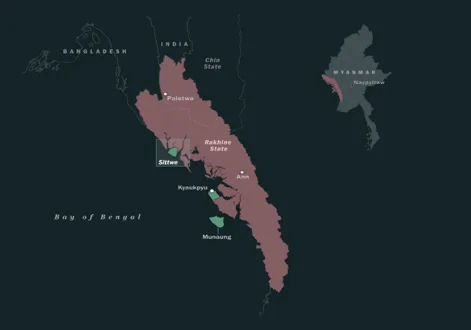
Source: (International Crisis Group, 2026)
The AA has increasingly expanded its military operations beyond Rakhine into neighbouring Irrawaddy, Bago, and Magwe regions. Having accumulated substantial territorial control, military strength, and administrative capacity, the AA now possesses the capabilities to sustain and enforce a system of self-rule while significantly reshaping the balance of power in Myanmar's civil war. The AA's objective of establishing comprehensive territorial control over Rakhine in the current scenario is therefore no longer a distant possibility but an increasingly an evolving, imminent, strategic reality
4. Regional Connectivity and Security Implications
The rise of AA and the near consolidation of authority in the Rakhine since 2025 has had a huge impact on regional connectivity and the security calculus of the neighbouring states, mainly India China, Myanmar’s largest economic partner and Bangladesh.
4.1 China’s Engagement
China remains the Tatmadaw's principal political, diplomatic, and economic partner and Myanmar's largest external investor. Despite the post-2021 civil war, Beijing has continued to deepen its economic engagement through cumulative investments of approximately US$20 billion, including around US$15 billion under its flagship China–Myanmar Economic Corridor (CMEC), in addition to the US$3 billion economic assistance package extended to the Junta ahead of the 2026 elections. However, Myanmar's territorial fragmentation has compelled China to recalibrate its approach beyond engagement with Naypyidaw alone.
Beijing has now increasingly adopted a strategy of strategic hedging, simultaneously engaging both the Tatmadaw and influential EAO’s to safeguard its security and economic interests particularly evident in Kachin and northern Shan States, where China has cultivated relations with organisations such as the Kachin Independence Army (KIA), United Wa State Army (UWSA), and National Democratic Alliance Army (NDAA), whose territories host significant rare earth and critical mineral deposits. The relationship is characterised by mutual dependence wherein while China relies on these groups for access to critical minerals, border stability, and cooperation against transnational scam centres, the EAO’s remain economically dependent on China for cross-border trade, essential supplies, and revenues generated through Chinese-operated rare earth mining. Beijing has repeatedly leveraged this dependence to influence the behaviour of the EAO’s, through closing of border crossings, suspending trade, and threatening to halt rare earth operations as illustrated during the KIA's anti-junta offensive against Bhamo.
4.2 The Conundrum
The AA however, represents an important exception to this pattern. Unlike the KIA, UWSA, or NDAA, the AA's strategic position along the Bay of Bengal, bordering Bangladesh and India rather than China, has insulated it from excessive economic dependence on Beijing. Although Chinese-origin weapons continue to reach the AA through other EAOs, the organisation's military expansion has been driven primarily by sustained local recruitment, financial self-sufficiency, and successive battlefield victories against the Tatmadaw. Consequently, China's ability to exert economic coercion over the AA remains comparatively limited while its consolidation has significantly increased its strategic leverage over Beijing. The Rakhine state hosts 11 major Chinese Belt and Road Initiative (BRI) projects, of which the AA now controls 10 projects , fully or partially. These include the China–Myanmar Economic Corridor (CMEC), the US$8.9 billion Mandalay–Kyaukphyu railway, the China–Myanmar oil and gas pipelines, the Kyaukphyu Special Economic Zone, and the Kyaukphyu Deep Sea Port, together forming the centrepiece of China's strategy to secure direct access from Yunnan Province to the Indian Ocean while bypassing the Malacca Strait.
With the Junta having limited authority across much of Rakhine, the security, implementation, and long-term viability of these projects increasingly depend on the AA's willingness to facilitate their operation placing the AA in the unprecedented position of exercising significant influence over some of China's most strategically important overseas infrastructure investments. This provides the AA with a special degree of bargaining leverage rarely enjoyed by a non-state actor. While recognising Rakhine's pressing development needs, the AA has consistently stated that it welcomes foreign investment and infrastructure development provided the projects respect Rakhine's interests, contribute to local socio-economic development, and are undertaken through engagement with the authorities exercising effective control on the ground.
4.3 Implications for India
India is a directly affected regional stakeholders of the AA's territorial consolidation in Rakhine State. New Delhi's interests are shaped by both security and connectivity considerations, including curbing cross-border insurgency, narcotics trafficking, illegal migration, and safeguarding its US$ 484 million Kaladan Multi-Modal Transit Transport Project (KMTTP). The project, which links Kolkata to Sittwe Port and onwards to Mizoram through Paletwa Township, is central to India's ‘Act East Policy’ and its efforts to improve connectivity with the Northeast. However, following the AA's capture of Paletwa in 2024, work on the project has remained largely stalled, despite plans to begin operations by 2027.
While the AA has consistently stated that it welcomes foreign investment and connectivity initiatives, India initially remained reluctant to engage directly with the organisation, preferring to continue its long-standing policy of working through the Tatmadaw and the central government in Naypyidaw. However, the AA's rapid territorial expansion and its near consolidation of Rakhine have compelled New Delhi to gradually recalibrate its approach. Although India has continued to engage with the Junta as understood from Senior General and now President Min Aung Hlaing's engagements with Indian officials in New Delhi. However, the regional reality remains that the military exercises only limited authority across much of Rakhine and therefore possesses little capacity to implement and enforce bilateral commitments with India on the ground.
Without formally recognising the AA, India has increasingly acknowledged the evolving realities in Rakhine by opening informal channels of communication with the organisation. The visit of an Indian delegation led by Rajya Sabha MP K. Vanlalvena in 2024 to AA-controlled areas, signal New Delhi's growing willingness to engage with the de-facto authority on the ground. The AA has positioned itself as a more credible partner than the Junta for implementing the Kaladan project, arguing that its effective territorial control enables it to provide security for infrastructure and construction activities. At the same time, it has emphasised that connectivity projects should ensure fair land compensation, environmental protection, and tangible benefits for local communities. The AA has also expressed interest in expanding cooperation with India by highlighting the historical ties between the former Mrauk-U Kingdom and India, while identifying cross-border insurgent groups such as the Arakan Rohingya Salvation Army (ARSA) and the Rohingya Solidarity Organisation (RSO), along with narcotics trafficking, as common security challenges requiring greater bilateral cooperation.
For India, therefore, the challenge is no longer whether to engage with the AA, but how to pragmatically safeguard its strategic and connectivity interests while balancing its long-standing policy of supporting Myanmar's sovereignty and maintaining relations with the Junta.
4.4 Implications for Bangladesh
Engagement with the AA is increasingly becoming a strategic necessity rather than a choice for Bangladesh, as the organisation now exercises effective control over the entire Myanmar–Bangladesh border. Dhaka's principal concerns are securing its porous border, preventing cross-border crime and instability, and managing the humanitarian and security consequences of the conflict in neighbouring Rakhine. Bangladesh has simultaneously accelerated efforts to strengthen border security, including the construction of fencing along vulnerable stretches of the frontier.
However a major concern for Dhaka remains the deteriorating humanitarian situation involving the Rohingya population. While the AA has consistently maintained that its struggle is political rather than communal and that it seeks to represent all communities in Rakhine irrespective of ethnicity or religion, relations between the organisation and sections of the Rohingya community have deteriorated sharply. The participation of some Rohingya armed groups alongside the Tatmadaw against the AA has deepened mutual mistrust, resulting in increased attacks, displacement, and civilian casualties. These developments have triggered renewed refugee movements into Bangladesh, which already hosts approximately 1.2 million Rohingya refugees. Many others have attempted dangerous sea crossings, exemplified by the disappearance of around 500 Rohingya in the Bay of Bengal in June 2026, underscoring the worsening humanitarian crisis.
These developments have also complicated the prospects for Rohingya repatriation. Bangladesh has increasingly recognised that any durable solution will require engagement with the AA, given its effective control over much of Rakhine. This was reflected in the congratulatory message sent by AA leader Twan Mrat Naing to Bangladesh's newly appointed Foreign Minister Khalilur Rahman, expressing hope for greater cooperation and a strategic partnership. While Dhaka clarified that such exchanges do not constitute political recognition of the AA, it has emphasised that the organisation bears responsibility for ensuring the inclusion, safety, and participation of the Rohingya within Rakhine's emerging governance structures if voluntary repatriation is to become feasible.
Further, pragmatic cooperation between Bangladesh and the AA has begun to emerge. The release of more than 73 Bangladeshi fishermen detained in Rakhine and growing cooperation over border management indicate a willingness on both sides to prevent localised tensions from escalating. Improved coordination along the Naf River could also facilitate the reopening of cross-border trade routes, including the Kanyinchaung Economic Zone and Maungdaw trading points, easing the movement of essential goods and contributing to greater stability along the border which is of mutual interest to both parties.
5. Conclusion
The Arakan Army's rapid military and political ascent have transformed Rakhine from a peripheral theatre of Myanmar's civil war to the centre of strategic crossroads where internal conflict intersects with regional security and connectivity. By emerging as Myanmar's largest Ethnic Armed Organization and establishing de facto authority over most of Rakhine, the Arakan Army has fundamentally altered the balance of power within the country while reshaping the strategic calculations of regional stakeholders. As the organisation moves closer to consolidating complete control over Rakhine and expands its military operations beyond the state, the implications increasingly extend beyond Myanmar's domestic conflict.
The Arakan Army's growing territorial control carries significant implications for the strategic interests of neighbouring states. China's flagship connectivity and energy projects in Rakhine increasingly depend on engagement with the de facto authority on the ground, while India's connectivity ambitions and border security calculus are becoming increasingly intertwined with the evolving realities in the Rakhine state. At the same time, Bangladesh faces the dual challenge of managing border security and addressing the deteriorating humanitarian situation surrounding the Rohingya, making pragmatic engagement with the Arakan Army increasingly unavoidable. Together, these developments underscore that the future of Rakhine will shape not only Myanmar's evolving political order but also the broader security and connectivity architecture of the Bay of Bengal, requiring regional stakeholders to adapt their policies to an increasingly complex political reality.
The views expressed are those of the authors and do not represent the views of CNAWS.
ImageSource: ChatGPT


