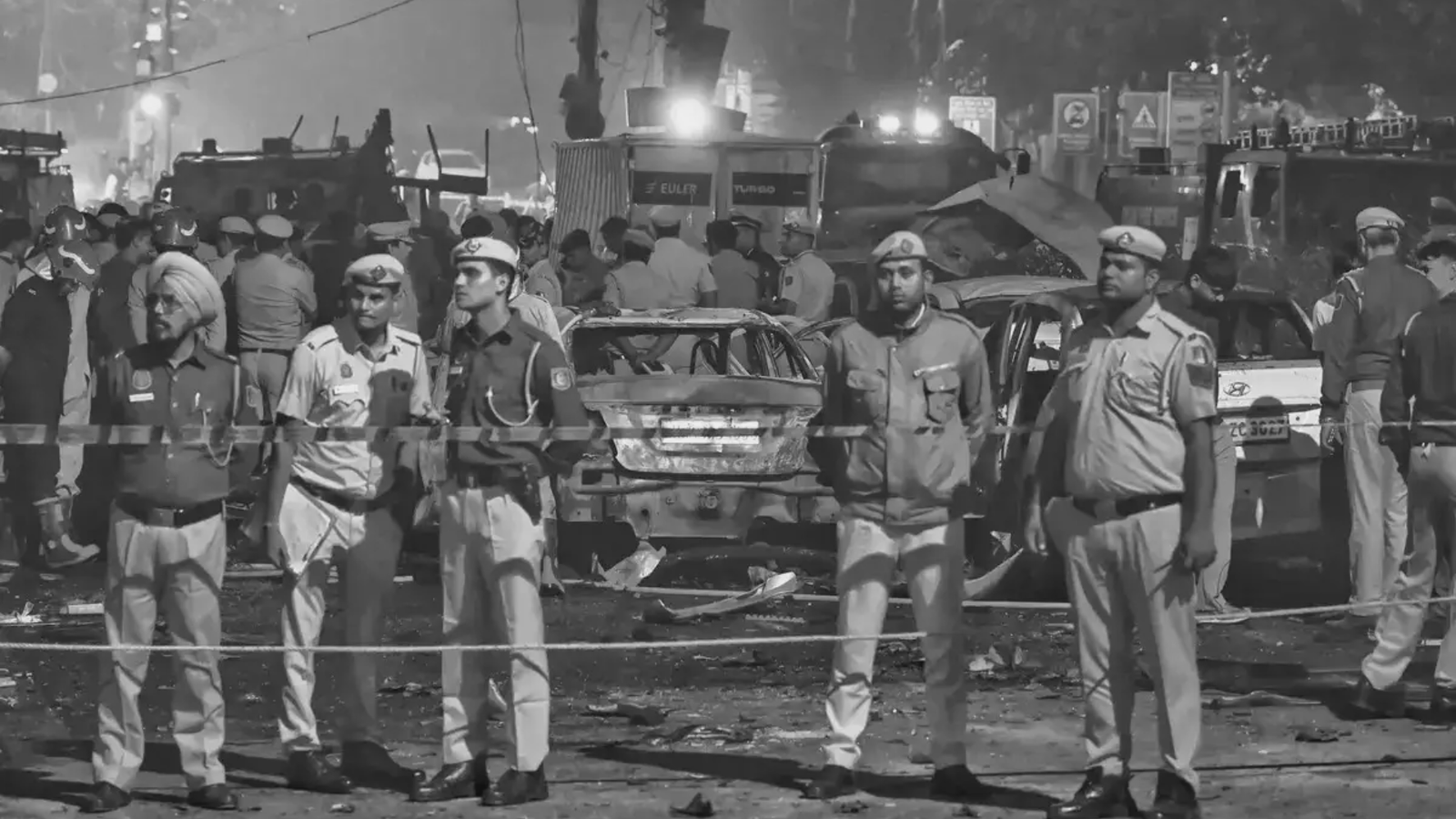
The Red Fort Blast Demands a Rethink of India’s Counter-Terror Strategy
Introduction
Over the last few decades, India has been facing a steady trend of cross-border terrorism, which has been carried out mainly by Pakistan-based terrorist organisations. The 26/11 Mumbai attacks and the more recent attacks carried out in Pathankot, Uri, including the latest Pahalgam incident, follow a consistent pattern. Terrorists crossing the Line of Control, International Border, and even the maritime border; trained and funded by known and sometimes sanctioned terrorist organisations. Even with the complexity that goes along with such attacks, Indian security agencies have been able to trace the trail of involvement to the Pakistan soil. Therefore, the Red Fort blast is a strategic turning point in all the meanings of this word. The initial examinations show the existence of a profile that is highly different from the past incidents. As of now, all the involved terrorists in this incident are Indian citizens, and most of them are also highly skilled or qualified, and none fit into the stereotyped image of foreign terrorists.[i] [ii] [iii] This does not come out of the blue and is a recalibration of Pakistan's long-held policy of proxy warfare against a new background of Indian counter-terror policy and the loss of the previously employed policy of plausible deniability.
This change is explained by two concepts that are closely connected: state-sponsored terrorism and proxy war, and the changing plausible deniability doctrine. The state-sponsored terrorism literature proves that states use non-state actors to carry out their attacks, which are in their strategic interests, without being involved and answerable.[iv] The situation in Pakistan with groups like Lashkar-e-Taiba and Jaish-e-Mohammed fits into this paradigm. The sponsor provides the funding, the training, the protection and the tactical support, and the proxies execute the attacks far enough away to make it difficult to trace them.
Plausible deniability is the second foundation block of this construct. For a long time, Pakistan could claim that terrorists were not under their control, but evidence presented many times proved to contradict this statement. But this deniability started to lose its ground following the Mumbai attacks on 26/11, and others. The fact that Ajmal Kasab was captured alive essentially changed the dynamics of diplomacy: India provided incontrovertible proof of his Pakistani nationality and training, thus putting a hole in the long-held narrative of Islamabad. On recognising that its old pattern was untenable, it took an even more advanced shape: deployment of terrorists from the target country itself and so making attribution to them harder. This is a development of classical plausible deniability to what scholars define as implausible deniability, which is a creation that has been carefully crafted to the extent that even strong suspicion cannot generate accountability with certainty.[v]
Analysis
This new phase is squarely in line with the Red Fort blast. The involvement of Indian citizens, even those who have both professional and academic qualifications, is an indicator of the dawning of what is now commonly referred to as white-collar terrorism.[vi] These actors do not have the traditional militant training, however, they are highly embedded in the wider society, and as such, it gives them social legitimacy, educational mobility, and low operational profile. Their invisibility is therefore better than the typical foreign infiltrators. Similar examples across the world, including the use by the Islamic State of locally radicalised citizens in France and Belgium, show the tactical benefit provided by these people to dangerous operators overseas.[vii]
More importantly, such a development is not within a vacuum. Rather, it is a response to the previous achievements by India to destroy the deniability mechanism of Pakistan. The intelligence community of Pakistan has been keen to realise that sending foreign terrorists to India has its predictable consequences- exposure, diplomatic isolation, and possible kinetic retaliation. On the other hand, the advantage of using Indian citizens as the working arm gives a greater range of ambiguity. No cross-border entry exit points, international records or financial tracks extend and complicate the attribution, this limits the political flexibility of India in the short term to retaliate.[viii] [ix]
This strategy is also indicative of the current international trends of asymmetric host-state interactions. Islamic State decentralised external operations that relied on the use of distributed and remote guidance, the development of national resources instead of penetrating the target country. The similar tactic of Pakistan is an indication of a shift that can be also reflected in other nations, but instead of cross-border infiltration it deals with in-country node either cultivation or activation a definite evolutionary trend in the habits of proxy warfare. The Red Fort attack, in this case, might not be a single anomaly but might be a readjustment in the strategy.[x]
Lastly, one should be wise enough to recognise the boundaries of existing inference. On going studies have not revealed on how, where, and by whom the involved perpetrators were radicalised. Open-source sources do not provide concluding information on ideological pipelines or recruiting periods. Arguments on the psychological course of the perpetrators or symbolic motivation to attack the Red Fort are thus merely speculative. It has been prematurely suggested by early reports that the blast itself may not have been targeted at that specific site, and as such, should not be interpreted until further notice is given.[xi] [xii]
Implications
This development has several subsequent implications on the Indian security stance at the domestic, as well as international level. At the very beginning, the process of attribution becomes significantly more complicated. Presence of Indian citizens makes the work of the intelligence agencies difficult in the detection of the hidden network that might be functioning without the blatant indications of cross-border intrusion.[xiii] Secondly, the improved plausible-deniability strategy of Pakistan makes diplomatic engagement activities and deterrent signalling difficult. The former supposition that any attack on Pakistani nationals will inevitably be the centre of international attention is no longer so clear. Thirdly, India needs to be ready to a long-term move towards proxy war. In case this trend continues, the business environment will resemble the European one with the ISIS-enabled assaults ever more - decentralised, deniable, diffuse, and connected to the domestic radicalisation.
White-collar terrorism has shown the loopholes in the avenues that were least susceptible to extremism in the otherwise strong institutions. It is not only a security issue, but it is a social issue, which should be strictly investigated, controlled, and preventing measures, which should be based on facts and not speculations.[xiv]
Conclusion
The attack is a fresh beginning in the trajectory of terrorism in India. It uncovers a modified form of proxy warfare which has developed due to limited operation of flexibility by Pakistan, aggressive counter-terror policy by India over the last few years and spread of decentralised terrorism methods globally.[xv] The choice of Pakistan to use Indian citizen, rather than foreign infiltrators, is trying to rebuild plausible deniability in a more palatable way, and complicates not only attributing the deed, but also responding to it.
One thing becomes clear as the investigation is underway, the strategic environment has changed. Today, India has been facing a kind of terrorism that can just be more difficult to track and more intertwined into the very code of the society. The acknowledgement of this change is the initial move. Through its resolution, it will be necessary to enhance the levels of preparedness in the country and reorganise foreign counter-terror operations. In this respect, the Red Fort blast could be regarded as not only an attack, but as a threat, the beginning of another stage of proxy war.
Endnotes:
[i] https://www.thehindu.com/news/cities/Delhi/delhi-car-blast-doctors-with-bombs/article70281425.ece
[ii] https://www.ndtv.com/india-news/timeline-of-entire-probe-into-white-collar-terrorists-behind-delhi-blast-9641607
[iii] https://www.hindustantimes.com/india-news/radicalised-by-umar-delhi-blast-co-conspirator-wani-backed-out-of-suicide-attacks-later-forbidden-101763441438077.html
[iv] https://scholarhub.ui.ac.id/cgi/viewcontent.cgi?article=1132&context=jts
[v] https://www.orfonline.org/english/expert-speak/implausible-deniability-and-indian-covert-action-after-pahalgam
[vi] https://www.thenewsminute.com/news/delhi-blast-ed-searches-places-linked-to-al-falah-university-trustees
[vii] https://timesofindia.indiatimes.com/toi-plus/defence-security/why-terror-wears-white-collar/articleshow/125278086.cms
[viii] https://www.bbc.com/news/articles/ce8zkdemv2ko
[ix] https://indianexpress.com/article/cities/delhi/red-fort-blast-explosive-contained-mixture-of-ammonium-nitrate-and-tatp-show-forensic-analysis-10368359/
[x] https://scholarhub.ui.ac.id/cgi/viewcontent.cgi?article=1132&context=jts
[xi] https://indianexpress.com/article/cities/delhi/red-fort-blast-explosive-contained-mixture-of-ammonium-nitrate-and-tatp-show-forensic-analysis-10368359/
[xii] https://www.bbc.com/news/articles/ce8zkdemv2ko
[xiii] https://timesofindia.indiatimes.com/toi-plus/defence-security/why-terror-wears-white-collar/articleshow/125278086.cms
[xiv] https://www.hindustantimes.com/india-news/radicalised-by-umar-delhi-blast-co-conspirator-wani-backed-out-of-suicide-attacks-later-forbidden-101763441438077.html
[xv] https://www.orfonline.org/english/expert-speak/implausible-deniability-and-indian-covert-action-after-pahalgam
(The views expressed are those of the authors and do not represent the views of CNAWS.)