

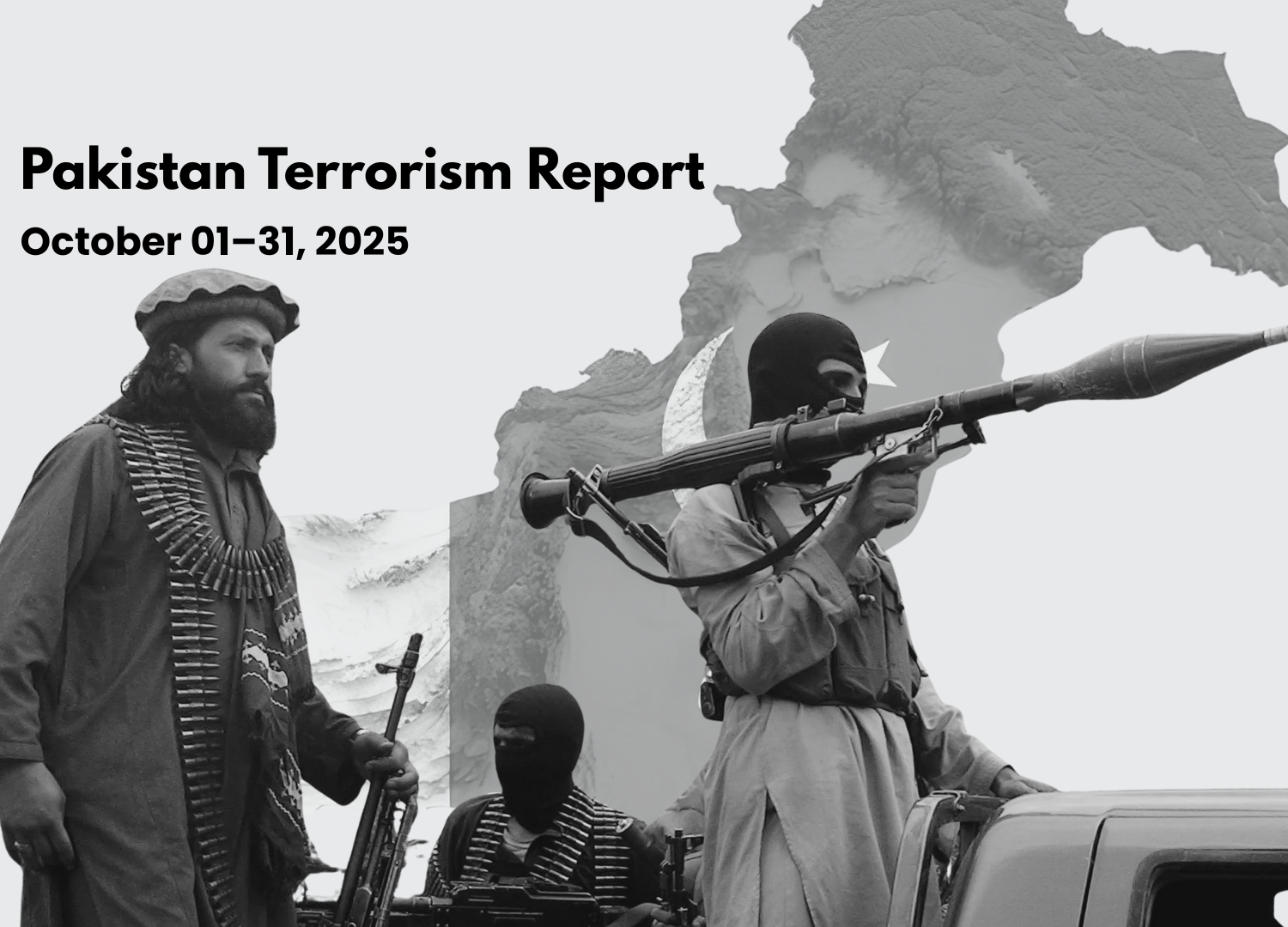
Pakistan Conflict Monitor (October 1–31, 2025)

Executive Summary
Pakistan faced a synchronised two-front insurgent campaign throughout October. In Khyber Pakhtunkhwa and the ex-FATA arc, the TTP ecosystem relied on complex, multi-phase ambushes, night raids, and targeted assassinations to attrit forward posts and convoys. In Balochistan, separatist formations escalated from infrastructure harassment to short-duration seizures of governance nodes, including the late-month takeover of Bhag Nari, paired with sustained rail and highway interdictions that amplified economic pressure. These dynamics unfolded against the backdrop of the most serious Pakistan–Afghanistan border clashes of the year on 11–12 October, which validated militant narratives of state vulnerability and complicated force allocation. The net effect was visible operational overstretch, especially where predictable reinforcement drills and lightly layered district defences persisted.


Introduction
The October picture fuses two distinct but converging insurgencies. The TTP and aligned factions consolidated a campaign rhythm built around fixing outposts, drawing in relief, and striking reinforcement columns at terrain choke points. Baloch groups evolved from episodic sabotage into governance denial and mass coercion of local labour, while keeping rail, pipeline, and CPEC-linked logistics as pressure levers. The 11–12 October Durand Line flareup created a third stressor that spilled into information operations and resource diversion. This monthly assessment synthesises both fortnightly datasets to trace patterns across the full period.
Operational Landscape and Regional Patterns
KP and the ex-FATA Arc
From early October, militants intensified operations across Kurram, North and South Waziristan, Bannu, Lakki Marwat, Khyber, Tirah, Tank and Hangu, where the TTP and its auxiliaries applied a consistent pattern built on layered, terrain-focused attacks. Their campaign combined night assaults on fixed posts using heavy and light weapons with convoy ambushes at river and bridge choke points, supported by persistent sniper and IED harassment designed to fix responding units. The 6 to 10 October Kurram sequence demonstrated this method clearly as militants first struck a fixed position, then ambushed relief elements along narrow bridges and defiles with recoilless rifles, RPGs, sniper fire and mines. Within this period the well-documented 6 to 8 October Central Kurram engagement brought an assault on Jogee Post, an ambush on a returning convoy and a subsequent strike on reinforcements at Ali Sher Zai, resulting in 11 security personnel killed, missing personnel and the destruction of vehicles. This architecture reappeared throughout the month, with night timing and terrain mastery compensating for state firepower and ISR limitations. The 13 October South Waziristan raid followed this pattern at larger scale as militants conducted a coordinated night attack on multiple posts with a claimed 25 security force fatalities. Mid-month suicide activity in Mirali and Razmak confirmed that the group retained the capability for high-impact breaches even as dispersed ambushes remained the primary mode of action. Militants also downed or claimed to down several small UAVs and intensified pressure on governance by targeting polio teams and local administrators. In the final days of the month security forces neutralised Mufti Muzahim, a senior TTP deputy, and repelled cross-border infiltration attempts at Spinwam, indicating some degree of improved targeting response and border interdiction capacity despite sustained militant pressure.
Balochistan
Separatist actors expanded both the geographic spread and the ambition of their operations as the month progressed, with insurgent activity cohering around logistics interdiction and symbolic demonstrations of state absence. Early in the month militants struck mineral trucking and security convoys near Khuzdar and Mastung, then broadened their efforts by blocking segments of the Quetta to Karachi artery, torching equipment and targeting pipeline and power infrastructure around Nasirabad and Kachhi. Rail and road interdictions remained persistent along the Bolan, Kalat and Makran corridors and set the stage for a shift toward more direct governance denial in the final third of the month. From 23 October onward, separatist groups abducted workers in multiple waves, briefly seized police posts and executed on-foot assaults on camps that degraded contractor morale and stretched Levies and police resources. This escalation culminated on 27 October when militants overran Bhag Nari, captured government buildings including the NADRA office and burned state facilities before disengaging, signalling an objective of imposing cost and broadcasting state absence rather than holding territory. The closing days of the month saw sustained clashes in Kalat and coordinated attacks on camps in Sheikhri Morgand and Shah Mardan, while security forces conducted counter-raids in Awaran and Zehri that killed mid-level BLA cadres but did not diminish insurgent initiative or their ability to decide time and place for blockades and raids.
The Durand Line
Fighting on 11–12 October spanned Helmand, Kandahar, Kunar and Paktia, with multiple Pakistani posts reportedly overrun or abandoned for hours and casualties acknowledged on both sides. Subsequent targeted strikes against Taliban commanders underscored an unstable deterrence dynamic that insurgents can exploit for sanctuary and propaganda. Residual friction persisted into late October through cross-border probes and interdictions.
Critical Infrastructure and Economic Leverage
Militants repeatedly targeted the Jaffar Express corridor and related railway assets, alongside pipeline and power infrastructure. Trains faced episodic suspension, and rail repair cycles became part of the insurgent playbook to impose recurring costs. These attacks extended into Sindh and kept investor confidence under pressure while forcing security dilution across long lines of communication.
Tactics, Techniques and Procedures (TTPs)
Militant groups displayed a consistent and evolving tactical repertoire across both halves of October. The most dominant pattern was the continued reliance on multi-phase ambushes built around a fix and finish design. Militants typically initiated contact by striking a vulnerable post or security picket, then channelled responding reinforcements into pre-sighted kill zones where recoilless rifles, RPGs and designated marksmen were positioned to inflict maximum attrition. This method remained unchanged throughout the month and proved resilient even when security forces attempted to vary their movement patterns. These ambushes were reinforced by a clear preference for night operations because militant units exploited dusk to dawn windows when visibility was low, terrain familiarity acted as a force multiplier, and Pakistani night-vision capabilities remained uneven. Local guides, micro-terrain routes and rehearsed withdrawal plans consistently gave insurgents a tactical advantage during engagements.
Both sides increasingly employed drones, which added a new dimension to battlefield dynamics. Militants used commercial quadcopters for reconnaissance and occasionally claimed to have downed Pakistani surveillance drones. They also experimented with simple munition-drop adaptations in a few areas. Security forces relied on UAVs for overwatch and post-operation pursuit, but insurgent attempts to blind or confuse aerial observation before launching ground assaults became more frequent in the second half of the month. Alongside this aerial contest, IEDs and sabotage operations remained reliable tools for insurgents. Roadside bombs, pressure-plate devices and repeated rail sabotage continued to serve as cost-effective equalizers. Even though the technical sophistication of these devices did not significantly improve, their consistent placement along key supply routes ensured that they remained a persistent threat.
All of these tactical developments were amplified through an aggressive propaganda strategy. Militant groups issued rapid claims of responsibility, circulated selective video snippets and frequently exaggerated casualty figures. They also linked operations to domestic political grievances, which helped convert isolated engagements into broader narratives of state vulnerability. The fusion of multi-phase ambushes, night fighting proficiency, drone contestation, persistent sabotage and highly reactive propaganda created a tactical environment that sustained constant pressure on Pakistani security forces throughout October.
Organizational Behavior and Command
The TTP treated October as a campaign month. It synchronized multi-district raids on 13 October and tied the messaging to domestic protest repression for political reach beyond tribal areas. It showcased fronts and deniable brands such as TIF around the D. I. Khan training center incident to manage risk and diversify claims. Two local factions publicly pledged allegiance to the central leadership, suggesting ongoing centripetal pull after a year of realignments. In parallel, IMP, HGB and TLIP nodes surfaced in Khyber and Bannu for ambushes and executions that provide local knowledge, sappers, and propaganda reach. In Balochistan, BLF and UBA field commands displayed agility in massing briefly at towns like Bhag Nari or Dhadar to seize weapons and burn state property, then dispersing before heavy forces arrived, while BRG sustained a national narrative by showing train IED activity in Sindh.
State Response and Vulnerabilities
Security forces mounted frequent intelligence-based operations and interdicted multiple cross-border infiltration attempts near Spinwam. Rotary assets were used around Manguchar and Khuzdar, while air and UCAV strikes eliminated field commanders in Awaran and Zehri and a senior TTP deputy, Mufti Muzahim, on 30 October. By 31 October, UCAVs struck compounds in Hassan Khel with an assessed 18–25 militants neutralized. Yet several constraints persisted. Convoys remained vulnerable on predictable resupply runs and at dusk, and district-level nodes in Balochistan lacked layered defense, allowing insurgents to seize and burn facilities. The spread of actions across KP and Balochistan during the border crisis showed the difficulty of massing reserves without creating soft flanks elsewhere. The cumulative picture by month-end was a tactically active but strategically stretched posture.
Civilian Environment and Governance Effects
October featured coercion of local administrators, judges and Levies, abductions of labor in Khuzdar–Kalat belts, and targeted killings around polio teams and service delivery. Brief town seizures and arson of records at administrative sites fed a narrative of official impotence. Rail and pipeline disruptions imposed everyday costs that resonated beyond the immediate battlespace. These actions create a permissive environment for taxation and protection rackets and complicate counterinsurgency because population-centric tasks collide with force protection needs.
Comparative Pulse Across the Month
Throughout October the conflict landscape in Pakistan evolved in two distinct phases that together revealed a widening and more complex battlespace. From 1 to 15 October the operational weight rested heavily on Khyber Pakhtunkhwa and the ex-FATA belt where the TTP drove a sustained campaign centered on complex night raids and multi-phase ambushes. The 6 to 8 October Central Kurram sequence demonstrated a deliberate fix and finish design, beginning with the assault on Jogee Post and extending into coordinated ambushes on relief elements at Sama Bazaar Bridge and Ali Sher Zai, generating significant security force casualties and missing personnel. This frontline pressure peaked with the intense 11 to 12 October clashes along the Durand Line that saw multiple Pakistani posts briefly overrun and substantial losses reported, followed by the TTP’s declared nationwide action day on 13 October that involved simultaneous raids across several districts. In the 16 to 31 October window the center of gravity began shifting toward Balochistan, although KP remained active. Baloch insurgent groups escalated from infrastructure harassment to direct governance denial as seen in the temporary seizure of Bhag Nari, the burning of government buildings including the NADRA office, and the clustering of multi-location attacks in Kalat, Awaran and surrounding districts. Tactically the first half was dominated by TTP’s use of recoilless rifles, RPGs, LMGs, sniper fire and pre-sighted choke points for ambushes, supplemented by targeted killings and IED harassment. Drone interactions were present but remained mostly limited to ISR denial. The second half saw an expansion of militant technique in Balochistan with temporary checkpoints, seizures of Levies posts, arson of civil registries, and the destruction of surveillance assets combined with rail interdictions, pipeline sabotage and mass worker abductions that forced the state to disperse forces across multiple points. During the first half Pakistan attempted to offset TTP pressure through IBOs and border strikes yet the Durand Line clashes forced reactive posture shifts and exposed vulnerabilities in predictable relief routes. The second half saw a mix of continued ground operations and decisive decapitation actions including the killing of Mufti Muzahim on 30 October and UCAV strikes in Hassan Khel on 31 October which neutralized a significant number of militants but did not prevent short-duration insurgent takeovers like Bhag Nari. Quantitatively KP maintained a consistently high incident rate across both halves while Balochistan registered roughly one third more incidents in the latter half reflecting the shift from sabotage to governance denial. Despite the late-month counter leadership strikes the structural weaknesses in convoy survivability, district-node protection and multi-front resource allocation persisted. Overall the first half confirmed TTP’s ability to sustain complex raids and exploit frontier vulnerabilities while the second half revealed Baloch groups’ capacity to convert interdiction into symbolic territorial displays, together stretching Pakistan across two demanding and evolving theatres.
Geopolitical Assessment
Pakistan’s October security environment can only be understood by placing internal militancy within the broader regional and economic pressures shaping the state’s behaviour. The violent clashes with the Afghan Taliban along the Durand Line did more than trigger tactical losses; they exposed the fragility of Pakistan’s border management posture and disrupted trade flows at Torkham and Chaman, deepening Islamabad’s conviction that Kabul’s inaction against the TTP has strategic consequences for Pakistan’s internal stability. At the same time, the TTP’s adaptability was evident in its sustained night raids, convoy interdictions and exploitation of predictable reinforcement routes, all of which continued even after Pakistan conducted leadership decapitation strikes. This persistence highlights that militant operational capacity is now distributed across multiple nodes rather than tied to individual commanders. In Balochistan, separatist organisations intensified efforts to undermine state authority by blending infrastructure sabotage with short-duration governance denial, including the temporary capture of administrative sites and clustered worker abductions. These actions directly intersect with the economic stakes of CPEC Phase II, where China has already signalled concern over inadequate security guarantees by exploring private security options to protect its workers and projects. The cumulative effect of insurgent pressure and cross-border friction unfolded in parallel with Pakistan’s ongoing negotiations with the IMF and its attempts to stabilise a fragile economy. Security shocks, investor risk aversion in Balochistan, and periodic border closures all threaten to dilute the impact of macroeconomic reforms and foreign financing. Taken together, the geopolitical picture is of a state caught in a tightening triangle: external pressure from Kabul, internally adaptive insurgent ecosystems, and a development strategy heavily reliant on foreign capital. Without systemic improvements in corridor security, district-level resilience, economic governance and cross-border crisis management, Pakistan risks entering a cycle in which tactical battlefield gains cannot offset the strategic consequences of sustained multi-theatre instability.
Strategic Assessment and Implications for India
Pakistan is contending with three interacting pressures. First, a resilient TTP campaign that degrades outpost resilience and convoy mobility through repeatable ambush templates. Second, Baloch insurgents are executing a denial strategy against state logistics and CPEC nodes, aiming to raise the economic and political cost of presence without overextending. Third, the Durand Line flare-up shows that cross-border crisis is no longer a background risk but a near-term trigger that can quickly alter operational tempos on both fronts. Historically, such compound stress increases the incentive for diversionary signalling, while tactical tradecraft tends to diffuse across networks and geographies. For India, the prudent course is to harden logistics and rail nodes, expand counter-UAS readiness down to post level, and maintain calibrated messaging that preserves deterrence without creating pretexts for escalation.
Four-to-Six Week Outlook
Expect sustained TTP pressure in North and South Waziristan, Kurram and Khyber during dusk and night windows, with renewed attempts to pair suicide action with indirect fire against fortified nodes. In Balochistan, anticipate additional one-to-two hour seizures of police or Levies facilities, road blockades near pay cycles, and targeted strikes on camps in the Kalat–Awaran–Kech axis. Rail and pipeline interdictions are likely to continue for economic leverage. Border friction may re-ignite if new leadership targets are struck or posts suffer visible reverses.
Conclusion
In conclusion, the October 2025 reporting period reveals insurgent campaigns in Pakistan that are not only enduring but strategically evolving. In the northwest theatre, the Tehrik-e-Taliban Pakistan (TTP) and its affiliates continued to exploit predictable relief routes, fixed posts and terrain obscurities to fix and attrite security forces with ambushes, sniper fire, RPGs and mines. Their sustained tempo and night-time orientation signal an operational maturity that goes beyond episodic attacks. At the same time, the southwest theatre in Balochistan displayed a shift from intermittently targeting infrastructure to conducting short-duration seizures of governance nodes, worker abductions and large-scale logistics interdiction. This altered the conflict’s centre of gravity toward economic and symbolic disruption of state presence. The concurrent escalation of cross-border tensions with the Afghan Taliban along the Durand Line further complicated Pakistan’s internal security balance and increased the burden on its security forces to manage multiple threat vectors at once. The state’s reactive operations, including intelligence-based raids and targeted strikes, remained necessary but were not sufficient to reverse militant momentum. Structural vulnerabilities persisted in convoy defence, district-level resilience and early warning systems. From an analytical perspective, the key insight is that Pakistan now faces a multi-theatre insurgency in which northwest guerrilla raids and southwest governance-denial operations are synchronised in effect even if not in direct coordination. For policymakers and analysts, this means that kinetic responses must be paired with systematic improvements in mobility security, governance resilience, multi-domain intelligence sharing and narrative management. Without such an integrated posture, the state risks managing crises in isolation while conceding strategic initiative to adversaries whose tactics are becoming increasingly patient, dispersed and politically sophisticated.
About the Author: Sushant serves as the Lead Intelligence Analyst for the Pakistan Security Desk at CNAWS, specializing in the Balochistan insurgency and Tehrik-e-Taliban Pakistan (TTP). His work spans monitoring the broader regional security environment , including insurgency trends, militant networks, and cross-border dynamics, to assess their impact on stability across South Asia. Beyond terrorism analysis, Sushant tracks Pakistan's evolving political and security landscape, delivering insights that inform regional stability and India's national security priorities.
(The views expressed are those of the authors and do not represent the views of CNAWS.)
Dataset for October will be uploaded on the website in the coming days. Our website team is working hard to make the 'Conflict Map' operational soon!


