

Tracking China's Space Activities: 06th - 12th September, 2026

China launches Yaogan-53 and Yaogan-56 satellite groups
A Long March-4B rocket launched from Jiuquan Satellite Launch Centre on 10 September, placed two groups of three remote-sensing satellites each into their planned orbits. The official account lists scientific experiments, land and resources surveys, crop-yield estimation and disaster prevention amongst their intended uses. This launch is the 666th launch of the Long March series of launch vehicles.(CASC. 10 Sep 2026. Long March-4B rocket successfully launches Yaogan-53 (01–03) and Yaogan-56 (01–03) satellites.(长四乙火箭成功发射遥感五十三号01-03星、遥感五十六号01-03星)
The mission adds to China’s orbital observation infrastructure. NORAD data suggests that the Yaogan satellite constellation currently has 184 active satellites. All six satellites were developed by the Fifth Institute of China Aerospace Science and Technology Corporation and are currently operating in 524/515 km inclined Low Earth Orbit and have military applications. While the satellites have obvious military applications, details about the sensors onboard are currently not available.
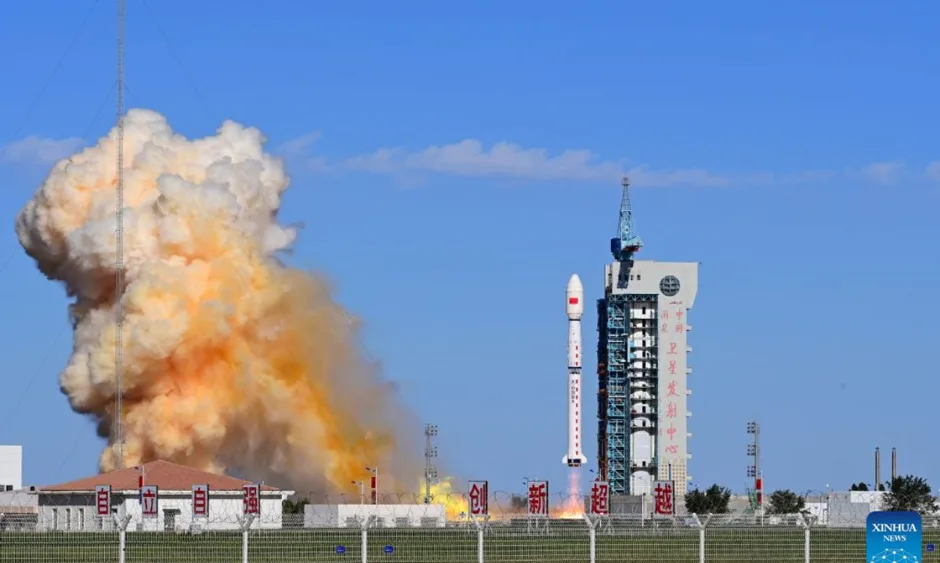
(Long March-4B launching Yaogan 53 and 56 satellite groups. Image Source: Xinhua)
Fengyun-3G and Ground Radar Network improve Typhoon Monitoring
A ST Daily article reported on 10 September that China’s Fengyun-3G precipitation satellite and national weather-radar network had captured detailed three-dimensional rainfall structures in typhoons, including Dolphin. According to China Meteorological Administration, the satellite measured peak instantaneous rainfall of about 100 mm per hour and storm-echo tops around 10 km high. Its dual-frequency (Ku and Ka band) radar helps fill observation gaps over oceans and difficult terrain, while comparisons with ground radar support calibration across the network. The article also highlights that ground weather radar network has more than 280 S/C-band large-scale weather radar and more than 560 X-band small radar networking system and together the system has facilitated monitoring and responding proactively to typhoons. (ST Daily. 10 Sep 2026. republished by NCSTI(风云三号G星与天气雷达网协同观测成效显著))
The practical value lies in bringing these measurements together to support forecasts, warnings and disaster-response decisions. This is an operational weather-monitoring application of an existing satellite.
Chinese researchers examine how Solar Cycle influences Ocean
A ST Daily article highlights research from the Chinese Academy of Sciences’ Institute of Oceanology. Using 80 years of ocean reanalysis data and modelling experiments, the team found that the Sun’s 11-year activity cycle can influence formation of subsurface water masses in the North Eastern Pacific. These water masses help store and transport heat and carbon. The study links reduced formation one to two years after solar maximum to changes in atmospheric circulation, winter mixing and water sinking below the surface. The strength of the relationship varies with Atlantic climate conditions. Published in Geophysical Research Letters, the work could inform longer-term climate prediction; it describes a natural influence, rather than an ability to control the ocean. (ST Daily. 09 Sep 2026. New Study finds solar activity ‘influences’ deep-sea climate change (新研究发现太阳活动“操控”深海气候变化). CAS Institute of Oceanology, 4 Sep 2026. Ocean Institute Study finds Solar Activity regulates Deep-Sea Climate Change(海洋所研究发现太阳活动调控深海气候变化)
Tiangong brings space science to Hong Kong and Macao classrooms
On 9 September, the Shenzhou-23 crew connected live with students in Hong Kong and Macao for a special Tiangong classroom session. Lai Ka-ying, Hong Kong’s first astronaut, and her fellow crew members demonstrated life and science aboard the station and answered students’ questions. Official coverage linked the event to scientific education, national identification and greater participation in China’s space programme. A 13 September SCMP editorial argued that the enthusiasm should be sustained through policies that strengthen science and innovation. Taken together, the reporting shows how an operating space station also serves as a platform for education and public engagement; its longer-term effect on scientific careers will take time to assess. (PLA Daily, 10 September; 同赴星约 齐心致远——“天宫课堂·港澳专场”活动激励港澳青年逐梦新征程 Xinhua report, 11 September republication; SCMP editorial, 13 September.)
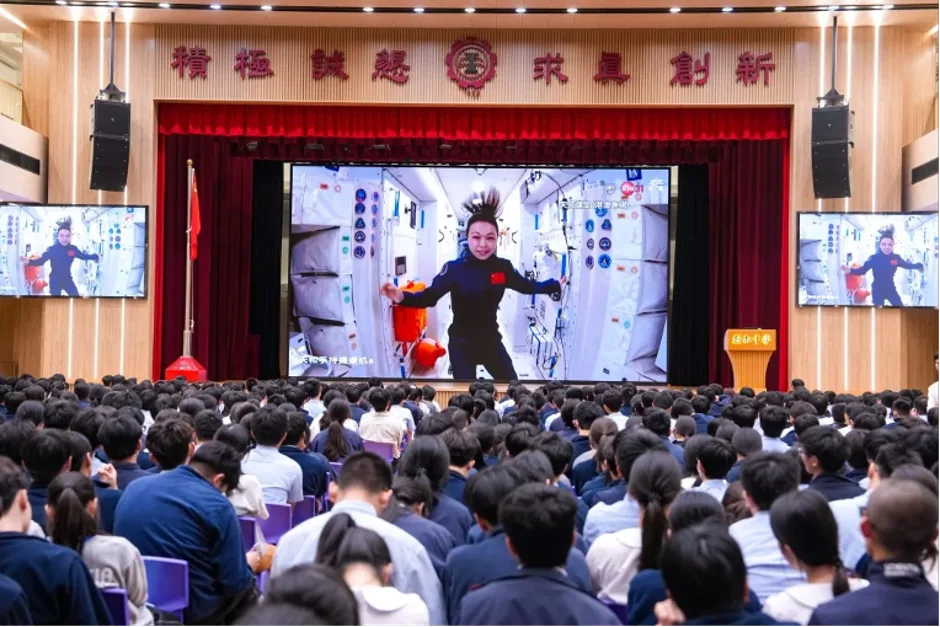
Students watch Lai Ka-ying’s live lecture from Tiangong on 9 September. Photo: Sam Tsang/SCMP
Japan’s planned AI satellites draw warnings from Chinese state media
Japan plans to develop tactical satellites that process intelligence in orbit, aiming to improve target identification and support long-range missile guidance. SCMP, citing Nikkei, reported that funding is included in Japan’s draft defence budget request for the 2027 financial year, with launches expected from financial year 2030 following prototype development and ground testing. Chinese state broadcaster CCTV characterized the project as a serious threat and part of Japan’s space militarization strategy. China is itself developing orbital computing capabilities, including the Three-Body constellation, whose first 12 satellites launched in May 2025.
If successfully deployed, Japan’s system could shorten military decision-making timelines and intensify regional competition over space-based intelligence. Its operational performance remains to be demonstrated. (Source: SCMP, 10 Sep 2026.)
As we wrap up, this week highlights how China’s space programme connects scientific progress with practical services and political messaging. Showcasing Hong Kong astronaut Lai Ka-ying reinforces Beijing’s “one country, two systems” narrative, inviting young Hongkongers to see themselves as part of China’s space ambitions. Meanwhile, the Yaogan launch warrants close attention. Additional satellites could strengthen observation on land and at sea, but their security significance depends on what they can detect, how frequently they observe and how their data are used.
See you next week with more space news, fresh insights and articles!


