

Tracking the People's Liberation Army (PLA): 02nd - 08th August, 2026
.png)
Neighbourhood
Taiwan
Taiwan commenced its annual Exercise Hankuang on 5 August 2026. This year’s exercise is the largest in recent years and is aimed at testing ‘whole of the society’ resilience. Taiwan’s Minister for National Defense, Wellington Koo informed media that this exercise will include ‘opposing force’ units, to improve unit’s response to circumstances, and command and control (C2) at lower levels. This will ensure that fighting components at company and below will continue fighting according to the higher commander’s intent, even if C2 is disrupted. The exercises will also include Urban Resilience exercises in four counties - Kaohsiung, Pingtung, New Taipei City and Yilan. (MND, Republic of China. 03 Aug 2026. Minister Wellington Koo: Han Kuang Exercise will strengthen Response; Build Multi-Domain Denial and Sustained Combat Capabilities(顧部長:漢光演習強化臨機應處 建構多域拒止與持久作戰能力). Taipei Times. 22 Jul 2026. Civil exercises to fully join Han Kuang drills this year).
Chinese Response to Taiwan Exercises
The PLA responded with a surge in number of daily sorties from 04 Aug 2026. A total of 54 sorties were flown this week, of which 40 sorties crossed the Median Line. On 02 & 03 Aug 2026, there were a total of 07 sorties. From 04 Aug onwards, minimum of 10 sorties were flown everyday. There were two* helicopter sorties, of which one entered Taiwan’s Air Defense Identification Zone (ADIZ). A solitary UAV progressed further to the East of the island. Movement of PLA aircraft was coordinated with PLAN ships, though Taiwan’s MND did not report the location of the ships. The Global Times commentator Hai Feng* termed the exercise as a placebo initially. Subsequently, he accused the ruling DPP of embedding war plans into the war fabric of Taiwanese society and termed it as alarming. (Global Times. 07 Aug 2026. ‘Han Kuang’ military exercises turn Taiwan’s cities into battlefields – who will ultimately bear the cost?: Hai Feng)
*Likely pseudonym
Japan releases White Paper on Defense
On 04 Aug 2026, Japan released White Paper on Defense. The White Paper covers changes in geo-political environment especially military strengthening of China and North Korea, and increasing military cooperation of both countries with Russia, and nature of warfare, especially AI and unmanned warfare. To ensure Japan’s security, the paper calls for promoting multi-lateral cooperation backed by defence capabilities under civilian control. The Chinese Ministry of National Defense spokesperson called the White Paper as a false narrative and stressed that Japan’s militarisation posed a serious challenge to post-WW II international order and a threat to regional peace and stability. The Chinese Ministry of Foreign Affairs (MFA) Spokesperson urged Japan to ‘reflect’ on its history and not to proceed further on the incorrect path. (PLA Daily. 05 Aug 2026. Page 4. Q&A regarding the Japanese government’s 2026 Defense White Paper(就日本政府2026版《防卫白皮书》答记者问) 06 Aug 2026. Page 4. MFA rebuts Japan’s Defense White Paper: Solemn Representations Made to Japanese Side(外交部驳斥日本《防卫白皮书》:已向日方严正交涉))
Scarbourgh Shoal, South China Sea
On 01 Aug 2026, China’s Ministry of Natural Resources, National Forestry and Grassland Administration, China Coast Guard, and Hainan Province jointly issued Management Measures for Huangyan Island National Nature Reserve(黄岩岛国家级自然保护区管理办法) and announced commencement of routine patrolling of Huangyan Island National Nature Reserve* with South China Sea Bureau of Ministry of Natural Resources acting as nodal agency. The Bureau will be responsible for daily protection and management, resource surveys and monitoring, and ecological protection and restoration. Concurrently, PLA’s Southern Theatre Command (STC) conducted a one-day joint sea-air exercise at Scarborough Shoal on 01 Aug 2026, which included heliborne insertion, simulated anti-ship strikes, air-defence and rescue of ‘seized vessel’. The PLA claimed it as a response to actions by certain countries to undermine regional peace and stability and to strengthen own capabilities. Participating troops included Type 52D Destroyer Zhanjiang (Hull No 165), Type 71 LPD Qilianshan (Hull No 985), AEW aircraft and bombers. (PLA Daily. 02 Aug 2026. Southern Theatre Command conducts Joint Sea-Air Exercises near Huangyan Island(南部战区位黄岩岛开展海空联合演训) Page 4. Routine Patrol System for Huangyan Island Nature Reserve to be established (我国将建立黄岩岛保护区日常巡护制度) Management Measures for Huangyan Island National Nature Reserve” released(《黄岩岛国家级自然保护区管理办法》发布))
*The Huangyan Island national natural reserve was approved by the State Council in September 2025.
The exercise and the commencement of routine patrolling come in the wake of Philippines depositing Chart showing baselines of Scarborough Shoal (Bajo de Masinloc) with the UN on 29 Jul 2026, under Article 16 of UNCLOS. The 2016 Permanent Court of Arbitration judgement concluded that China’s claims to ‘historical rights’ within South China Sea were incompatible to the extent that it exceeded the limits provided under UNCLOS. Routine patrolling by Ministry of Natural Resources will project a softer view of China’s control over Scarborough Shoal, while Chinese Coast Guard and PLAN would remain in the background and respond if the situation escalates.
Combat Theory
Combat Power Generation in the AI Era
Zhao Hui and Yu Yang call for analysis of internal mechanisms of combat power generation in the AI era to win wars. First is by creating a Force-Multiplier effect by creating system wide synergy and shifting the focus from information and firepower to decision making. Second, is the shift to man-machine collaboration while retaining ‘man in the loop’ to ensure operational control while optimising operational efficiency. Third is the shift cross-domain swarm intelligence through connectivity and improving the efficiency of the system. Next is the closed OODA loop which drastically reduces the time taken for decision—making, Last but not the least, is the self-learning and self-evolving capabilities of AI, which facilitate adaptation and iteration. Finally, the authors suggest that a combination of digital and manual systems can complement each other, be realistic and help develop combat capability in an all round manner. (PLA Daily. 4 Aug 2026. Page 7. An Analysis of the Internal Mechanisms of Combat Power Generation in the Age of Intelligence (探析智能化条件下战斗力生成内在机理))
Reassessing Approach to Unmanned Combat Systems
Liu Peng and Cao Heng call for a reassessment of the approach to unmanned combat. They argue that while unmanned combat equipment has changed the shape of warfare, history has repeatedly proved that tactical success does not translate into strategic advantage, nor does battlefield innovation guarantee victory. Towards this, they call for adhering to the fundamental laws of war, consider the overall situation of system development, and define the role of unmanned system to avoid exaggeration or overgeneralization. They support their argument by highlighting that changes in combat methods invariably result in development of countermeasures. With the concurrent development of counter-unmanned systems, it is difficult for unmanned systems to gain the decisive advantage. Second, while the individual cost of unmanned systems might be low, the overall costs to the nation remain high. Third, they argue that unmanned combat systems serve as an extension of traditional combat rather than as replacement. To sum up, the authors argue that while unmanned systems have enriched operational techniques, they have not changed the fundamental laws of war. They call for a systemic mindset and integrated development of technologies. (PLA Daily. 4 Aug 2026. Page 7. Taking a Rational View on the Employment of Unmanned Combat Forces(理性看待无人作战力量运用))
Joint Operations
Challenges in Joint Operations
A set of three PLA Daily articles highlights some of the challenges of having multi-service airbases and how these are being resolved. First is ground support. The base has adopted a ‘Zero-accompaniment’ and ‘modular ‘support model, wherein visiting units no longer get their own support detchments during sorties. The support unit of the base is capable of supporting multiple types of aircraft including fighters and helicopters. The Political Commissar of the base highlights that the group support unit was restructured by reorganising tasks, personnel and equipment and provide a unified interface for operational integration. The base is concurrently shifting towards intelligent predictive models. modular reconfiguration and universal compatibility. The other challenge was Air Traffic Control with both Army and Naval Aviation wanting priority for their aircraft in terms of airspace. To resolve the issue, the ATC learnt the training manuals of both services, understood their requirements and evolved customised plans with reserved airspace to cater for emergent requirements. (PLA Daily. 4 Aug 2026. Page 5. When “Long-term Host” meets “New Tenant”(当“老房东”遇到“新房客”). Ensuring deployed units remain focused on Training, not Logistics (让驻训部队不为保障分心) Coordination was really efficient this time (“这次调度真利索”))
Training
PLAAF - PLA Army Aviation Joint Exercise
PLAAF and the 75 Group Army Army Aviation Brigade organised a joint training recently. While the Army Aviation helicopters focused on low altitude penetration, multi-dimensional assault and contingency response, PLAAF fighters rehearsed aerial interception and destruction of ground targets including by use of real time data transfers. (PLA Daily. 08 Aug 2026. Page 2. Forging “Iron Wings” Through Day and Night (披星戴月淬铁翼)
Development of Naval ‘Blue Force’
A PLA Daily article highlights the upgradation of the maritime ‘Blue Force’* (海上蓝军) which operates in land, sea, air and cyber domains. The force employs a combination of physical and digital assets to carry out multi-dimensional, integrated joint attacks and create complex combat environments for naval forces. The force uses digital simulation by injecting digital software into Red Force to depict tactics such as launch of missiles towards the surface group. Over the years, the unit has accelerated development of training environments, upgraded simulation capabilities, developed hybrid (digital-physical) “Blue Forces” and intelligent systems, and conducted large-scale, iterative simulations of Red-Blue confrontations., enhancing the capabilities of PLAN units. (PLA Daily. 08 Aug 2026. Page 1. A New Type of “Maritime Blue Force” Rapidly Emerges(新型“海上蓝军”加速崛起))
*PLA uses the term ‘Blue Force’ for units which play the role of Opposing Force. These units are familiar with adversary tactics and provide realism during exercises. The most famous of these is the 195th Combined Arms Brigade at the Combined Arms Tactical Training Base, Zhurihe.
ACs in Exercises?
A PLA Daily article covered the use of modular cabins and ACs during and exercise of unidentified brigade of 76 Group Army in Gobi Desert recently. After taking into account, that temperatures at the brigade’s training area in Turpan Basin often exceed 45° celsius and that there were 10 cases of heat stroke last year, the brigade decided that AC units in modular huts were not comfort but one essential to preserve combat effectiveness and health of troops. (PLA Daily. 04 Aug 2026. Page 8. Camping in the Gobi: Air Conditioning Brings Cool Relief (宿营戈壁滩 空调送清凉)
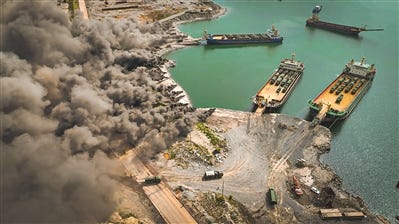
(A smoke screen created by the Camouflage Detachment of an unidentified Army brigade: Image Source: PLA Daily)
Camouflage Detachment
Three PLA Daily articles highlight the role of Camouflage Detachment (伪装兵) of an unidentified Army brigade. The detachment’s task is to ensure deception and multi-spectral camouflage of own troops by various means including setting up decoys and camouflage positions before arrival of the main body of troops, providing smoke cover and finally vetting their efficacy. Apart from camouflage nets and smoke devices, the detachment uses meteorological instruments, drones and thermal imagers. (PLA Daily. 05 Aug 2026. Page 5. Heartfelt Reflections from a Group of “Camouflage Soldiers” (一群“伪装兵”的真情述说) Thirty-Three Hours Hidden in the Mountains(隐入山林的三十三小时) From “Seeking an Adversary” to “Concealing Oneself”(从“找对手”到“藏自己”)
There hasn’t been any coverage about camouflage detachments previously. There are two possibilities - One, that the detachment is adhoc organisation within this particular brigade. The other possibility is that these are being established across PLA Army as one of the articles is written by Lieutenant Colonel Zhao Lu, who has previously posted to reconnaissance section and hence could discern what needed to be concealed. Going by the image, the brigade is likely to be one of the amphibious brigades. The image itself is interesting, as it shows three landing barges likely to be of the PLA Army at a beaching site, loading vehicles.
Technology
C4IRS3K Network
A PLA Daily explainer gives an insight on how the PLA’s future C4IRS3K networks* are likely to be organised. Yin Hao, a researcher at the Systems Engineering Research Institute of the Academy of Military Sciences, explains that future ‘intelligent’ network will link physical, cyber and cognitive domains and will integrate four types of networks. First, is the communication sensor network which monitors network functioning and provides a real time assessment of battlefield situation. Second is the Command and Control (C2) network which integrates command posts, C2 systems and mission platforms forming C2 hub. Third is the firepower strike platform which integrates firepower units of different organisations and provides greater flexibility in their employment. Fourth is the Logistic Support network, which caters for fuel, ammunition, medical services etc. Finally, a multi-domain perception model is built by converting the terminals, routers and network management systems into ‘intelligent’ nodes, which provide information to regional hubs and central core, thus forming a distributed, multi-level ‘brain’. Together, the brain creates three types of Network knowledge: the ‘Data Information’ knowledge about the status of the network, the ‘relational computational’ knowledge which maps the patterns in the network and provides optimal solutions and Logical-decision’ knowledge which compromises problem-solving and contingency planning and optimises and iterates the complete network. Overall, the network can help to shift to proactive functioning and decisive advantage in OODA cycle. Some of the challenges envisaged are both technical and operational in nature, including allocation of resources, AI vulnerabilities, and the interplay between EM environment and cognitive warfare. (PLA Daily. 05 Aug 2026. Page 9. A Unified Battlefield Network: Enabling “Intelligent Interconnectivity” for All (战场一张网 万物可“智联”))
*Command, Control, Communication, Computers, Intelligence, Reconnaissance, Surveillance, (Combat) Support, (Service) Support) and Kill
Personnel Management
Senior Cadre Management
A South China Morning Post analysis highlights that new cadre have taken over the appointments which fell vacant following the Xi’s anti-corruption drive in the PLA during the past one year. Most of these newly appointed general officers were promoted as Lieutenant Generals recently. These include Lieutenant General Chen Demin and Vice Admiral Xiong Zhaoyuan who have taken over the CMC’s Political Work Department, Zhu Chuansheng who heads the Joint Staff Department and Vice-Admiral Zhang Like who heads the CMC’s National Defense Mobilisation Department. Amongst the service heads, Cai Zhijun heads the Army, Zhang Zheng the PLAN, Wang Gang and Shi Honggan the PLAAF and Lei Kai and Zhou Jingjiong the PLA Rocket Force. Amongst the Theatre Commands, there appears to be little clarity with Han Shengyan and Yang Zhibin heading the Central and Eastern Theatre Commands. (SCMP. 05 Aug 2026. Who are the officers filling the big shoes left behind in PLA anti-corruption drive?)
Space
Launch of 9 Satellites into Low Earth Orbit
A Long March-8A rocket launched 9 internet satellites to the Low Earth Orbit from the Hainan Commercial Space Launch Centre, on 04 Aug 2026. (China Academy of Space Technology(CAST. 04 Aug 2026. 23 LEO Internet Satellites developed by Fifth Academy Successfully Launched (五院研制的卫星互联网低轨23组卫星成功发射))
The 9 satellites form the 23rd batch of Hulianwang series and are numbered 178 - 186. They will form part of guowang(国网) constellation which will have 12,992 satellties. The guowang is one of the Chinese counterparts to the Starlink, the other being the Qianfan.
“Dongfang Huiyan” 01 and 02 Satellites Successfully Launched
A Jielong-3 rocket successfully launched ”Dongfang Huiyan” 01 and 02 hyperspectral satellites off the shores of Haiyang, Shandong on 5 Aug 2026. (PLA Daily. 06 Aug 2026. my country “Dongfang Huiyan”01 and 02 Satellites successfully launched(我国成功发射东方慧眼高光谱01、02星))
The Dongfang Huiyan is part of a proposed constellation which will have 258 AI-enabled remote sensing satellites in the optical, radar, hyperspectral and infrared bands by 2030. The two satellites have a spatial resolution of 5 metres and swath of 300 kilometres with a revisit cycle of 5 days. The complete constellation is expected to provide real time coverage of the earth.
Maritime Technology
Underwater Hull Cleaning of Ships
A PLA Daily article highlights underwater hull cleaning of a ship Huizhong No 5 at Qingdao port using underwater robots in a day. Current solutions are to use a dry dock which can be expensive and time consuming or use divers which entails risk and is dependent on weather or Remotely Operated Vehicles. The Chinese solution is to use an intelligent robots which are shaped like a cross between a gecko and an octopus and attach to the hull and move around like an octopus. The article claims that the robots are equipped with underwater vision, can assess the extent of fouling and device customised solutions to clean the hull. Cleaning is done primarily by cavitation which uses microbubbles in a high speed water flow. The technology has been developed by Zhejiang University and cleaning can be done while the ship is in port for loading and unloading of cargo. Apart from reducing fuel and maintenance costs, naval ships will benefit from improved from increased speed and imrpoved acoustic signatures. (PLA Daily. 05 Aug 2026. Page 9. “Deep-Sea Scrubbers”: Removing “Grime” from Giant Ships(“深海搓澡工”:为巨轮“除垢”))
Based on information from Vessel Tracker, Huizhong 5 (MMSI number 413208450) is a cargo ship which is 117 metres long, and a beam of 16 metres. I am unable to access the tonnage data of the ship. While the ship is small and is used for coastal shipping, the technology can be scaled up to meet the requirements of larger ships.
Defence Cooperation
Visit of PLAN Ships to Indonesia
A PLAN task group comprising of training ship Qi Jiguang (Hull 83) and amphibious dock landing ship Kunlunshan (Hull 998) visited Surabaya Port, Indonesia from 02 to 06 Aug 2026. During the visit, PLA crew and cadets visited the Indonesian Naval Academy and had crew visits to each other’s ships. An open day was organised for local residents, ethnic Chinese and Indonesian military personnel. (PLA Daily. 7 Aug 2026. Page 2. PLAN Task Group 83 concludes Goodwill Visit to Indonesia(我海军83舰编队结束对印度尼西亚友好访问))
The task group comprises more than 900 crew members including cadets from the Naval Academy, Dalian and provides practical training to the intricacies of sailing to cadets. Prior to their arrival in Vietnam, the task group had visited Vietnam and Brunei.
Have a nice weekend.
This weekly newsletter is first published by the author on platracker.substack.com and subsequently republished on the CNAWS website.


