

Tracking the People's Liberation Army (PLA): 12th - 18th July, 2026
.png)
Visit of Heads of State to China
Visit of Kazakhstan President to China
Kazakhstan President Kassym-Jomart Tokayev visited Beijing and Shanghai from 15 to 17 Jul 2026. Apart from attending the World AI Conference, he met President Xi Jinping on 16 Jul 2026. Both sides signed more than 70 agreements worth more than $ 15 billion including setting up of a data centre at Ekibastuz, establishment of a vehicle manufacturing hub by Li Auto, petrochemical complex, and a hydelpower plant in Almaty. (Official website of President of the Republic of Kazakhstan. 16 Jul 2026. Kassym-Jomart Tokayev met with the heads of high-tech companies in China (Касым-Жомарт Токаев встретился с руководителями высокотехнологичных компаний Китая))
Kazakhstan forms part of a key BRI corridor connecting China with Europe and handles 85% of the rail traffic between China and Europe. Apart from reduced transit times, this route has the least number of transportation bottle necks. Both sides are investing heavily on improving railway networks, enhancing port capability in the Caspian Sea and upgrading shipping capability. The 300 km, under construction Bakhty-Ayagoz railway will help develop a third land port at Dacheng(Bakhty) on the Sino-Kazakh border. This will be in addition to existing land ports at Khorgos and Alashankou.
Visit of Cambodian PM to China
The Cambodian Prime Minister Hun Manet visited China from 15 to 17 Jul 2026 and met with President Xi Jinping and Premier Li Qiang. Apart from cooperation and boosting investment, both Xi and Li called for working together to eradicate online gambling, telecom fraud, counterfeiting and smuggling to improve the safety of people of both countries. (CGTN. 17 Jul 2026. Xi urges China, Cambodia to carry forward ironclad friendship)
World AI Conference 2026

(Qiji X1 Quadruped. Image Source: Chain Daily)
The World AI Conference 2026 & High Level Meeting on Global AI Governance is in progress at Shanghai from 17 to 20 Jul 2026. The theme of the conference was “Intelligent Partners, Co-creating the Future”. Delivering the Keynote address at the Inauguration Ceremony, President Xi Jinping called for open source software and promoting AI innovation, industrial development and applications, strengthening risk awareness and ensuring safety and control over AI, encouraging inclusiveness and mutual learning and cooperation to improve global governance. Xi also announced 5,000 training opportunities on AI for developing countries, establishment of AI cooperation centres and implementation of ‘Mazu’ intelligent meteorological systems in 30 countries. The conference was attended by Kazakhstan President Tokayev, Cambodian PM Hun Manet, Thai PM Anutin Charnvirakul, and UN Secretary-General Antonio Guterres. More than 1100 enterprises presented more than 3000 exhibits. This included AI-powered Qiji X1 from DaxAI Robot which can carry a 300 kg payload across 40 km of rough terrain at a maximum speed of 10 kmph, (PLA Daily. 18 Jul 2026. Page 1. Xi attends Opening Ceremony of 2026 World AI Conference and High-Level Meeting on Global AI Governance and delivers Keynote Address(习近平出席2026世界人工智能大会暨人工智能全球治理高级别会议开幕式并发表主旨讲话). Page 2. Working Together to Build a Fair and Reasonable Global AI Governance System(携手构建公正合理的全球人工智能治理体系).
World AI Cooperation Organisation(WAICO)
The Conference also witnessed the signing ceremony of World AI Cooperation Organisation in which 29 countries including Kazakhstan, Laos, Pakistan, Russia, and Indonesia participated. Conceived as an independent international organisation, WAICO aims to promote international cooperation and global governance of AI regulation and ensuring that development of technology is beneficial, safe and equitable for mankind. (PLA Daily. 17 Jul 2026. Page 2. Signing Ceremony for Establishment of World Artificial Intelligence Cooperation Organization held at Shanghai(成立世界人工智能合作组织协定签署仪式在上海举行)
(The establishment of WAICO will help China lead and guide development of rules and institutions governing AI in a manner similar to the US’ role in development of Internet. It will also help in establishing China’s leadership amongst the Global South. At the 2025 World AI Conference, China announced a 13 point Global AI Governance Plan which called for greater cooperation and support to the Global South, creation of cross border, open source communities to facilitate sharing of AI resources, and promote inclusiveness in adoption of AI for the overall benefit of mankind. Together with “AI+” International Cooperation Initiative announced by Chinese Premier Li Qiang in Sep 2025, and the establishment of AI Cooperation centres such as China-BRICS AI Development and Cooperation Centre in Shanghai and the China-SCO AI Application Cooperation Centre at Zhongguancun, Beijing, WAICO will help China share its model of AI governance with the Global South, assist in global adoption of Chinese standards, and in the long term, promote Chinese influence in the use of AI. It is interesting that the PLA Daily published an article on how rising countries can exploit Lawfare to wage asymmetric warfare against more powerful countries. See Lawfare under Combat Theory section.
Combat Theory
Advancing Command and Control in the AI-Era
Cai Mingjun, Li Yuyan and Liu Feng call for a leap in command and control capabilities to match the requirements of AI-Era. They foresee futuristic trends such as: 1. Shift in situational awareness towards ‘cognitive alignment’ with synergised awareness across all domains and in real time 2. Shift in coordination and control towards crowd sourcing of capabilities where single point requests are responded with rapid integration and precise matching of combat capabilities 3. Shift in assessment to pre-event prediction and in-process adjustment by extensive use of simulation to optimise plans and course correction based on real time feedback. The operational principles include ensuring quality of battlefield data, man-machine integration for qualitative improvement in command and control, and improving the quality of algorithms which process data. To achieve the leap in command and control capabilities, they call for development of human resources by improving AI-literacy, military-civil cooperation by integrating theory developing capabilities of academies with operational experience of combat units and realistic training; creating an institutional framework by optimising the command architecture, regulatory control to ensure safety and control of AI and refining operational regulations; and lastly, creating a work environment which prioritises data and intelligence driven operations, creating digital twins, and fostering man-machine collaboration. (PLA Daily. 14 Jul 2026. Page 7. Driving a Leap in Intelligent Command and Control Capabilities(推动智能化指挥控制能力跃升))
Data: The New Oil
Chen Zhihua and Li Qi argue that with the shift towards ‘Intelligentization’, the quality of military data decides the effectiveness and reliability of combat system, and in turn victory or defeat. Towards this, they call for establishing unified data standards and establishing norms for data by adhering to the requirements of combat effectiveness, rigid implementation of data standards and adapting the standards to meet the requirements of current and future warfare; improving data management chain and quality of data by control over the data process, controlling the data source, cleaning the data and data verification; ensuring smooth and efficient data sharing links; and ensuring the security and reliability of data throughout the complete process. (PLA Daily. 16 Jul 2026. Page 7. Create a high-quality military data set(打造高质量军事数据集))
Transforming Air Defence for AI-Era
Feng Weiqiang and Li Desheng identify changes in the nature of airstrikes such as stealth, long range precision strikes and swarms leading to convergence of diverse means across multiple domains, resulting in challenges such as inability to assess air situation clearly, delay in decision making and failure to intercept incoming threats. To address the challenges, they call for leveraging joint air defence reconnaissance and surveillance capabilities across multiple domains and fusing data in real time, man-machine collaboration for timely decision making, AI-enabled decision support systems and integration of weapon systems through collaborative networks. (PLA Daily. 14 Jul 2026. Page 7. Agility: The Key to Victory in Modern Air Defense(现代防空,敏捷制胜)
Three Attacks, Three Defences against Unmanned Systems
In PLA’s history, ‘Three Attacks and Three Defences’ has signified priorities in attack and defence. With the increasing integration of unmanned systems in warfare, hang Wei and Zhao Zexia call for a revision of Three Attacks and Three Defences. Their revision calls for three attacks - small unmanned systems, large unmanned platforms and unmanned systems nodes and three defences - against reconnaissance, saturation attacks and precision strikes. They advocate reorientation of training to counter unmanned systems as the key to ensuring survivability and improving combat effectiveness. Towards this, they call for networked multi-domain early warning system, layered interception and destruction of nodes, countering enemy reconnaissance and surveillance, improving survivability by integrated hard and soft kill methods and exploring new tactics and technology to counter unmanned systems. (PLA Daily. 16 Jul 2026. Page 7. Prioritizing “Three-Strike, Three-Defense” Training Against Unmanned Systems (重视反无人“三打三防”训练))
Lawfare
In a PLA Daily article, Jun Tan* calls Lawfare or the use of international law by nations or group of nations as weapons, as an advanced form of hybrid warfare. This includes dominating international institutions, achieving legitimacy and gaining moral high ground to curtail adversary’s freedom of action, while amplifying own advantages and reducing costs. The author identifies the distinctive characteristics of Lawfare as devoid of kinetic warfare and exploiting asymmetric, high level confrontation where the hegemonic state leverages its dominance over existing legal mechanisms to exert pressure by means of sanctions and ability to interpret law while a rising country exploits incremental rule changes, establishing new standards, and multilateral alliances—to reshape the old order. Other characteristics are that it transcends spatial, temporal and sectoral boundaries with any domain regulated by international law becoming a battlefield, is concurrently legitimate and covert, long term and incremental in nature, and is a systemic confrontation aimed at achieving dominance of law. The author further argues that Lawfare manifests in economy, trade and finance, science and technology, law and judiciary, cyberspace and ideology and in armed conflict and uses international, legal institutions, discourse shaping and systemic control to win by iteration. (PLA Daily. 16 Jul 2026. Page 7. “Law Warfare”: An Advanced Form of Hybrid Conflict(规则战:混合战争博弈的高阶形态))
*Likely pseudonym
This article is recommended read to understand how China will shape international rules in future. China’s growing influence in the WHO and other international organisations and the establishment of World AI Cooperation Organisation are precursors of how China intends to shape international law to suit its requirements.
PLAN
New Replenishment Ship
Based on satellite imageries, Joseph Trevithick reveals in the TWZ, the construction of what is likely to be the world’s largest replenishment vessel. The 270 metres long and 37 metre wide ship is being constructed by CSSC Offshore and Marine Engineering Company (COMEC) at Longxue Island, SE of Guangzhou. The under construction ship has a large superstructure at the bow end and a separate superstructure at the stern end with the exhaust stacks in front. The ship has a large flight deck and a hangar. Between the two superstructures, there are five sets of pillars which are found in replenishment ships. It is not known whether it is an enlarged version of the existing Type 901 class ships (240 metres long, 31 metres wide and a displacement of 48,000 tons) or is a completely new class altogether. (TWZ. 17 Jul 2026. China is building a Monster Supply Ship for its Carrier Groups)
Replenishment ships are amongst the fastest growing class within the growing PLAN, which operates two Type 901 fast combat support ships, one Type 905 (Jyoti class) and atleast 14 Type 903A replenishment vessels. Nevertheless, these are heavily in demand as the PLAN extends its outreach towards the far seas. With three conventional powered aircraft carriers and a fourth one in the making, the need for replenishment ships is likely to increase further. A Sep 2025 article in the journal ‘Shipborne Weapons’ calls for a new 55,000 ton class ship by enlarging the existing Type 901 class. The author (likely to be a naval logistics officer) recommends that the new generation ship should have the capacity to carry 13 to 15,000 tons of marine fuel, 6,000 tons of aviation fuel and 2,500 tons of Ordnance, to sustain intense Fujian-class carrier operations for 15 days. Of interest in the article is the limitations of Fujian from a replenishment perspective and recommendations for future aircraft carriers to improve replenishment. English translation of the article is available at CMSI.
New Y-9 ASW Aircraft
The PLA Navy revealed its upgraded Y-9 ASW aircraft featuring a new AESA radar with wider coverage, broader scanning range and longer detection distance and a new Magnetic Anomaly Detector with a larger detection range. Compared to the Y-8 ASW aircraft, the Y-9 can carry a larger payload and has greater endurance. While the aircraft was displayed during the 2025 Military parade, the present aircraft is an upgraded version of it. (Global Times. 16 Jul 2026. Y-9 anti-submarine aircraft debuts with upgrades in S.China Sea exercise following 2025 military parade display)
Watchkeeping in the PLAN
Two PLA Daily articles cover role of watch keeping sailors of PLAN. Apart from acting as linesmen during replenishment, the sailors are also responsible for watching out for ships during bad weather and harmful subjects such as nets which may not be discernible on radar. During underway replenishment, both ships come closer to about 20 metres of each other after which the linesman of one of the ships throws a cable to the other ship. The cable is then used to fetch a load bearing cable (spanline or highline) is used along with a pipe line or basket to supply oil and cargo. This is unlike western navies which either use an air rifle or a regular rifle with a cup and a special blank cartridge and can do so at longer ranges. (PLA Daily. 14 Jul 2026. Page 5. Sail and Rigging Sailors: Anchoring their Dreams to Warships( 帆缆兵:将梦想系在战舰上). A Warship’s Other Pair of Eyes(舰艇的另一双眼睛))
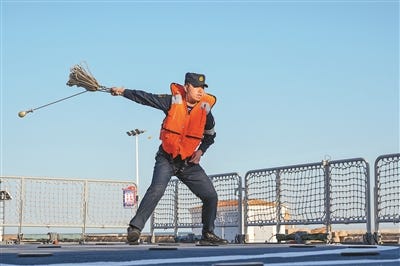
(A linesman throwing a cable to another ship. Image Source: PLA Daily)
Information Support Force
The newly created Information Support Force (ISF) receives plenty of coverage. This week’s PLA Daily article focuses on optimising expenditure by an unit of ISF to meet operational requirements. The examples cited in the article suggests that since its inception, the ISF is playing a larger role than simply performing the information support tasks of the erstwhile Network Systems Department of Strategic Support Force. This includes providing information collection, data and technical support, direct to the brigades and combat units across the theatre command. (PLA Daily. 17 Jul 2026. Page 5. Run the “First Leg” Well; Write the “Source Code” Right (跑好“第一棒” 写好“源代码”))
*Command, Control, communications, computers, Intelligence, Recce, Surveillance, (combat) support, (logistic) sustenance and Kill.
The erstwhile-Network Systems Department of Strategic Support Force, was responsible for communications from the CMC to the Theatre Commands, with the Information Assurance brigades providing network support at the Theatre Command level. Similarly Group Armies and brigades had their units. The examples cited in this article suggesting that the Force provides direct network and data support to brigades and units along with other articles in recent weeks, would mean that the Information Assurance brigades have been merged with the ISF and the ISF provides complete spectrum of C4IRS3K* support, facilitate ‘plug and fight’ and enable Multi-Domain Integrated Joint Operations at all levels.
Innovation in PLA
Innovation Studios
A PLA Daily article highlights the success of Innovation Studios in developing software/equipment to improve operational preparedness, such as integrated mission planning, situational awareness, and data retrieval software ‘Wings of Kunpeng’ (鲲鹏之翼) for Y-20 transport aircraft, and a “smart border control system” which integrates sensors, communication, and data analysis. To achieve this, innovation studios have been established at company, battalion and brigade level across the PLA services, where soldier innovators are provided guidance by mentors - senior NCOs, academicians, researchers and OEMs. Over the years, the levels of challenges being addressed has gone up and has helped the PLA to enhance its operational preparedness. Another article cites an intelligent battery charging systems which reduces workload while improving efficiency. (PLA Daily. 17 Jul 2026. Page 1. Gathering Sparks of Innovation to improve Combat Readiness(汇聚星火 创新向战). 13 Jul 2026. Page 10. A Special Wall of Honour(一面特殊的荣誉墙))
Space
China announces Open Source Standards for Space Systems
The Beijing University of Posts and Telecommunications has released China’s first open-source standard system for space operating systems. As against the current approach of ‘one satellite, one system’ and ‘one mission, one development’, the new regulatory system covers the entire value chain from user development and ground operations to on-orbit adaptation and industry-wide verification. To cater for complex space environments, the standards provides detailed specifications for on-orbit run times, kernels, and hardware abstraction, ensuring compatibility between diverse satellite platforms and payloads. The standards also cover the complete cycle of space computing—including access, operation, management, and verification unified standards, collaborative development, and large-scale growth. The standards will facilitate multi-satellite networking and multi-mission collaboration, standardization and control. (ST Daily. 13 Jul 2026. Page 7. Open-Source Standard for Space Operating Systems established (我国太空操作系统搭建开源标准底座))
While standards such as Unified Space Data Link Protocol by Consultative Committee for Space Data Systems exist, this is the first time, China has promulgated open source standards. The standards are comprehensive and comes at a time when China has a large number of players amongst State owned Enterprises and the private sector participating in Space sector and intends to become the largest operator of satellites. The unified standards will help Chinese satellites to form a cohesive integrated network and ensure redundancy, reliability and coverage at a scale not seen before.
4th National Defense Science and Technology Highland Forum Held
The 4th National Defence S&T Forum was organised by National University of Defense Technology, Academy of Military Sciences, and China Electronics Corporation, at Changsha on Jul 2026. The conference was attended by 19 academicians and 800 experts from both military and civilian sectors. The event included discussions on Earth-to-space transportation, mechanics and engineering challenges in extreme aerospace environments, high-performance inorganic fibers, advanced propulsion systems, and space-based IT. The Forum seeks to promote exchanges in the defense sector, facilitate cooperation across industry, academia, research, and application, advance integration of combat requirements with technical capabilities and support the development of a world-class military. (ST Daily. 13 Jul 2026. Page 3. Military and Civilian Experts Gather at Changsha to discuss Cutting-Edge Aerospace Technologies (军地专家齐聚长沙探讨空天前沿技术))
History
1962 Shooting Down of U-2 Recce Aircraft
PLA Daily articles often covers events of historical importance as a means of motivating all ranks. One of the articles published during this week covered the 1963 shooting down of U-2 recce aircraft. While the U-2 had a ceiling higher than 20,000 feet ( 70,000 feet), PLAAF aircraft could operate only at lesser altitudes. The article highlights some of the challenges faced in operating the S-75 Dvina in the aftermath of the 1959 Sino-Soviet split, such as filling the missiles with corrosive liquid propellant and how the PLAAF overcame them. It then highlights analyses of previous flight paths of U-2 sorties, once the missile guidance radar was activated. Based on the analysis, the tactics devised was to activate the missile guidance radar at the last possible second. The battalion successfully intercepted two U-2 aircraft amongst the five intercepted by PLA. (PLA Daily. 13 Jul 2026. Page 12. A Whistling Arrow Soaring in a Dream(梦里飞鸣镝))
That is all for this week, folks. Have a nice week ahead. See you next week.


