

Tracking the People's Liberation Army (PLA): 14th - 20th June, 2026
.png)
Global Governance
On 17 June, China released its White Paper on Global Governance titled, "More Just and Equitable Global Governance: China's Principles, Proposals and Actions." The White Paper highlights global challenges, and offers China's proposals for an equitable global governance system. The Paper identifies increasing geopolitical tensions, global economic fragmentation, climate change, digital divide, unilateral actions, deglobalisation and protectionism as some of the challenges faced by humanity. Highlighting weaknesses of existing global institutions such as UN such as inadequacy, lacking equitable representation and in need of improvement, the article calls for a new model of global governance which is ‘more inclusive, equitable, and sustainable’. It proposes Global Governance Initiative with five core concepts of sovereign equality, international rule of law, multilateralism, a people-centric approach and real actions, as the solution. The paper highlights China’s contributions such as safeguarding global peace within the framework of the UN, using unique approach to solve crises, promoting global development and supporting the Global South, and calls for developing consensus to improve global governance, ensuring an equitable multipolar world and inclusive economic globalization, with true multilateralism as the way forward and common values of humanity as the guide. Finally, the article calls for the global community to unite and act for the betterment of humanity and civilisation. Full text of the White Paper is available here.
Coming on a series of initiatives such as Global Civilisation Initiative and Global Development Initiative and unilateral US actions in Venzuela, Iran and elsewhere, the White Paper ticks the right words. The White Paper’s timing suggest now that China is now started its initial steps to change the global order. While changes to the global order will be long in the making, it remains to be seen whether the proposed order will be ‘inclusive, equitable and sustainable’ as China claims. If anything, Chinese actions in blocking reconstitution of UN Security Council, growing trade imbalance with other countries, increasing military assertiveness along its maritime and land border disputes, suggest otherwise. The question really is, are we going to have a more inclusive system or are we going to exchange one hegemon for another?
Combat Theory
Building an ‘intelligent’ Combat Ecosystem
Zhang Yi & Zhang Zhigang call for building joint operations capability system in the AI Era, by considering all combat elements as an organic ecosystem and dismantling structural barriers - such as data silos, functional fragmentation, and coordination failures - which hinder combat capabilities. This will facilitate upgradation of joint operations capabilities from a localized to system oriented-AI. They propose to do so by creating a open-architecture, systemic coordination across domains to synergise combat power, integrating diverse capabilities, autonomous organising capability and continuous learning. The system will facilitate all-domain awareness, enable cross-domain linkages, achieve smart resource sharing, and generate leap in systemic intelligence and transform combat paradigms. The authors call for top level design with unified architecture, building open platforms to pool capabilities, achieving breakthroughs in key technologies while balancing security and efficiency, innovative assessment mechanisms to drive combat validation and transforming mindsets to break away from ‘thinking in silos’. (PLA Daily. 18 June 2026. Page 11. Striving to Build an Intelligent Combat Ecosystem (着力构建智能作战生态))
Asymmetric Warfare in AI Era
Kong Rui argues that development of AI is profoundly reshaping the nature of warfare, in particular, asymmetric warfare employed by a weaker force to challenge a strong one. Rather than concentrating superior forces at critical times and locations and creating a local superiority, the author argues the need to gain algorithmic advantage by applying diverse units cohesively, rapid iterations to adapt to battlefield scenarios and multilayered security of the algorithms themselves. Secondly, he calls for shifting from manoeuvre in time and space to synchronisation across all-domains by creating an integrated, all-domain, command and control system. Lastly, he calls for shift from linear attrition to non-linear paralysis and destruction and shift to man-machine collaboration where humans and machines complement each other, have a clear division of responsibility and commanders who have interdisciplinary knowledge, can master AI technologies, and are capable of executing man-machine collaborative operations. (PLA Daily. 16 June 2026. Page 7. The Game Dynamics of Asymmetric Warfare Are Evolving非对称作战博弈机理正在发生变化)
Application of Tau Law* in Warfare
Wei Yijun & Chen Yonglong call for applying Tau Law to achieve victory in warfare. They suggest the underlying logic of Tau Law - prioritizing timing, aggregating systemic power, and winning through efficiency - aligns perfectly with the wisdom for victory. They call for a shift from spatial competition to temporal (time) competition by breaking the enemy’s rules, applying own strengths and avoiding weaknesses, unleashing the system’s effectiveness and improving efficiency, to upgrade ‘system of systems’ capabilities. (PLA Daily. 18 Jun 2026. Page 11. Grasping the Path to Victory through “Tau Law”(从“韬定律”中感悟制胜之道)
*With Moore’s Law, which calls for doubling the number of transistors in a chip every 18 months, reaching its limits in recent years, Tau (τ) Scaling Law has been proposed. Instead of increasing the number of transistors per unit area, it calls for developing innovative technologies to reduce signal delays to speed up semiconductors. The methodology has been applied in China’s latest supercomputer LineShine, which does not use GPUs. For a brief on Tau Law, see Huawei.
Transformation of S&T Research
Xu Qing calls for transformation of defence scientific research by shifting from ‘experience based preconceived ideas’ to ‘data and intelligence driven’ approach, from linear development approach to agile, responsive iteration and from ‘human-centric, machine assisted’ to 'man-machine collaboration’.(PLA Daily. 18 June 2026. Page 11. Accelerating the Transformation of the Scientific Research Paradigm (加速推进科研范式转型))
Weapons and Equipment Development
Zhu Fabao* calls weapons and equipment as the foundation of combat capability and calls for speedening the development of advanced weapons and equipment. He calls for keeping futuristic battlefield and the need to integrate combat requirements throughout the lifecycle of the weapon and equipment in mind, while developing them. To achieve this, the author calls for finding answers to questions such as “what kind of war, against whom, and how to fight,” to finalise the scale, structure, performance parameters of weapons and equipment, aligning battlefield requirements with the standards and prioritising combat effectiveness. The author calls for achieving breakthroughs in weapons technology to keep pace with cutting -edge technologies and be capable of operating in emerging domains of warfare. Finally he calls for driving innovation and systemic support for weapons and equipment. (PLA Daily. 18 June 2026. Page 11. Providing Robust Weaponry and Equipment Support for Advanced Combat Capabilities(为先进战斗力提供强大武器装备支撑))
*Likely to be Researcher at Systems Engineering Research Institute, Academy of Military Sciences.
Intelligentisation
Smart Barracks
A regiment of Beijing Garrison has adopted technology to reduce manpower commitments. By using infrared sensors and thermal imaging cameras, along with biometric access control, the regiment has improved security while reducing manpower commitments. Human guards are still posted at sensitive locations like armoury. The system has stabilised and has withstood weather conditions and human errors. Other areas of intelligentization include kitchen where sensors monitor consumption and storage conditions and provide recommendations, ammunition depot for calculation of vehicle loads for shifting of ammunition, and the Physical Training Ground to monitor performance and record results. The Challenge - changing the mindset that ‘manpower’ translates into safety and stability. The Regimental Commander’s parting words that freeing troops from redundant administrative tasks so that they focus on combat training and enhance their professional skills is a call which many armies need to absorb. (PLA Daily. 20 Jun 2026. Page 3. A regiment of Beijing Garrison implements “external sentry + intelligent monitoring” model(北京卫戍区某团推行“外部哨兵+智能值守”新模式))
Training
Streamlining Training at Naval University of Engineering
A series of articles cover the streamlining of training at Naval University of Engineering to ensure that trainees can step into their operational roles with ease. The changes include more-practical oriented curriculum along with a layered, progressive, simulated battlefield environment and refined assessment system which rates command proficiency and ability to handle battle field contingencies. The model calls for training academies to visualise future warfare and translate operational requirements and gaps into training, innovate training by emphasising on combat case studies and tactics, and simulating real-world scenarios. The new integrated simulator not only enables individual skills to be practiced but operate as a crew. The fourth article discusses about the actual streamlining process. Apart from refining the syllabi, the teaching team interacted with submarine crew and formations to identify the requirements of a submarine simulator and designed a simulator which replicates a submarine’s interior environment and operational procedures, along with portable training units for submarine handling and support systems. This facilitates customised, specific and immersive training for specific battle stations as well as the complete crew. The revised model has been found successful and is being implemented across other PLAN institutions. (PLA Daily. 15 June 2026. Page 5. Bridging the Classroom and the Battlefield: Ready for Duty Upon Graduation(课堂通战场 毕业即上岗). Synergy Between Combat Training and Education Fortifies the Strategic Pivot for Strengthening the Military and Cultivating Talent (战教耦合筑牢强军育人战略支点). Calibrating the Direction of Instruction Amidst the “Wind and Waves” (在“风浪”中校准教学方向) Innovating for Combat Readiness: A Flagship Course Ventures into “Deep Waters”(向战而新:一门精品课潜入“深水区”))
Modernising NCOs Education
Three articles from different service academies highlight modernisation of NCOs Education. The first one covers the two year Pilot Programme for Modernising NCOs Education. The pilot programme conducted at National University of Defense technology and Aviation Maintenance NCO School of the Air Force Engineering University, is aimed at developing highly skilled technical personnel with strong theoretical knowledge and excellent technical skills and are capable of solving complex technical challenges independently. Through case studies, the article highlights the creation of solid technical foundation, integrating with other specialisations, training on the latest technologies and practical application of skills, amongst NCOs. In recognition of their capability, NCOs are now awarded a Bachelors degree instead of an Associate Degree (Diploma). The second one highlights an NCO of NCO School of Space Engineering University, whose project won the first position in Beidou Space-Time Intelligent Application Development Competition. The Third article looks at NCOs Education at the Naval Petty Officers School. The School has innovated a 3 stage teaching model where NCOs with strong practical skills are empowered to self-study, practical application and problem solving and finally, the ability and confidence to solve problems independently. (PLA Daily. 16 June 2026. Page 11. Sergeant cadets put on their bachelor’s graduation gowns.(军士学员穿上学士服). Boldly Breaking Boundaries and Forging a New Path(勇敢跨界突围). “Return the initiative in learning to the learners.” (“把学习主动权交还给学员”))
R&D and Training by Air Force Early Warning Academy
An article on Air Force Early Warning Academy highlights the changes in selection and development of research projects. Based on requirements projected by units through PLAAF HQ, the Academy now conducts courses and selects Research Projects, whose results are validated by operational units. The Academy reaches out to the units where the equipment is to be finally deployed, to identify parameters, obtain inputs, validate the equipment prior to induction and finally post-induction evaluation of the equipment. Some of the systems developed by the Academy includes system for generating alternate deployment locations along with routes, based on mission parameters; another system for logistic moves and a new interface for counter-UAS system*. (PLA Daily. 15 June 2026. Page 3. Eyes Fixed on the Skies: A Report from the Air Force Early Warning Academy(投向空天的目光))
*The article does not clarify whether the complete system was developed by the Academy.
Space
Space Warfare
The PLA Daily carried a set of four articles about Space Warfare by researchers from the Space Security Research Centre of Space Engineering University. Feng Songjiang, and Wang Xiaoyan cover the $ 4.16 billion contract for Space-Based Airborne Moving Target Indicator to SpaceX last month. The authors argue that Low Earth Orbit(LEO) constellations are integrated into operational tasks reconnaissance & surveillance, data relay and precision strikes and have become key enablers in modern battlefield. This has resulted in serious competition and accelerated deployment of constellations by various countries in LEO. The constellations themselves will reshape tactics by expanding unmanned operations, strengthening command and control (C2) networks and reshaping the kill chain. The authors call for a consensus to restore peace in space, a global common. Chen Ning and Cai Zucheng from the same Centre highlight the role of LEO constellations with their advantages such as low latency, high bandwidth, broad coverage, and high survivability are key enablers of Unmanned Aerial Systems (UAS) operations by providing situational awareness, enhancing range, improving communication and enhancing survivability. Wang Xiaoyan and Zhang Tingting cover the Japanese Tri-Sat constellation which will provide targeting data from SAR and optical images and enable stand-off defence capability of the Japanese Self Defense Forces. Integrated with US capabilities, the article claims that Japan’s launch of constellation will erode regional security and mutual trust. The fourth article covers three issues specific to LEO. One, LEO slots are a scarce resource, where satellites must maintain a separation of several 10s of kilometres. Going by the ITU’s ‘First-come, First-served’ rule, the first country to occupy the slots has an advantage and hence there is increasing competition for the same. Second, it discusses the US Space Force’s Sustained Space Manoeuvre (SSM) concept which calls for equipping satellites with unpredictable orbital manoeuvre capability which will not only enhance survivability but also enable offensive action. Hence, the authors argue that space will become a warfighting domain. Third, is the Russian Volna Kupol Garant Electronic Warfare Systems which can deny starlink commmunications in an area of 10 kilometre radius, adding the system has vulnerabilities such as short range necessitating close-deployment to the enemy and hence vulnerability to enemy counter measures. (PLA Daily. 15 June 2026. Page 8. The Era of Militarized Applications for Low-Earth Orbit Constellations is Approaching (低轨星座军事化应用时代加速到来). LEO Constellations Empower Unmanned Combat Operations(低轨星座赋能无人作战). “Satellite Constellation” Strips Away Japan’s “Exclusively Defense-Oriented” Facade(“卫星星座”撕下日本“专守防卫”伪装). Insight Brief(认知小站))
The article is notably silent on Chinese plans to launch more than 2,44,000 satellites in the LEO over the next decade. In Dec 2025, China filed for more than 2,00,000 satellites in 154 constellations in LEO. This includes CTC-1 and CTC-2 which comprise 96,714 satellites each, filed by a newly established Institute of Radio Spectrum Utilization and Technological Innovation, based in Tianjin. Under the ITU’s rules, China must launch its first satellite within seven years, 50 per cent within 12 years and the remaining within 14 years. The other competition is in terms of radio spectrum. A successful launch will deny others the spectrum which the constellation uses. While the Institute claims it is for civilian communication, the nature of Chinese governance and Military-Civil Integration will ensure that the constellations comply with Chinese requirements prior to and during war. Simply by occupying these slots, China would be dominating roughly 80 per cent of the planned launches to LEO, over the next decade.
Satellite Launches
There were four satellite launches this week. On 15 Jun 2026, Jixing Gaofen-07C04 was launched onboard a Lijian-1 rocket along with seven other satellites from Dongfeng Commercial Space Innovation Test Zone. The other seven satellites include Anxi Tieguanyin-2 satellite—jointly developed by Chang Guang Satellite and CAS StarBridge to serve Fujian’s tea industry; Wenwu-01 satellite developed by National Cultural Heritage Administration (NCHA) and Chang Guang Satellite Technology Co, dedicated to cultural heritage protection; the Caiyun Optical-01 satellite; and Lichuan Hong satellite. A Global Times report suggests that the Wenwu-01 will link with Jilin-01 constellation to provide remote sensing data. (PLA Daily 16 Jun 2026. Page 2. Eight Satellites including Jixing Gaofen-07C04 Successfully Launched (我国成功发射吉星高分07C04星等8颗卫星))
The same day, a Long March-3B carrier rocket successfully launched a Shijian-31 satellite from the Xichang Satellite Launch Center. The Shijian-31 satellite is primarily used for space environment exploration.(PLA Daily. 17 June. Page 2. Shijian-31 Satellite Successfully Launched (我国成功发射实践三十一号卫星))
On 17 Jun 2026, a Long March-12 carrier rocket launched from Hainan Commercial Spacecraft Launch Site, placed 22 satellites in LEO for satellite internet services. (PLA Daily. 18 Jun 2026. Page 3. 22 LEO Satellites Successfully Launched to provide Satellite Internet services(我国成功发射卫星互联网低轨22组卫星))
On the same day, a Kuaizhou-11 rocket successfully placed, successfully placed Weili Kongjian-05* satellite group in the orbit. The rocket was launched from Jiuquan Satellite Launch Centre on 17 June 2026. (PLA Daily. 19 Jun 2026. Page 3. Kuaizhou-11 Y13 Carrier Rocket Successfully Launched (快舟十一号遥十三运载火箭发射成功).
*Weili Konjian(CentiSpace) is a 240 satellite constellation by Shandong Future Navigation Technology Co., Ltd which will augment Beidou satellite navigation to achieve centimetre-level 3D spatial accuracy. The firm plans to deploy 120 satellites by end of this year. The previous set of 10 satellites were launched in March 2026. The satellites are supported by ground station located in Jinan. While the system is expected to help in autonomous driving, its centimetre level accuracy will be invaluable in military targeting. Apart from augmenting navigation, the system is expected to conduct experiments in ionospheric data collection, and inter-satellite laser networking communication.
International Cooperation
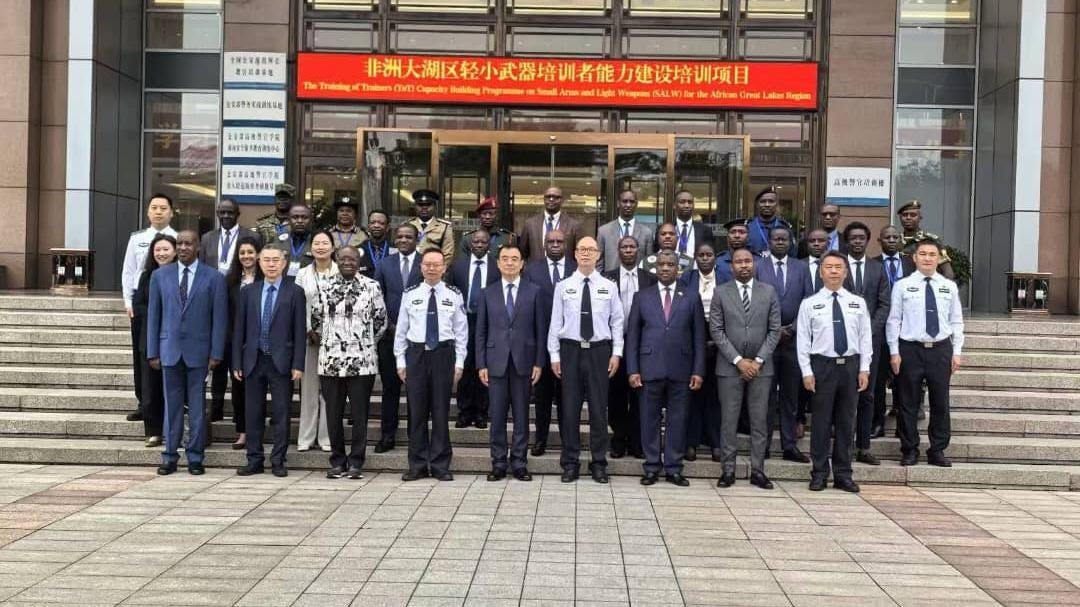
(Participants at the ‘Training the Trainer’ programme on management of small arms and light weapons (SALW). Image Coutesy: UN OSEGL)
Course on Control of Small Arms and Light Weapons
The UN Office of the Special Envoy of the Secretary-General for the Great Lakes Region (OSEGL) along with China, organised a ‘Training the Trainer’ programme on management of small arms and light weapons (SALW) at the People's Public Security University of China, Beijing from 8 to 28 June 2026. The training aims to strengthen national and regional capacities in arms control, weapons and ammunition management, diversion prevention, and security cooperation. Security and defence officials from the five African Great Lakes countries of Burundi, DRC, Rwanda, Tanzania, and Uganda, participated in the programme. The programme is supported by China and UN Peace and Development Fund. (PLA Daily. 17 June 2026. Page 4. China-UN-Africa Training Course on Small Arms and Light Weapons Control Capacity Building Launched (中国—联合国—非洲轻小武器管控能力建设培训班开班))
Eurosatory Defence and Security Expo
Nearly 50 Chinese companies took part in Eurosatory 2026 Defence and Security Expo held at Paris from 15 to 19 June 2026. NORINCO showcased its BZK-005E MALE UAS, FL-60A Loitering ammunition, CY-8 heavy lift drone, GAS-8 and GAS-9 multilayered AD systems. (Zona Militar. 18 Jun 2026. NORINCO led China’s presence at Eurosatory 2026 with its unmanned aerial systems, from the BZK-005E UAV to the FL-60A loitering munition. SCMP. 16 Jun 2026. China showcases anti-drone air defences at Paris show as conflict fuels demand)
Unlike other defence expos such as World Defense Show at Saudi Arabia where more than 200 companies participated, the number of participating companies was relatively less. As per inputs the stalls had models displayed instead of inert systems and functional equipment as is usually the case. This is probably due to lesser likelihood of Chinese companies breaking into the European market.
That’s all for this week, folks. Hope to catch up with you in next week’s newsletter. Have a nice weekend.
This weekly newsletter is first published by the author on platracker.substack.com and subsequently republished on the CNAWS website.


