


Tracking the People's Liberation Army (PLA): 19th - 25th July, 2026
.png)
Visit of Thailand PM to China
The Thai PM Anutin Charnvirakul visited China from 16 to 20 Jul 2026 and met President Xi Jinping, Premier Li Qiang and NPC Chairman Zhao Leji. The Joint statement issued at the end of the visit calls for establishment a 2+2 (Foreign and Defence ministers) strategic dialogue mechanism, strengthening defence cooperation, enhancing cooperation against trans-national crimes and infrastructure development. Thailand has also agreed to complete the first phase of China-Thailand High Speed Railway (HSR) between Bangkok and Nakhon Ratchasima by 2030. (Thailand MFA. 21 Jul 2026. Joint Statement between the Government of the Kingdom of Thailand and the Government of the People’s Republic of China towards a Thailand-China Community with a Shared Prosperous Future)
The visit strengthens China-Thailand cooperation in multiple areas, especially defence, crime prevention and BRI. The increasing defence cooperation comes at a time when US support for Thailand has reduced despite being Thailand being a Treaty partner since 1954. Cooperation in crime prevention will reduce transnational crime such as credit card scamming, illegal property acquisition and human trafficking, which are of critical importance to both countries. The China - Thailand HSR is a BRI project and will connect Kunming with Bangkok through Laotian capital of Vientienne. Subsequently, the line will be extended to Malaysia and Singapore. With Phase Two connecting Nakhon Ratchasima with Nong Khai near the Laos-Thailand border by 2031 and Phase 3 from Nong Khai to Vientienne not yet been approved, completion will take time. Nevertheless, Thailand’s announcement will provide greater clarity on the project.
Japan’s Rearmament
Japan’s Quest for Unmanned Systems
Monday’s PLA Daily carried four articles highlighting unmanned systems programme of the Japanese Self Defense Forces(JSDF). The first article covers the establishment of Unmanned Defense Capability Promotion Office and Unmanned Systems Office within the JSDF, and investment of over ¥ 1 trillion between 2023 and 2027 to develop unmanned systems, including a multi-layered coastal defense system SHIELD. The remaining articles highlight the shift from defensive to offensive systems, Japan-US cooperation and Japan-Ukraine cooperation on unmanned systems. The articles call on the international community to prevent Japan’s military buildup. (PLA Daily. 20 Jul 2026. Page 8. Japan Develops Unmanned Combat Forces to Seek “Asymmetric” Advantage(日本发展无人作战力量谋求“非对称”优势). Beware of Japan developing unmanned combat capabilities and advancing “remilitarization”.(警惕日本发展无人战力推进“再军事化”). A Look at Japan-US Cooperation in Unmanned Combat (透视日美在无人作战领域的勾连与合作). Cognitive Station(认知小站))
Discussion of Nuclear Deterrence
Chinese media called the Japanese Defence Minister Shinjiro Koizumi’s call for discussion on national security including nuclear deterrence, as a serious provocation against Post World War II order. The article highlights that Japan was an initiator of World War II, resulting in immense suffering in the Asia-Pacific. Calling PM Sanae Takaichi’s attempts at rearmament as a violation of Japanese and international law, the article called on the international community to resist the same. The PLA Daily covered the criticism against Koizumi’s remarks by Satoshi Tanaka, Secretary General of Liaison Conference of Hiroshima Hibakusha (Atomic Bomb survivors) Organizations. (PLA Daily. 24 Jul 2026. Page 4. Representatives of Hiroshima NGOs Criticize Japanese Defense Minister’s Nuclear-Related Remarks(广岛民间团体代表批评日防卫大臣涉核言论) 25 Jul 2026. Page 4. Beware of Japan’s nuclear ambitions behind Koizumi’s “outrageous remarks”(警惕小泉“狂言”背后的日本核野心)).
Chinese media has been vocal against Japan’s rearmament and have selectively highlighted divergent views prevalent in democracies to support its arguments. However, they remain silent on China’s military modernisation, which is causing concern amongst its neighbours.
South China Sea Clashes
The week witnessed three clashes between Chinese Coast Guard (CCG) and Philippines Navy in South China Sea. On 20 Jul 2026, a CCG rigid hull inflatable boat approaching the grounded BRP Sierra Madre* at the Second Thomas Shoal(known as Ren'ai Jiao in China and Ayungin Shoal in the Philippines) was repulsed by Phillipines Navy boats, in which one Filipino personnel was injured. While the Philippines President summoned the Chinese Ambassador, Foreign Affairs Secretary, Theresa Lazaro protested to Chinese Foreign Minister Wang Yi, who was attending the ASEAN Foreign Ministers Meeting at Manila. The remaining incidents took place at Scarborough Shoal (known as Huangyan Dao in China and Panatag Shoal or Bajo de Masinloc) when two Philippines vessels were repulsed on 23 Jul and seven Philippines government vessels, three coast guard ships and one fish carrier from Philippines were repulsed on 24 Jul.
*BRP Sierra Madre was run aground by Philippines in 1999 to serve as an outpost.
Scarborough Shoal is claimed by China, Philippines, Taiwan and Vietnam and the Second Thomas Shoal is claimed by China, Brunei, the Philippines, Malaysia and Vietnam. The 2016 award by an arbitration tribunal concluded that China’s claims to ‘historical rights’ within South China Sea were incompatible to the extent that it exceeded the limits provided under UNCLOS. Further, it declared the Scarborough Shoal as a rock i.e. a high tide feature and the Second Thomas Shoal as a low tide elevation (P 174), meaning that it did not create an EEZ on its own. The tribunal did not rule on the sovereignty of the Scarborough Shoal. China neither participated in the arbitration proceedings nor has accepted the tribunal’s conclusion.
Training
Joint Live Firing Exercise
A PLA Daily article covered preparations for a forthcoming joint live firing exercise between units deployed across hundreds of kilometres. The article highlights that Acceptance Testing of joint land, sea and air training base has been completed. Going by Taiwanese Researcher Joseph Wen’s X post last year, the PLA’s only Joint Training Base (三军联合登陆训练基地) is located at Dongshan Islands, off the coast of Fujian. On 22 Jul 2026, China Maritime Safety Administration (CMSA) issued a Notice to Mariners announcing live fire exercises near Dongshan islands on 23 and 24 Jul 2026. (PLA Daily. 25 Jul 2026. Page 3. Deepening the “Naval Warfare Testing Ground”(深耕“海战试验田”). Global Times. 23 Jul 2026. Taiwan Straits live-fire drills are routine warning to separatists, expert says, as Fujian issues maritime alert)
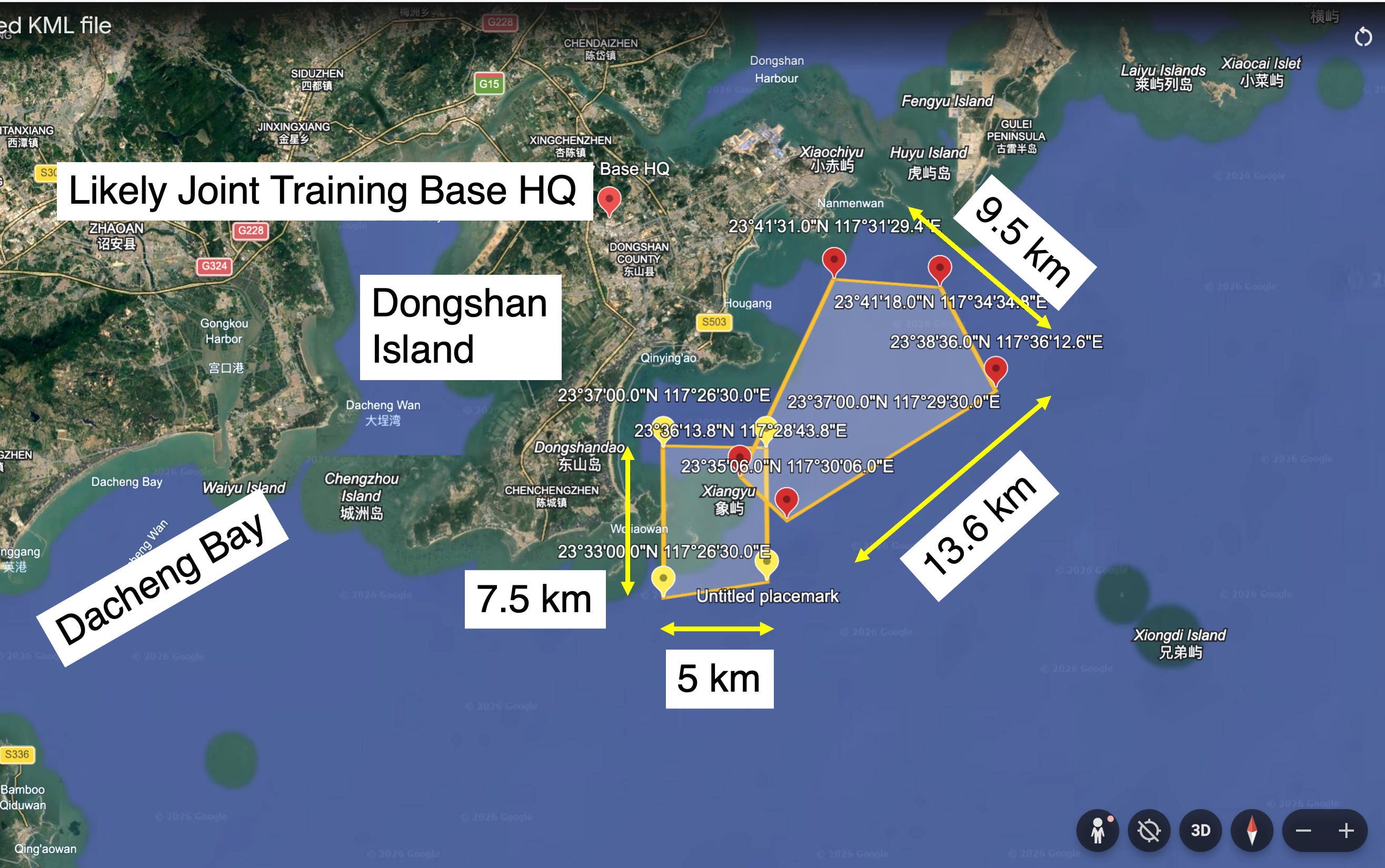
(Image Source: Google Earth)
Dongshan Island was captured by PLA in 1950 and two subsequent Taiwanese attempts to retake the island in 1953 and 1965 were defeated. PLA has used this island for amphibious training since 1995, including during Exercise Justice Mission-2022. The current notified area falls within the territorial waters of mainland China. The size of the notified areas (7.5 km by 5 km and 13.6 km by 9.5 km), restricts the quantum of troops to an amphibious battalion and firing by amphibious infantry fighting vehicles, artillery (with restrictions), helicopters and short range air defence systems. With the acceptance testing of Joint Training Base at Donghshan, this area and the adjacent Dacheng Bay are likely to witness more joint exercises in future, albeit in greater scale and complexity.
Submarine Rescue Training
The Type 926 Submarine Rescue Ship Yangchenghu (Hull 847) and ccean going tug boat Beituo 739 participated in a submarine rescue exercise conducted in the Yellow Sea recently. The exercise involved detection and identification of the submarine at a depth of 70 metres, escape of its personnel by deep submergence rescue vehicle launched from Yangchenghu, repairs, flotation to surface and towing to base. (PLA Daily. 21 Jul 2026. Page 4. Establishing a “Lifeline” in the Deep Ocean (大洋深处架设“生命通道”))
PLAN lays special emphasis on submarine rescue training after the 2003 loss of Ming III class submarine, in which 70 crew members were lost. The Yanchenghu had participated in submarine rescue during the recent Sino-Russian Exercise Joint Sea 2026 submarine rescue though details were not publicised and belongs to the Northern Theatre Command Navy.
Combat Search and Rescue
An unidentified regiment of Naval Aviation University conducted a combat search and rescue exercise. Under cover of a combat air patrol which provided continuous updates on the air situation, the rescue helicopter rescued the ‘downed’ pilot who had landed midway up a cliff. The ‘enemy’ ground search team was engaged by a fighter strike formation. (PLA Daily. 25 Jul 2026. Page 2. Reinforcements Descend from the Cliffside (崖壁之上 援兵天降))
Operations
PLA Activities in Taiwan Straits
There were total of 80 sorties by PLA aircraft (Fighters, bombers, support aircraft, helicopters and UAVs along the Taiwan Straits, of which 18 sorties crossed the median line. The largest number was 29 sorties on 24 Jul 2026, of which 19 crossed the median line. A new trend observed was the use of helicopters. A total of 11 helicopter sorties* were conducted along the Straits and to the North, South and South East of Taiwan with increasing distances and endurance especially towards the South East of the Island. One of the helicopter sorties on 21 Jul 2026 was accompanied by an UAV and flew for more than 9 hours. Data Source: Taiwan Ministry of National Defense (https://x.com/MoNDefense)
*The figure does not include combined sorties (fighter, support aircraft, helicopters and UAVs) for which category-wise breakdown is not available.
The PLA considers its Army Aviation as a combat arm rather than a combat support arm. With a large fleet of medium lift helicopters such as Mi-17 and Z-20, it has substantial heli-lift capabilities. Apart from making up the shortfall of amphibious lift capabilities, the Army Aviation can support PLA operations across the Taiwan Straits by landing troops in depth and providing fire support. PLA is experimenting with both tactics and technology to address these challenges, including manned-unmanned teams of helicopters and UAVs, to launch airstrikes.
Sino-Russian Joint Naval Patrol
Four Russian and PLAN ships are conducting a joint patrol around Japan. The Japan Joint Staff announced that as on 21 Jul 2026, the Russian Steregushchy-class corvette Rezkiy along with Chinese Type 55 Destroyer Anshan (Hull No 103), Type 52D destroyer Kaifeng (Hull No 124) and Type 903A comprehensive replenishment ship Kekexilihu (Hull No 903) were moving South East of Japan. The joint patrol had commenced after Exercise Joint Sea-2026 between the navies of both countries, terminated on 13 Jul 2026.
Orbat
Yushu Independent Cavalry Company(玉树独立骑兵连)
A PLA Daily article highlights an Independent Cavalry Company attached to an unidentified brigade of 76 Group Army. The company is located in Batang Grasslands (巴塘河国家湿地公园) near Yushu city. The company was raised in 1949 and was awarded the battle honour ‘Model Company for Ethnic Unity on the Plateau’(高原民族团结模范连). (PLA Daily. 24 Jul 2026. Page 2. There is a “PLA Road” on the Batang Grasslands.(巴塘草原有条“金珠玛米路”))
The PLA retains few cavalry units, primarily in Inner Mongolia, Xinjiang and Tibet to cover areas with rough terrain and with few Rocket Force units for local security. These units are likely to be composed, primarily of ethnic minorities along with few Han Chinese. Coverage of Battalion Commander’s interview suggests that this brigade is likely to have a cavalry battalion with Yushu Cavalry Company being an independent company. Based on its orbat under 76 Group Army and its current location, which is more than 400 kilometres from the LAC in Arunachal Pradesh, it is likely that the company is deployed for domestic stability and disaster relief in the Tibetan grasslands during peace and are employed as scouts and reconnaissance, during war. These units are equipped with drones and Beidou terminals to enhance their capabilities.
Administration
Code of Conduct and Professional Ethics for Military Audit Issued
PLA recently issued Code of Conduct and Professional Ethics for Military Audit (军队审计职业道德行为规范). The code lays down guidelines for professional conduct, and will play a crucial role in ensuring quality of audit, preventing corruption, and improving efficiency. The regulation is in three parts and covers 11 aspects including positive benchmarks and negative behaviour. The regulations will be integrated in education and training, inspections, and performance evaluations. (PLA Daily. 21 Jul 2026. Page 1. Code of Conduct and Professional Ethics for Military Audit issued(军队审计职业道德行为规范出台)
Organisational Culture
A number of articles in the PLA Daily, highlight changes in inspection procedure of units. One article on a detachment of Tianjin Armed Police highlights the shift to 'no-prior notice, on-site' inspections with random checks and impromptu drills to identify issues and rectify them. Another highlights the revised system adopted an unidentified brigade of PLA Rocket Force, where minor issues are rectified in situ while recurring issues in the unit are addressed by a member of the brigade’s Party committee staying in the unit’s barracks to identify the root causes and work out solutions with the troops. The third article highlights the case of an unidentified regiment of Xinjiang Military District, where case of an unidentified regiment of Xinjiang Military District where the regiment and the units have streamlined their procedures to rectify issues and avoiding protraying units in negative light. (PLA Daily. 24 Jul 2026. Page 1. Take off your shoes, go to the fields, and get down to the front line to do practical work.(脱鞋下田到一线 扑下身子干实事). Page 8. Provide more services, issue less notices, and offer genuine guidance and support.(多服务 少通报 真帮带) 21 Jul 2026. Page 8. How Should Grassroots Units Respond to the Changing Work Style of Headquarters?(机关转作风,基层该咋办))
The steps taken above are part of the PLA’s endeavours to improve functioning and quality of life at the battalion level and below. While these units are bottom of the organisational pyramid, they form the cutting edge of the PLA’s combat capabilities. Cumulatively, these measures along with others will improve the operational efficiency of the PLA.
Personnel Management
This week’s PLA Daily articles highlight some of the challenges with respect to personnel and how PLA is addressing them. One article highlights the case of a staff officer of an unidentified brigade of 81 Group Army, who felt that he had ruined his chances of promotion after an unsuccessful application for lateral transfer and was surprised when he was selected for promotion. The brigade announced that it considered officers exploring opportunities outside, as a healthy sign and is proactively assisting officers for training and identifying suitable opportunities, based on their specific situation. Another article highlights that newly inducted soldiers are better educated and tend to question rationale behind actions and decisions. It calls for providing answers wherever feasible, emphasising that this will promote greater compliance to orders. The third article highlights the case of a soldier from Eastern Theatre Navy who understood how to operate a newly inducted system and was asked to train senior NCOs. (PLA Daily. 23 Jul 2026. Page 8. Allow New Recruits to Ask “Why” More Often (允许新兵多问“为什么”). 24 Jul 2026. Page 7. Releasing “talented horses” and wishing for “phoenixes to return to their nests” (既放“千里马”,也愿“凤还巢”) Long service doesn’t mean you know everything (兵龄长,不代表啥都会))
The changes come at a time when the PLA faces challenges in developing and retaining quality human resources. Some of the reasons for soldiers quitting include restrictive rules, which are being rectified.
Space
Gravity 1 launches Nine Satellites
A Gravity-1 (Yinli) successfully launched nine satellites from a sea based launch pad off the coast of Shanghai on 22 Jul 2026. The satellites include Dongpo-13, 14, 17-20, Xiguang-2 01, Tianyi-49, and Zidingxiang-3. (PLA Daily. 23 Jul 2026. Page 3. Gravity-1 rocket successfully launched (引力一号遥四运载火箭发射成功))
Tianlian-2 Satellite Launched
A Long March-3 rocket launched successfully launched a Tianlian-02 satellite from Xichang Satellite Launch Centre on 23 Jul 2026. The satellite will be shifted to the geosynchronous orbit from where will provide data relay and telemetry services for space station, manned spacecraft and satellites in LEO and MEO, and telemetry support for satellite launches. (PLA Daily. 24 Jul 2026. Page 3. Tianlian-2 06 Satellite successfully launched(我国成功发射天链二号06星))
The satellite is part of China’s second generation of tracking and data relay satellites of which five have already been launched into GEO. The satellite will enhance China’s capability to monitor, control and exploit China’s growing fleet of satellites, improve space based communication capabilities and provide redundancy. It is manufactured by China Academy of Space Technology.
Launch of Five Satellites
A Lijian-1 rocket successfully launched five satellites from the Dongfeng Commercial Aerospace Innovation Test Zone at Jiuquan on 24 Jul 2026. The five satellites are Tianyi-48(Chenguang-1), Gande-1, Xiguang-2, Jitianxing A, and Yinglong Fengguang-1. (PLA Daily. 25 Jul 2026. Page 1. Five Satellites Including Tianyi-48 successfully launched (我国成功发射天仪48星等5颗卫星))
The Tianyi- 48/Chenguang-1(辰光一号) will validate key technologies for establishing Space based data centres. The Beijing Orbit Chenguang Technology consortium comprising of 30 firms, plans to establish a 200 teraflops space based data centre with 64 MW of power by 2030.
The Gande-01 is part of a constellation of 120 satellites which will monitor space debris in in LEO, MEO and HEO, and is expected to be completed by 2030. The satellite carries a camera to monitor tiny space debris and is equipped with an AI-enabled onboard computer which helps to perform routine monitoring, emergency response and speedy tracking. It is also equipped with an innovative propulsion system to shift orbits and perform close observation.
The Xiguang-2 is a hyperspectral and optical remote sensing satellite with in-orbit intelligent processing capabilities. The satellite has a spatial resolution of 10 metres and spectral resolution of 7 nanometres and can cover 1 million square kilometres in one day.
Jitianxing A is an earth observation satellite equipped with AI-enabled processors, routers and laser communication devices and is capable of autonomous health management, task planning in-orbit data processing without ground support.
Yinglong Fengguang-1 is an earth obervation and scientific experiments satellite equipped with an IR camera and humidity sounder for weather forecasting and early warning for disasters.
Defence Cooperation
Mission Harmony 2026
PLAN’s hospital ship Auspicious Ark (Hull No 868) departed on its first overseas mission from Qingdao on 22 Jul 2026. Over the next seven months, the ship will visit African and South Asian countries and provide medical assistance. The ship is equipped with 18 clinical departments and five auxiliary diagnostic units, spanning general surgery, orthopedics, obstetrics, gynecology and ophthalmology. The medical personnel are drawn from Northern Theatre Command Navy, Naval Medical University and other units. (China Daily. 22 Jul 2026. Chinese navy hospital ship sets sail for humanitarian medical mission in Africa, South Asia)
The PLA Navy has conducted the Mission Harmony series since 2010. Commissioned in 2025, the Auspicious Ark is a Type 920 class Ocean going Hospital ship and is the third of its class. Apart from defence diplomacy, PLAN’s hospital ships provide medical cover to amphibious troops during conventional operations and troops deployed in remote islands such as in South China Sea and Humanitarian Assistance and Disaster Relief.
Naval Task Force visit to Brunei
A PLAN flotilla consisting of training ship Qi Jiguang (Hull No 83) and the Type 71 landing ship Kunlunshan (Hull No 998) are visiting the Brunei port of Muara from 24 to 28 Jul 2026. The 900 plus cadets and service personnel are predominantly drawn from the PLA Naval Academy at Dalian and includes nine officers from friendly foreign countries including South Korea, Vietnam and Bangladesh. The mission is designed to enhance cadets' navigation skills, professional competence, and overall capabilities. (PLA Daily. 24 Jul 2026. Page 4. Mixed Training Between Chinese and Foreign Cadres Deepens Friendship(中外学员混编同训深化友谊) China Daily. 21 Jul 2026. PLA Navy flotilla departs on far-seas training mission)
That is all for this week, folks. Have a nice week ahead.


