What is Algorithmic Warfare?

1. Introduction
Warfare has closely evolved with humanity as a result of survival needs. With the evolution of human beings, the means and methods of waging war, advanced. Technological innovation has been a cornerstone in the transformation of warfare since eternity. Gunpowder revolutionized medieval wars, industrialisation mechanised armies and during the Cold War nuclear weapons redefined strategic deterrence. Today, AI represents the latest military advancement. AI seeks to improve how militaries collect information, make decisions and coordinate operations. This starkly differs from earlier advancements that were primarily rooted in increasing destruction capability.
Modern battlefields are complex, often fluxed with enormous data. AI offers swift decision making by reducing processing time and surpassing complex-layered hierarchical authorisation structures. Modern wars require a reduced OODA loop and timely decision to gain decisive edge in the battlefield.
Recent conflicts have proved that algorithmic warfare is no longer a theory. The US had used the Maven Smart system to identify, track and engage targets in the recent Iran-Israel-US war. Likewise, Ukraine has also used AI driven FPV drones to autonomously engage amid signal interferences. Israel uses systems like Gospel, Lavendar and "Where’s Daddy" to track, target and surveil potential threats. China is consistently modernising the PLA and building capacity for algorithmic wars through its ‘Intelligentized Warfare’ doctrine by 2050.
For India, algorithmic warfare holds significant strategic importance. The country's tantalizing security environment is characterised by an unresolved boundary with China, continuous tensions with Pakistan, maritime competition in the Indian Ocean and evolving cyber threats. These challenges require faster intelligence processing and integrated command systems. Thus, AI becomes an essential component of India's defence modernisation strategy.
2. Definition and Scope
The term emerged from the U.S. Department of Defense’s Project Maven launched in 2017 as the Algorithmic Warfare Cross-Functional Team under the aegis of Robert O. Work. There isn’t any single universally accepted definition of algorithmic warfare.
Algorithmic warfare refers to the use of artificial intelligence, machine learning and data analytics for military decision-making support. AI learns from data, recognises patterns, and recommends adaptively under changing circumstances without following predefined instructions like conventional automation.[1]USA’s Maven Smart System, Israel’s Lavender and Gospel systems or Palantir’s Meta Constellation platform are examples of such systems deployed in active conflicts for precision targeting.[2]
Peter Layton describes, “Algorithms are the sequence of instructions and rules that machines use to solve problems. They transform inputs to outputs and as such are the crucial conceptual and technical foundation stone of modern IT and the new intelligent machines”.[3]
Martin Klein, Vice President of Analytics and Artificial Intelligence at Everforth ECS federal defines, “Algorithmic warfare, the integration of advanced algorithms into military operations to enhance decision making (across the warfighting functions of intelligence, maneuver, fires, logistics, and C2 systems), represents the cutting edge of this data-driven approach”.[4]
The program relies on machine learning to process the huge volume of surveillance drone footage. Instead of manually reviewing videos, analysts receive AI-generated identification of vehicles, infrastructure and other military assets. This reduces workload, speeds up intelligence analysis and retains human oversight. Algorithmic warfare is best understood as a decision-support ecosystem across the operational cycle rather than autonomous warfare. Humans authorise operational decisions, especially those involving lethal force.[5] AI supports them by processing information beyond human speed and capacity.
The scope of algorithmic warfare covers Augmented Decision Making, Automated Response Systems, Integrated Warfighting Systems and Resource Optimization.[6] Its applications span the military spectrum. Intelligence agencies use AI to analyse satellite imagery, intercept communications and open-source intelligence. Command systems use data from various sensors to create a common operational picture. Predictive analytics is used in logistics for maintenance and supply chain management, while cyber defence applies AI to detect intrusions and abnormal network activity.[7]
3. Historical Development
The evolution of Algorithmic warfare represents decades of technological and doctrinal change. In modern, information-intensive warfare, collecting information alone does not guarantee battlefield success. The decisive advantage lies in analysing information faster than an adversary.
The first significant use of AI was in the 1990s through the Dynamic Analysis and Replanning Tool by the US military. It was the first wave of AI to optimize the logistics and planning during the Iraq War. Precision-guided munitions, satellite navigation and real-time intelligence improved battlefield operational effectiveness. However, intelligence analysis remained heavily dependent on human operators, limiting the speed of decision-making.[8]
To address this challenge, the U.S. Department of Defense introduced Network-Centric Warfare during the late 1990s, developed by Admiral Arthur Cebrowski and John Garstka. NCW argued that digitally connecting sensors, commanders and weapon platforms would improve situational awareness and operational coordination.[9] The concept transformed military networking but failed to effectively resolve the analysis of massive battlefield data.
The developments in machine learning, cloud computing and big data during the 2010s fundamentally altered this landscape.[10] AI was able to recognise images, detect behavioural patterns and generate predictions at incredible speed. With the proliferation of drones, satellites and cyber-sensors that collected millions of data points daily. AI became an operational necessity rather than an experimental technology.[11]
In 2017, the DoD, in partnership with Google, launched Project Maven, an initiative aimed at enhancing the military’s surveillance and intelligence capabilities using AI. It used complex convolutional neural networks to process large volumes of battlefield data in order to facilitate recognition and classification of different kinds of targets and their subsequent engagement.[12] Google left the project in 2018 due to internal protests. Since Palantir took over the project, the Maven Smart System has become a flagship element in the NATO Intelligence, Surveillance, Reconnaissance program.
Simultaneously, DARPA continued AI research through initiatives such as AI Next and Mosaic Warfare.[13] Other major powers followed similar trajectories. China incorporated AI into its doctrine of Intelligentized Warfare, emphasising intelligent command systems, autonomous platforms and cognitive warfare. Russia invested in AI-enabled command systems, electronic warfare, and autonomous technologies, while NATO adopted AI as a key technology for future military interoperability.[14]
Recent conflicts have accelerated this evolution. The Russia–Ukraine war demonstrated the operational value of AI-assisted intelligence, commercial satellite imagery and autonomous drones.[15] Israel's AI-supported intelligence systems have similarly illustrated both the operational benefits and ethical challenges associated with algorithm-assisted military operations.
The evolution of algorithmic warfare therefore represents more than technological progress. It reflects a doctrinal transition from information dominance to decision dominance, where military success increasingly depends on transforming data into rapid and informed operational decisions.
4. Theoretical Foundations
Algorithmic warfare is rooted in several existing military theories rather than an entirely new doctrine. AI serves as the technological enabler that strengthens information superiority, command and control, and rapid decision-making.
The intellectual foundation lies in Colonel John Boyd's OODA Loop— Observe, Orient, Decide, and Act. Boyd argued that military success depends upon the actor’s completion of faster decision cycle than its adversary. AI strengthens every stage of this process by analysing surveillance data, identifying dangers and generates forecast assessments within seconds.[16] Hence, the modern battlefield increasingly hinges on decision superiority rather than numerical superiority
Algorithmic warfare also draws on Network-Centric Warfare. NCW focuses on improving situational awareness by connecting sensors, commanders and combat platforms through digital networks. However, the doctrine rests on human operators to analyse incoming information. [17]This gap is filled by algorithmic systems by transforming raw data into actionable intelligence. Thus, making networked operations faster and more effective.
Despite these advances, meaningful human control remains fundamental. Most democratic militaries continue to support human-in-the-loop decision-making, particularly regarding lethal force. AI assists commanders but does not replace accountability, ethical judgement, or compliance with international humanitarian law.
5. How Algorithmic Warfare Works
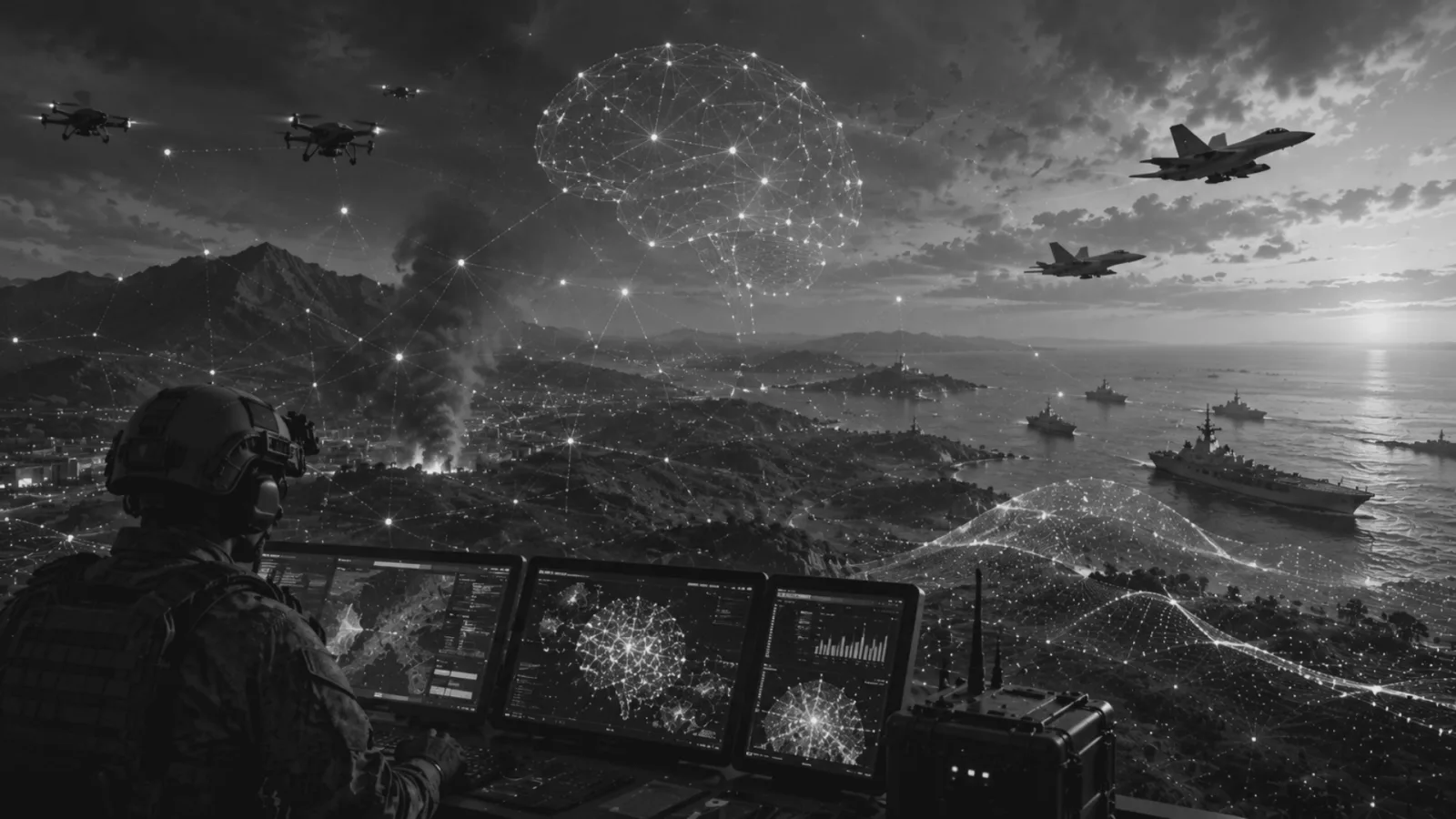
Algorithmic warfare operates through a continuous loops of data collection, analysis, decision support, execution and assessment. AI and machine learning acts as the bridge between enormous battlefield information and military action. Algorithms do not replace commanders but provide them with precise target selection, reduce cognitive overload and accelerate operational decisions.
The process begins with data collection. The system receives data from satellites, drones, AEW radars, cyber sensors, signal intelligence and deployed force units. AI processes this data using machine learning. Information collected from different domains is integrated into a common operational picture. Once identified, the system runs the military kill chain sequence of find, fix, track, target, engage, assess. The system suggests weapons and munitions based on proximity and suitability.[18] This capability is essential for multi-domain operations. The developments in cyberspace, outer space, maritime, air and land domains are increasingly interconnected.
It also supports operational planning. Predictive algorithms assess possible courses of action, predicts adversary behaviour, identify logistical constraints and recommends operational options. Importantly, these systems provide recommendations rather than independent decisions.[19][20] Human commanders remain responsible for evaluating political objectives, operational context and legal considerations before authorising military action. Once approved, platform routes it to execution through kill webs. Following military operations, platform also contributes to Battle Damage Assessment. It analyses satellite imagery and drone footage to determine whether operational objectives have been achieved. This creates a continuous feedback loop that improves future planning.[21]
6. Notable Examples
6.1 Russia–Ukraine War
The Russia–Ukraine war represents one of the clearest demonstrations of algorithmic warfare in practice. The Russia-Ukraine war has become a major testbed for algorithmic warfare, driven by systems like Ukraine's Delta situational awareness platform, GIS Arta artillery targeting software etc. Delta Platform, Ukraine's central military ecosystem that integrates data from drones, satellites and human intelligence to map the battlefield and recommend actions in real time.
GIS Arta, often described as an "Uber for artillery". This software automatically allocates targets by routing requests from frontline spotters to the closest available gun crew in seconds.[22] At the operational level, firms such as Palantir Technologies provided battlefield analytics using AI, sensor fusion and targeting support. These networks compress the sensor-to-shooter kill chain from hours to mere minutes.
Ukrainian forces used facial recognition tools like Clearview AI. Alongside automated image analysis of social media platforms, used to identify military personnel and track combatants.[23] SpaceX provided communications through Starlink. Maxar Planet and Black Sky had delivered ISR data. AI firms such as Primer AI and Recorded Future provides intelligence from open and technical sources.[24]
First-person view drones have been used by both sides. While humans operating in initial phases and switches to automation in terminal phase after locking the target. This had created a 30 Km kill zone with 15km each side at the frontline. Anything spotted in this zone is neutralized automatically through drones.[25]
At the same time, the war has exposed vulnerabilities. Electronic warfare, cyber-attacks, GPS jamming, and misinformation campaigns have repeatedly disrupted digital systems, highlighting that algorithmic superiority depends on resilient communications and trusted data.
6.2 Israel–Hamas Conflict
After the Hamas carried out op. Al-Aqsa Flood on 7 October 2023, Israel had extensively used algorithmic warfare systems in its subsequent operations. Primarily Gospel (Habsora), Lavender and Where’s Daddy had been deployed for target identification, predictive analysis, decision support and to autonomously engage targets. These three systems act in layers from intelligence gathering, target selection to decision support to operators and then execution of the strike. This was followed by battle damage assessment, feedback for learning and continuing the loop.[26]
Gospel was used to identify non-human and infrastructure targets such as buildings, command posts, tunnel networks and suspected militant facilities.
Lavender was used for targeting individuals, processing massive surveillance data to assign threat scores and generate suspected lists of Hamas operatives within 20 seconds.[27] Journalists from +972 Magazine revealed in April 2024, Lavender works as an automated kill-list generator: "It works by processing vast amounts of data, including intercepted phone calls and text messages, to flag people suspected of being militants, The AI model assigns individuals a 'target suitability' score based on their behavioural patterns and communications".[28][29]
Where's Daddy was used in tandem with other platforms to track targeted individuals and alert operators when they return to their homes, enabling strikes to occur off the battlefield.[30] A strike on United Nations school in Nuseirat on 7 July 2024, killed 23 people and injured over 80. The Israel Defense Forces later accepted that only 8 of them were Hamas members.[31]
7. Limitations and Challenges
Despite having several advantages, it comes with certain limitations and challenges. Algorithmic warfare remains vulnerable to cyber-attacks, manipulation, algorithmic biases and automation bias.[32] AI systems rely on secure networks and reliable information. Misleading information and disruption of communications can lead to the generation of faulty predictions, increasing operational risk and escalation. Therefore, robust digital infrastructure and meaningful human oversight became indispensable components of AI-enabled warfare.
Algorithmic systems carry ethical concerns and accountability issues. Their reasoning is based on LLMs and previously fed data. Automated profiling increases the likelihood of false positives and indiscriminate targeting. Israel’s Lavender system generated 260 false positives due to skewed biometric data.[33]In the Iran-Israel-USA war 2026, a girl’s school in Minab was hit by missile, reflecting ethical concerns and error in target selections.[34]
The issue of rubber-stamping remains prevalent. In tense war situations, human operators may over-trust an algorithm’s suggestion and validate it without exercising true oversight. Prolonged wars with quickly changing battlefield effort often leads to decision fatigue among operators. This remains a key challenge in algorithmic warfare.[35]
Psychological detachment mechanisms emerge to mitigate the moral distance associated with civilian harm. Remotely operating humans often connects less to the consequences than to soldiers in the battlefield. Systems often misinterpret human contexts leading to civilian casualties, like the SGR-A1 sentry guns couldn’t interpret surrendering combatants.[36]
Additionally, any legal framework or binding treaty regulating algorithmic warfare, does not exist. There is no single mechanism to differentiate between intentional war crimes or algorithmic errors.
8. Implications for India
Algorithmic warfare presents both an opportunity and an operational necessity for India. The country's security environment is shaped by military competition with China, evolving tensions with Pakistan, maritime challenges in the Indian Ocean and growing cyber and grey-zone threats. Thus, rapid intelligence processing and integrated decision-making becomes a key necessity.
Operationally, AI can strengthen surveillance along the borders. It can improve counter-infiltration along the Line of Control and enhance Maritime Domain Awareness across the Indian Ocean Region. Algorithmic smart systems can support quick decisions involving the complex border situations. It can improve the ability to identify, track and engage targets autonomously through fast processing of satellite images, drones, radar and cyber intelligence.
India has already recognised the importance of AI in defence through the establishment of the Defence AI Council, Defence AI Project Agency, iDEX, ADITI initiatives within DRDO. These programmes aimed at indigenous innovation in surveillance, autonomous systems, cybersecurity and decision-support technologies.[37]India has extensively invested in algorithmic systems through projects like Sanjay, Trinetra, SAMA, ECAS system, AI-enabled Drones etc. Several weapon systems were used during Operation Sindoor. During the operation, the Indian Army claimed to precisely identify, prioritize, locate and engage targets with a success rate of 94 percent using AI.[38]
Nevertheless, several challenges remain. India lacks jointness and an integrated operational model due to doctrinal gaps and slow structural reforms. The application of AI in warfare is existential for India to counter “Intelligentized Warfare” and its adversarial duo. India lacks a unified inter-service defence cloud infrastructure. India’s dependency on imported weapons and platforms remains a key hurdle.
By leveraging India’s IT sector and AI talent pool, harnessing dual-use technologies and deepening international collaboration, India can boost its algorithmic warfare capability.[39] India's long-term deterrence and operational effectiveness will depend upon its ability to develop indigenous AI capabilities while maintaining resilient digital infrastructure.
9. Conclusion
Algorithmic Warfare marks a fundamental shift in the nature of contemporary warfare. Instead of substituting soldiers with autonomous machines, the integration of AI in intelligence gathering, command and control, logistics and operational planning enhances the military's decision-making process. The end-game is not mere automation but attaining superiority in making decisions through rapid and informed actions.
The experiences of the US, China, Israel, Russia and Ukraine indicate that the application of AI in the battlefield has become a reality. These examples also reveal continuing problems involving cybersecurity, algorithmic discrimination, responsibility and ethical governance issues. Hence, the future of military dominance rests on striking a balance between technological advancements and human supervision.
For India, algorithmic warfare must be seen as a strategic necessity instead of an emerging choice. Strengthening indigenous AI research, building resilient digital infrastructure, unified defence-data networks and integrating the command system becomes necessary for competitive advantage. In the end, the winning state in future battles will not only possess the best weapons; it will combine intelligent algorithms, trustworthy data, resilient networks and sound human judgment in military decision-making.
References:
[1] Layton, Peter. (2018). ‘Algorithmic Warfare Applying Artificial Intelligence to Warfighting’. ResearchGate https://www.researchgate.net/publication/326248009_Algorithmic_Warfare_Applying_Artificial_Intelligence_to_Warfighting
[2] Mishra, Priyesh, Prakhar Pandey, Leah Cole, Seungmi Hong, Brandon Tran, Kathy Huang and Isaac Andrew Bangura. “Code, Command, and Conflict: Charting the Future of Military AI.” 2025. Belfer Center for Science and International Affairs
https://www.belfercenter.org/research-analysis/code-command-and-conflict-charting-future-military-ai
[3] Peter Layton, “Algorithmic Warfare Applying Artificial Intelligence to Warfighting”. Canberra, Air Power Development Centre, 2018,02.
[4] Martin Klein. ‘Decoding The Battlefield: The Power of Algorithmic Warfare’.2024. Everforthecs https://everforthecs.com/ecs-insight/article/decoding-the-battlefield-the-power-of-algorithmic-warfare/
[5] Mishra et. al.’ Code, Command, and Conflict: Charting the Future of Military AI.” 2025
[6]Martin Klein. ‘Decoding The Battlefield: The Power of Algorithmic Warfare’.2024. Everforthecs https://everforthecs.com/ecs-insight/article/decoding-the-battlefield-the-power-of-algorithmic-warfare/
[7]Ashish Kumar Gupta. ‘Algorithmic Warfare: A New Paradigm in the Age of Artificial Intelligence’. 2026.Issue Brief. CENJOWS https://cenjows.in/wp-content/uploads/2026/06/Gp-Capt-Guptas-IB.pdf
[8] Martin Klein. ‘Decoding The Battlefield: The Power of Algorithmic Warfare’.2024. Everforthecs https://everforthecs.com/ecs-insight/article/decoding-the-battlefield-the-power-of-algorithmic-warfare/
[9] DeLange, Eric & Morris, Mike. (2006). Decision-Centric Warfare: Reading Between the Lines of Network-Centric Warfare. 26. https://www.researchgate.net/publication/235128453_Decision-Centric_Warfare_Reading_Between_the_Lines_of_Network-Centric_Warfare
[10] Chan, Joseph. (2020). Digital Transformation in the Era of Big Data and Cloud Computing. International Journal of Intelligent Information Systems. 9. 16. 10.11648/j.ijiis.20200903.11.
[11]Vigyan Dhara Issue. ‘Shaping Artificial Intelligence (AI)for INDIA and the WORLD’.2025 https://psa.gov.in/CMS/web/sites/default/files/psa_custom_files/VIGYAN%20DHARA%20MAGAZINE%20AUGUST%20EDITION%20-%2008%20Sept.pdf
[12] Pietrzak, Piotr W. "Project Maven, Software-Defined Warfare, and Their Impact on China and Russia's Strategic Culture." The Morality of Software-Defined Warfare: Just War Theory, Army Medicine, and AI, edited by Piotr Waldemar Pietrzak and Evangelos Ioannis Koumparoudis, IGI Global Scientific Publishing, 2026, pp. 1-32. https://doi.org/10.4018/979-8-3373-6264-9.ch001
[13] Ashutosh kumar Singh. ‘What is Mosaic Warfare? 2026.CNAWS https://cnaws.in/explainers/what-is-mosaic-warfare
[14] Sanur Sharma. ‘NATO’s AI Push and Military Implications’. 2022. Issue Brief. IDSA https://idsa.in/publisher/issuebrief/natos-ai-push-and-military-implications
[15] David Kirichenko. ‘Artificial Intelligence’s Growing Role in Modern Warfare’. 2025. War Room online Journal
https://warroom.armywarcollege.edu/articles/ais-growing-role/
[16] Frans P. B. Osinga, Science, Strategy and War: The Strategic Theory of John Boyd (London: Routledge, 2007).
[17]Southwest Research Institute. (n.d.). ‘Network Centric Warfare’. (n.d.) https://www.swri.org/markets/defense-security/defense-aerospace-aircraft/avionics-support-systems/network-centric-warfaren
[18]Hanna Duggal. ‘Can AI systems make moral decisions in war?’. 2026.Al-Jazeera
https://www.aljazeera.com/news/2026/7/21/can-ai-systems-make-moral-decisions-in-war
[19] Dieu Anh Nguyen. ‘AI in Military: Top Use Cases You Need to Know’. 2025. Smartdev https://smartdev.com/ai-use-cases-in-military/
[20] August Cole et al., Artificial Intelligence in Military Planning and Operations: Ethical Considerations Oslo: Peace Research Institute Oslo, 2024
[21] Nadibaidze, Anna & Bode, Ingvild & Zhang, Qiaochu. ‘AI in Military Decision Support Systems: A Review of Developments and Debates’. 2024
[22]David Zikusokia. ‘How Ukraine’s “Uber for Artillery” is Leading the Software War Against Russia’.2023.NewAmerica https://www.newamerica.org/insights/how-ukraines-uber-for-artillery-is-leading-the-software-war-against-russia/
[23] Rakhmetov, Baurzhan and Murzagulova, Kamila. "Artificial Intelligence in Warfare: The Case of the Russia-Ukraine War." Journal of Strategic Security 18, no. 4 (2025): 64-77. DOI: https://doi.org/10.5038/1944-0472.18.4.2470 Available at: https://digitalcommons.usf.edu/jss/vol18/iss4/5
[24]Can Kasapoğlu. ‘From cloud to kill zone: How Ukraine rewired naval warfare for the age of algorithmic warfare’.2026. Report. Atlantic Council https://www.atlanticcouncil.org/in-depth-research-reports/report/from-cloud-to-kill-zone-how-ukraine-rewired-naval-warfare/
[25]Mariano Zafra, Mike Collett-White, Tom Balmforth and Max Hunder. ‘Inside Ukraine’s Kill Zone’. 2026. Reuters https://www.reuters.com/graphics/UKRAINE-CRISIS/KILL-ZONE/znpnojmknvl/
[26] Mohee, Ahmad. (2026). Algorithmic Warfare in Evolution: A Cyber-Conflict Analysis of Israel's AI Targeting from Gaza 2021 to Gaza 2023-2025. 10.13140/RG.2.2.31505.08806.
[27] Sibel Düz. ‘Gaza as a testing ground: Israel’s AI warfare’.2025. Opinion. SETA https://www.setav.org/en/gaza-as-a-testing-ground-israels-ai-warfare
[28] Abraham, Y., & Local Call. How Israel Uses Lavender, The Gospel and Where’s Daddy? Automated Kill Lists in Gaza.2024. Democracy Now https://www.democracynow.org/2024/4/5/israel_ai
[29] Abraham, Y. ‘Lavender’: The AI machine directing Israel’s bombing spree in Gaza.2024. +972 Magazine. https://www.972mag.com/lavender-ai-israeli-army-gaza/
[30] Human Rights Watch. Questions and Answers on Israel’s Use of Artificial Intelligence in Gaza. 2024 https://www.hrw.org/news/2024/09/10/questions-and-answers-israeli-militarys-use-of-digital-tools-in-gaza
[31] Sibel Düz. ‘Gaza as a testing ground: Israel’s AI warfare’.2025. Opinion. SETA https://www.setav.org/en/gaza-as-a-testing-ground-israels-ai-warfare
[32] Iraj Abid. ‘ How Algorithmic Bias in Military AI Challenges IHL’.2026. CSCR
[33] B'Tselem, "Automated Repression: AI Surveillance in Occupied Territories," Report 2024-01, 2024.
[34]Natali Gbele, Lessons Learned from the Minab School Strike: AI Decision-Support Systems in Targeting and the Duty to Verify, Völkerrechtsblog, 07.04.2026, Doi: 10.17176/20260407-172930-0.
[35] Sourav, Md Tanvir & Masud, Nasrullah & Al Bassam, Abdullah & Sobhan, Abdus. (2025). Governance and Ethical Challenges of Artificial Intelligence in Warfare. 1-5. 10.1109/QPAIN66474.2025.11171759.
[36] S. Kim et al., "Autonomous Sentry Guns and Civilian Harm," Defence Analysis, vol. 40, no. 2, pp. 145–167, 2024
[37]PIB. ‘Application of Science and Technology in Defence Sector’.2022. Govt. of India https://www.pib.gov.in/Pressreleaseshare.aspx?PRID=1848671
[38] Vansh Pincha. ‘AI-Driven Warfare and Indian Military Doctrine: Challenges in Adoption and Integration’. 2026. CNAWS https://cnaws.in/research-papers/ai-driven-warfare-and-indian-military-doctrine-challenges-in-adoption-and-integration
[39] Ibid.
The views expressed are those of the authors and do not represent the views of CNAWS.
Image Source: ChatGPT