

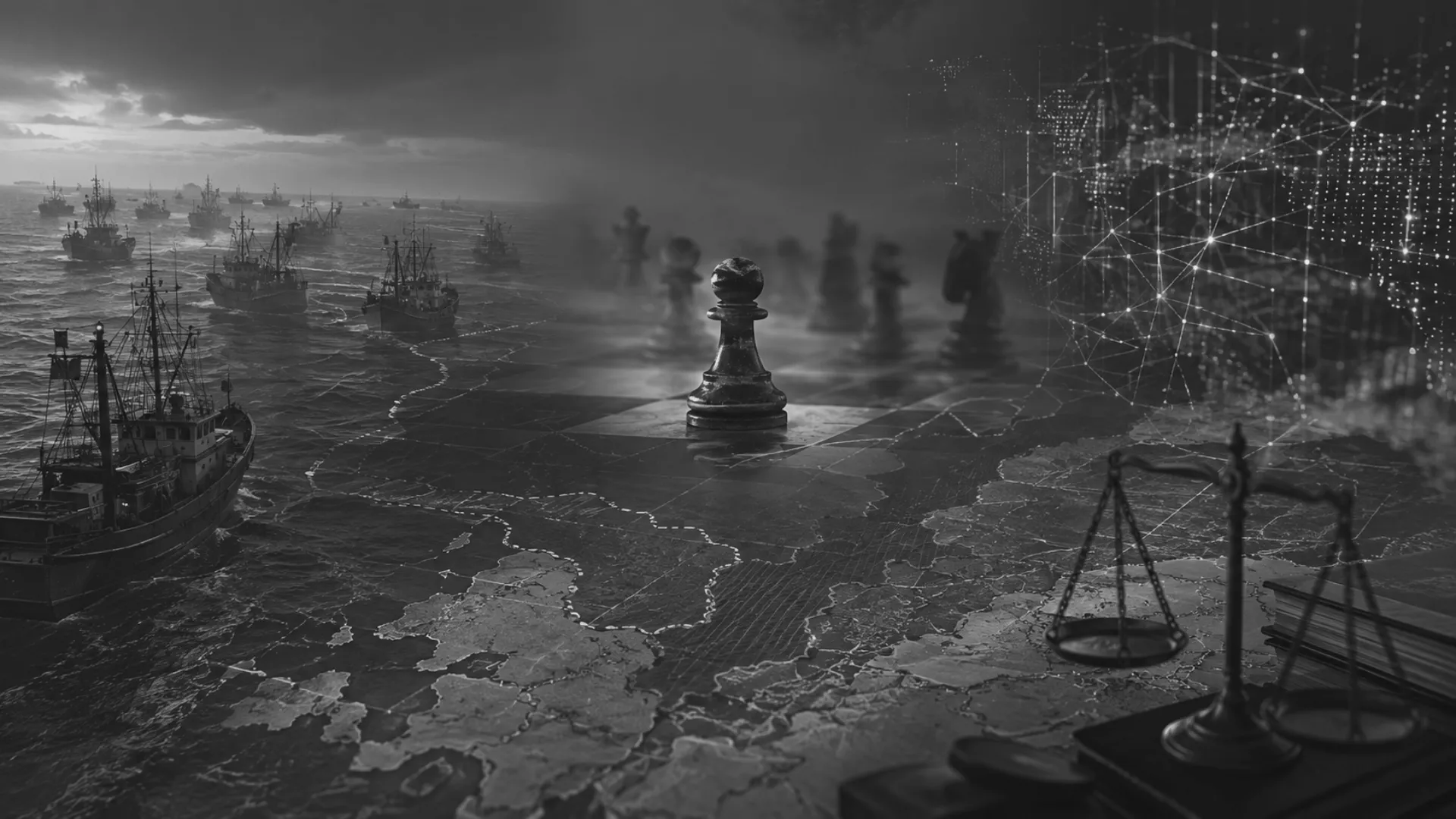
What is Grey Zone Warfare?

Introduction
In March 2021, more than 200 Chinese fishing vessels appeared at Whitsun Reef which is located near the Philippines’ 200-nautical-mile Exclusive Economic Zone (EEZ) in the South China Sea. Philippine coast guard had detected their presence earlier that month, so when they demanded answers for their presence, Beijing responded that they were ordinary commercial fishing vessels taking shelter from bad weather.However, satellite imagery and maritime patrol showed that the weather was calm and none of these ships deployed were carrying any fishing equipments.Since these vessels were unarmed with any weapons, Philippines could not fire at them without looking like an aggressor attacking “civilian fishing boats”. Although no shots were fired, no war was declared, the satellite imagery and Philippine statements made it clear this was not a normal peacetime activity but a coordinated move to reinforce China’s claim to another state’s maritime zone.[i]
This incident showed that nowadays, many actions in global competition happen between this murky middle zone which is neither outright war nor simple peace. Grey Zone strategy is designed to exploit this gap as it relies on this coercive ambiguity and its goal is to alter the status quo without triggering an armed response or international sanctions.
This article explains what ‘Grey Zone Warfare” is, how it evolved , how it operates, why new technologies deepen the challenge and what it means to India’s security.
What is Grey Zone Warafre?
Grey Zone Warfare lies in the middle of peacetime diplomacy and overt armed conflict, but still coercive enough to shift the status quo.They operate in shadows, pushing the boundaries just far enough, without provoking any military attacks. To linger carefully below the threshold which would normally trigger conventional military response or any formal alliance obligations.
U.S Special Operation Command[iv] defines Grey Zone challenges as, “competitive interactions among and within state and non‑state actors that fall between the traditional war and peace duality”. RAND defines[xix] it as activity that “involves coercive statecraft short of traditional war, is designed to incrementally alter the status quo”, without crossing the line of major war.
There are four central characteristics of Grey Zone Warfare. Firstly, the “grey” comes from ambiguity about who is acting,what exactly is being done and does any rule or strategy apply to it or not. Actors obscure the real attribution by using militias, proxies, private hackers or pseudo-civilian vessels.It makes it difficult to locate the accountability quickly and clearly[ii]. Secondly, Deniability: Even if everybody knows who is behind it,the sponsor flatly denies the involvement, hence delaying and complicating the coalition response. Third is Gradualism: The sponsor country takes small incremental steps over the course of a long time period( years).These small steps won’t require a high response but as it cumulates, the balance of power shifts over time.And fourthly, Hybridity: It blends military actions with economic pressure(like trade cuts, high tariffs), cyberattacks, disinformation campaigns and legal maneuvers to wear down the opponents. [iii]
Grey Zone Warfare should be distinguished from other related ideas. Hybrid warfare includes mixing of non-conventional methods (irregular, on-military tools) with kinetic military forces, whereas Grey zone specifically focuses on staying under the threshold of open fighting. Asymmetric Warfare explains how a comparatively weaker actor exploits certain vulnerabilities of stronger actor, or uses its advantages against it. However, Grey Zone is about staying obscure to avoid war, regardless of who is stronger. Also, Covert Operations are single, discrete and clandestine. But Grey Zone operations are continuous, strategic and multi-year campaigns. [xx]
Historical Evolution
The practice of Grey Zone Warfare has no single starting point in human history. Ancient strategists like Sun Tzu and Kautilya were already describing these methods thousands of years ago without explicitly calling it Grey Zone tactics. However, it changed in the Cold War and post-2014 era, as these practices were being institutionalized through modern intelligence agencies and cyber tools. The term “ Grey Zone” was first coined by Philip Kapusta, a strategist at the U.S. Special Operations Command (USSOCOM). It first appeared in an official military paper titled White Paper: The Grey Zone. [iv]
Cold War Foundations: The Blueprint for deniability(1940s–1980s)
During the Cold War , the doctrine of MAD(Mutually Assured Destruction) made direct confrontation difficult because it will lead to total destruction. At that time, the Soviet Union used disinformation, funding front groups, and manipulating foreign politics to erode enemies from within without firing a missile. Meanwhile, The United States used covert operations such as CIA interventions in Latin America to shape political outcomes while maintaining plausible deniability. These methods blurred the line between intelligence operations and foreign diplomacy, prefiguring today’s Grey Zone Campaigns.
Post-Cold War: Asia’s Maritime disputes (1990s-2010)
After the cold war, actors specifically in Asia started operating in grey zones to prevent intervention of the overwhelming US conventional military,as they sought to alter borders. The most prominent example is China's gradual expansion of the South China Sea.[v] In 1995, China seized the Mischief Reef[vi] ,initially building wooden structures by claiming they were for fishermen. Gradually they started using Coast Guards and fishing fleets instead of using the Navy, to keep the dispute a “civil” matter rather than the military. Gradually (2013-2015), they started building artificial islands over the submerged reefs(e.g., Fiery Cross Reef [vii], Subi Reef[viii]), fully equipped with airfields, radar and missile defense systems.
Each of these individual constructions moved below the threshold of a war but the cumulative effect it brought was the drastic shift in the de facto control of a sea lane.
Modern Grey Zone: A Permanent State Strategy (2014–Present)
There are two significant events which showcased how “Grey Zone” had been normalized as one of the primary operational frameworks for modern geopolitical rivalries in post-2014. One is Russia’s annexation of Crimea(2014), where Russia wanted to seize Crimea from Ukraine without provoking a response from NATO, for which they used the strategy of , “Little Green Men” : they were armed Russian forces wearing uniforms alongside local pro-Russian militia. Since they wore no insignia, no rank, no national identification, Moscow denied them as being Russian troops. They also integrated hybrid elements to it. (cyberattacks, disinformation campaigns ) [ix]
In parallel, China also opted for non-lethal, coercive tactics in their disputed borders. In 2017 Doklam standoff Chinese troops started constructing roads over the disputed region. When India intervened , it resulted in a 73-day standoff from both sides. Although any armed conflict was prevented, China did attempt to use a combination of non-lethal physical confrontation and infrastructure building to alter the realities of the border on the ground. Post-2014 grey zone strategy is no longer a set of isolated clandestine missions. It is a continuous, state-level strategy. At present, States continue to operate in Grey Zone because it allows continuous territorial and strategic gains without the economic and political cost of open war.
Theoretical Grounding
Thomas Schelling’s idea of “coercive diplomacy” states using limited force as a persuasion tool rather than destruction to change the adversary’s behavior without full-scale war. Grey Zone campaigns build further on it with states using threats, economic sanctions or naval blockades to make the enemy decide that backing down is cheaper than fighting. But Coercion requires precision. It only works if the actor precisely knows how much pressure will turn the persuasion into provocation. This is where Herman Kahn’s escalation ladder becomes essential.[x]
Herman Kahn in his concept of “Escalation Ladder” states that conflict is like a ladder, its intensity increasing with each successive rung. The escalation ladder has 44 rungs. Grey zone actors study their opponents limit, their “red line” which upon crossing will lead to open conflict. They analyze how their opponent defines their rungs in law, alliance obligations and political culture. They figure out the exact target threshold and operate under it.This ladder creates opportunities for the actors. The more precisely they calculate the target’s threshold, the more efficiently they can operate beneath it and the slower the opponent’s institutional structure, the longer they can sustain their operations.[xi]
Grey Zone tactics exploit the structural vulnerability of democratic bureaucracy. Legal constraints, need of evidence, need for public justification and political consensus before taking military actions; they all take a lot of time when an action is intentionally ambiguous. Hence allowing authoritarian systems to take action and lay down facts before the response can be organized. Combining all these structural advantages help to explain why Grey zone warfare works and why it has become a preferred strategic instrument. But what exactly qualifies as grey Zone and what doesn’t?
To answer this question, a Spanish scholar Javier Jordán published one of the most comprehensive academic attempts to build an explicit model specifically for the Grey Zone. In his work (Theory of Grey Zone Conflict-2021),he explains that a conflict strictly qualifies as a grey zone ,only if it checks four core dimensions. Revisionist goal : means there should be an intent to change the status quo in territory, law or regional power. Sub-Threshold nature: means their operations’ deliberate design to remain below the target's kinetic trigger. Gradualism & Continuity : means the operation should have a long term, multi-phase timeline. Lastly, Multi-Domain Hybridity: means integrated use of non military tools such as lawfare, cyber, proxies and economic pressure. If an activity lacks any one of these dimensions then this model deems it as not a grey zone warfare.[xii]
All these frameworks together reveal that Grey-Zone Warfare is a deliberate strategic choice which is grounded in rationality and structure.It is designed to exploit the gap between what a state can tolerate and what it can respond to.
How it works: Operational Mechanism
Based on Lyle Morris et al’s "The Coercion Spectrum Framework" (2019),Grey Zone warfare works under the following categories. [xviii]
Maritime militia & proxies
They exploit liberal rules of engagement. If the navy attacks military warships, then it's a war but if the navy attacks civilian fishing ships then it can be deduced as a humanitarian atrocity . These ships act as a human shield. China’s People’s Armed Forces Maritime Militia (PAFMM) is a network of civilian fishing vessels backed up by the state. Over 200 of these fishing vessels were sent to The Whitsun Reef in 2021, where they occupied Philippine EEZ waters Beijing responded that they were ordinary commercial fishing vessels taking shelter from bad weather and since these vessels were unarmed, Philippines could not fire at them without looking like an aggressor attacking “civilian fishing boats”. This resulted in blocked Philippine access and established de facto control without firing a shot.[xiii]
Economic Coercion
It is highly effective and technically, “legal” under international law. Cutting rare-earth exports or imposing high tariffs forces the target to choose between national pride and domestic economic state. In 2010 a Chinese fishing trawler which was fishing illegally in the disputed region of Senkaku/Diaoyu islands, rammed itself at two Japan Coast Guards vessels. Japan arrested the captain and refused Beijing's demand for release. To which China restricted the rare earth material exports bound for Japan. China never declared an embargo as it would violate WTO rules. But it stalled shipments with sudden “inspections” and administrative delays. This resulted in skyrocketed prices in rare earth minerals and Japan had to back down and release the captain. Simply by exploiting a chokepoint in the global supply chain, a powerful neighbor can be coerced.[xiv]
Lawfare
In Grey Zone Warfare, lawfare is not about seeking justice at international court. But to creatively interpret and apply both international and domestic laws to legitimize its own actions and deter the other's action. China claims sovereignty over 90% of the South China sea based on its historic “Nine Dash Line” which is a boundary map originally drawn in the 1940s. However, China’s nine dash line cuts directly through EEZs(under UNCLOS) of many regional states. Also in 2021, China passed domestic maritime law to be followed by its coast guards, authorizing them to claim foreign disputed waters as their own and use their force against foreign ships in those regions. With that it reframes international aggression as “routine domestic policing against illegal trespassers". But it also selectively invokes UNCLOS laws like “freedom of navigation” or “innocent passage” to defend its own military activities in foreign waters. This puts foreign navies in a dangerous legal dilemma.[xv]
Cyber operations
Operating in digital space where physical damage is not immediately visible hence blurring the international definition of “armed attack”. Core Grey Zone cyber toolkits include, IP & Data theft like stealing defense strategies, citizen database, Infrastructure probing like hacking into foreign power grids, financial networks etc. or disruptive attacks such as deploying malware/wiper software. One notable example is the case of The NotPetya Cyberattack (2017) where Russian military intelligence deployed malware disguised as ransomware aimed at Ukrainian financial and energy systems. It spread globally ,harming logistic networks worldwide, causing over $10 billion in damage. Cyber warfare has become a prominent element in the grey zone because it is low cost and high leverage and it has legal ambiguity.[xvi]
Information and cognitive operations
It includes disinformation campaigns, narrative framing and focus on the human mind. It shapes perceptions by sowing doubt or distrust in the institutions through traditional media or social platforms. We can again take the Russian invasion of Donbas and Crimea annexation as an example where Russian state media and social media bots heavily broadcast the narrative that Ukraine was run by fascists and were persecuting Russian speakers. This was targeted to Russia’s domestic citizens and to shape the public opinion over the annexation. In Grey Zone, Cognitive operations lay the groundwork for physical actions. If an actor successfully alters how the population perceives a crisis, they can win the fight without conventional military campaigns. [xvii]
All of these tools operate under the threshold and their scale of damage and its weightage can only become obvious, when seeing all of it cumulatively. By the time the target nation realizes what’s going on, the aggressor has completely changed the strategic balance without ever needing to fight a conventional war.
Case Study: Crimea (2014)
Russia achieved a massive objective of seizing 10,000 sq miles of territory without triggering direct conventional war with NATO or Ukraine. They accomplished this by applying five distinct mechanisms of the grey zone as mentioned above.
Firstly, Using Proxy forces as a tool, Moscow deployed well trained soldiers wearing unmarked uniforms (popularly dubbed as , “little green men”) in the disputed areas, they worked alongside pro-Russian Militia in the region and wore no insignia so Moscow denied their association with Russia by claiming that they were merely local militia who bought their military gear at commercial army surplus store. By maintaining this deniability, Russia delayed the decision making at Kyiv and the west as they debated whether this was a foreign invasion or internal Ukrainian insurgency.
Russia also laid psychological groundwork before the unmarked troop even appeared. In early 2014, massive pro-European protests broke out at Kyiv where Ukraine's pro-Russian President, Viktor Yanukovych, fled to Russia after parliament voted to remove him from his office when he backed out of a trade deal with the EU under the pressure of Moscow. Russia spun the narrative by broadcasting the narrative that the political upheaval at Kyiv was a “fascist coup” which threatened the existence of ethnic Russian speakers in Crimea. Their state media started broadcasting campaigns about protecting Russian speakers and correcting historical injustices. Domestically and in Crimea it framed Russia’s military presence as heroic, "humanitarian intervention”, and internationally it caused enough confusion for the global audience to question the legitimacy of the new Ukrainian Government.
Russia also wrapped the annexation under the cloak of “legalism”, as local pro-Russian politicians organized a rapid referendum within two weeks under the military occupation with international observers barred, which resulted in favoring unification with Russia. Moscow then formally passed domestic legislation annexing Crimea based on the “popular vote”. Europe’s heavy reliance on Russian natural gas was also exploited by shutting off or hiking the prices of the supply. This muted EUs initial response because of fear of economic coercion.
Contemporary Relevance
With the emergence of new technologies, the grey zone domains have expanded. States are actively using AI for social media manipulation, deepfake contents and automated bot networks to influence elections, shape conflict narratives and change public opinions. On the kinetic side, low-cost drones and autonomous maritime vessels are being used to shadow or obstruct military ships and if spotted, the sponsoring govt. can easily deny it by claiming it was the work of non-state actors.
Space has also become a grey zone domain. States can jam or spoof satellite signals or send fake GPS coordinates. They can conduct close‑approach maneuvers to threaten or spy on the adversary’s satellite .These actions can disrupt navigation, timing or ISR to both civilian and military operations, without being kinetic-satellite attack.
Undersea & infrastructure sabotage is the grey zone instrument which is most difficult to detect. Modern world depends highly on connections that are not visible to our naked eyes, and millions of undersea fiber-optic internet cables and gas pipelines remain unmonitored in deep waters, hence making them perfect targets. When grey zone actors target such critical infrastructures, its of high impact, there is environmental shield and also a built-in ambiguity as attacks can be claimed as accidental or commercial anchor drags. For example, recent multiple cable cuts in the Baltic sea where gas pipelines and data cables have been severed. It highlights how difficult it is to prove sabotage. As technology enables more actors to operate below the threshold, attribution is getting more difficult whilst deniability is becoming more achievable hence cementing Grey Zone as a default arena.
Implications for India
India faces Grey zone pressure on two major fronts: Pakistan and China. On the western front ,Pakistan has relied on proxies and narrative warfare. They use cross-border terrorism and proxy organizations such as Jaish-e-Mohammed in the 2019 Pulwama attack under the veil of deniability. It was done to inflict damage while maintaining official state denial. They also mobilize diaspora networks, social media campaigns and put international diplomatic pressure to shape the global narrative around Jammu & Kashmir.
On the northern and eastern front ,China utilizes the strategy of “Salami Slicing” which means small, calibrated, territorial expansion to alter the status quo. Rather than one full-frontal grab , the actor makes many small moves such as positioning ships, building roads and structures at border posts like Depsang, Galwan and Tawang. At sea, Chinese research. ships, fishing fleets and possible maritime militia have increased in the Indian Ocean, complementing “String of Pearls” ports across Sri Lanka and other littoral states.
The Andaman and Nicobar Islands sit right at the mouth of the Malacca Strait, which is a critical hub of maritime transit lines and subsea cables. Sabotage and disruption of these cables would bring economic and security effects and yet attribution is difficult in these waters. Many debt-backed port projects and loan infrastructures in the regional neighbors such as that of Maldives and Sri Lanka create strategic pressure points which China can exploit.
India’s response to this infrastructure is evolving but still incomplete. Proposals for Integrated theatre commands are still evolving and have not yet fully structured. Also, India’s cybersecurity remains scattered across multiple ministries and intelligence bodies(MeitY, NTRO, Defense Cyber Agency, MHA), with no single unified operational command.
Grey zone conflict isn't a series of isolated crises. It is continuous and in perpetual state of competition . To counter this, India should shift from reactive mitigation to continuous strategy. There should be a dedicated national Grey Zone Strategy , unifying military (for kinetic), MHA (for internal terrorism), MEA (for external terrorism), MEITY (for cyber and disinformation) and intelligence community (for attribution), all under a single strategic command. Rather than treating these crises individually ,unified doctrine would allow India to maintain efficient and consistent defense.
Conclusion
Traditional viewpoint assumes a clear line between war and peace much like a light switch which is either flipped on or off. But modern strategic landscapes operate less like a light switch and more like a game of chess played through positional pressure. Adversaries no longer need to launch an all-out offensive strike when they can systematically restrict rival’s options square by square which cumulatively can alter the status quo until the target find themselves in the position of checkmate before a single battle has been fought.
Footnotes:
[i] "Philippines Says 220 Chinese Boats Have Encroached on South China Sea Reef." Reuters, March 21, 2021. https://www.reuters.com/world/china/philippines-says-220-chinese-boats-have-encroached-south-china-sea-2021-03-21/
[ii] Jordán, Javier. "International Competition Below the Threshold of War: Toward a Theory of Gray Zone Conflict." Journal of Strategic Security 14, no. 1 (2021): 1–24. https://doi.org/10.5038/1944-0472.14.1.1836
[iii] Michael J. Mazarr, Mastering the Gray Zone: Understanding a Changing Era of Conflict (Carlisle, PA: Strategic Studies Institute and U.S. Army War College Press, 2015)
[iv]Kapusta, Philip. The Gray Zone. White Paper. Tampa, FL: United States Special Operations Command, September 9, 2015. White Paper - The Gray Zone.
[v] Pretat, Harrison. "More Island Upgrades Across the South China Sea." Asia Maritime Transparency Initiative, Center for Strategic and International Studies, July 8, 2022. https://amti.csis.org/more-island-upgrades-across-the-south-china-sea/.
[vi] Asia Maritime Transparency Initiative. "Mischief Reef." Center for Strategic and International Studies. https://amti.csis.org/mischief-reef/
[vii]Asia Maritime Transparency Initiative. "Fiery Cross Reef." Center for Strategic and International Studies. https://amti.csis.org/fiery-cross-reef/
[viii] Asia Maritime Transparency Initiative. "Subi Reef." Center for Strategic and International Studies. https://amti.csis.org/subi-reef/.
[ix] Azad, Tahir Mahmood, Muhammad Waqas Haider, and Muhammad Sadiq. "Understanding Gray Zone Warfare from Multiple Perspectives." World Affairs 186, no. 1 (2023): 81–104. https://doi.org/10.1177/00438200221141101.
[x] Schelling, Thomas C. Arms and Influence. New Haven, CT: Yale University Press, 1966.
[xi] Kahn, Herman. On Escalation: Metaphors and Scenarios. New York: Frederick A. Praeger, 1965.
[xii] Jordán, Javier. "International Competition Below the Threshold of War: Toward a Theory of Gray Zone Conflict." Journal of Strategic Security 14, no. 1 (2021): 1–24. https://doi.org/10.5038/1944-0472.14.1.1836.
[xiii] Asia Maritime Transparency Initiative. "Caught on Camera: Two Dozen Militia Boats at Whitsun Reef Identified." Center for Strategic and International Studies, April 21, 2021. https://amti.csis.org/caught-on-camera-two-dozen-militia-boats-at-whitsun-reef-identified/.
[xiv] Evenett, Simon, and Johannes Fritz. "Revisiting the China–Japan Rare Earths Dispute of 2010." VoxEU, Centre for Economic Policy Research, July 19, 2023. https://cepr.org/voxeu/columns/revisiting-china-japan-rare-earths-dispute-2010.
[xv] Asia Pacific Foundation of Canada. "China's New Coast Guard Regulations in South China Seas." Asia Pacific Foundation of Canada, 2024. https://www.asiapacific.ca/publication/chinas-new-coast-guard-regulations-in-south-china-sea
[xvi] Greenberg, Andy. "The Untold Story of NotPetya, the Most Devastating Cyberattack in History." Wired, August 22, 2018. https://www.wired.com/story/notpetya-cyberattack-ukraine-russia-code-crashed-the-world/
[xvii] Holloway, Michael. "How Russia Weaponized Social Media in Crimea." The Strategy Bridge, May 10, 2017. https://thestrategybridge.org/the-bridge/2017/5/10/how-russia-weaponized-social-media-in-crimea
[xviii] Gaining Competitive Advantage in the Gray Zone: Response Options for Coercive Aggression (2019) https://www.rand.org/pubs/research_reports/RR2942.html
[xix] Mazarr, Michael J. Mastering the Gray Zone: Understanding a Changing Era of Conflict. Carlisle, PA: Strategic Studies Institute and U.S. Army War College Press, 2015.
[xx] Morris, Lyle J., Michael J. Mazarr, Jeffrey W. Hornung, Stephanie Pezard, Anika Binnendijk, and Marta Kepe Gaining Competitive Advantage in the Gray Zone: Responses to Coercive Aggression Below the Threshold of Major War (Santa Monica, CA: RAND Corporation, 2019)
The views expressed are those of the authors and do not represent the views of CNAWS.
Image Source: ChatGPT


