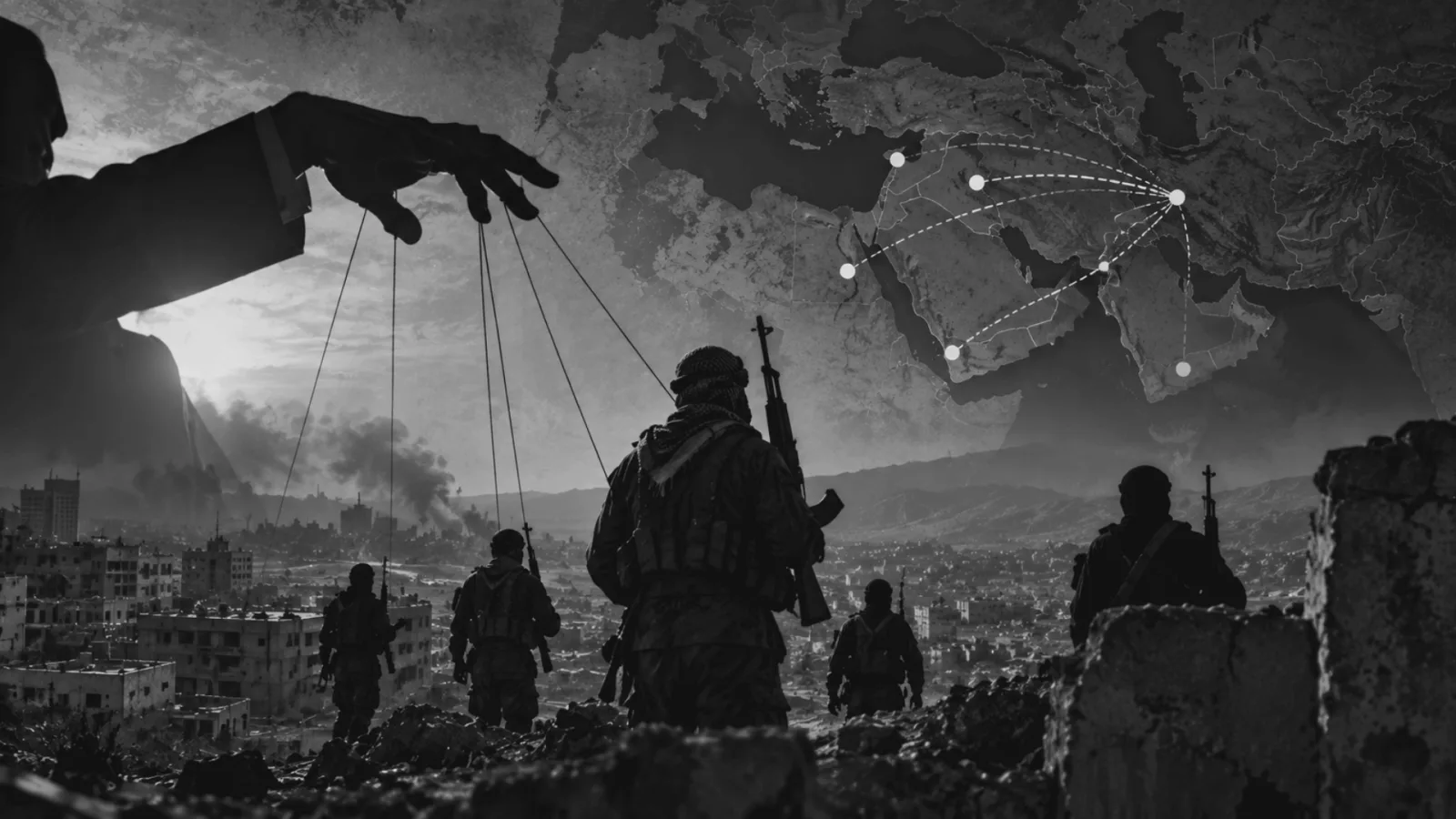
What is Multi-Domain Warfare?

1. Introduction
The character of contemporary warfare is changing. The opening moves of modern conflict are often invisible, silent and deniable. War doesn’t start when a bullet or missile is fired. It starts much earlier, when the adversary starts shaping narratives, degrading your satellite links, mapping your logistics and disturbing societal equilibrium. The battlefield no longer unfolds sequentially or phase by phase. It unfolds simultaneously across every domain, where a single tactical action can produce strategic consequences within minutes.[1] For much of modern military history, war was understood through physical battlefields. Armies fought on land, navies at sea and air forces contested the skies. Joint operations gradually brought these services together. Yet the battlefield of the 21st century is becoming harder to divide into separate spaces.
A satellite can detect an adversary's movement. A drone can confirm the target. Artificial intelligence can help process the resulting data. Electronic warfare can interfere with enemy communications. Cyber operations can disrupt command networks. A precision weapon can then exploit the temporary vulnerability. Information operations may simultaneously attempt to influence how the conflict is perceived.
These activities may occur across different geographical locations, but they can form part of the same operational design. Achieving information superiority and decision dominance through cross-domain application, synergy and tempo are central to a successful MDO.
This is the central idea behind Multi-Domain Operations (MDO). On 27 August 2025, the Headquarters Integrated Defence Staff released the unclassified Joint Doctrine for Multi-Domain Operations. It identifies six domains: Land, Sea, Air, Space, Cyber and Cognitive. It also calls for coordinated employment of military and non-military national capabilities.
The significance of MDO therefore lies not in simply adding new domains to warfare. Its deeper significance lies in connecting them. The central question is no longer only who has the better aircraft, ship, missile or satellite. It is increasingly about who can connect information, decisions and effects faster and more effectively than the adversary.
MDO consequently represents a transition from jointness towards convergence.
2. Definition and Scope
NATO has defined MDO as “The orchestration of military activities across all operational domains and environments, synchronised with non-military activities to enable the alliance to create converging effects at the speed of relevance.”[2]
India's unclassified Joint Doctrine for Multi-Domain Operations promulgated by the Headquarters Integrated Defence Staff (HQ IDS) defines Multi-Domain Operations (MDO) as the “coordinated, integrated and synchronised employment of military forces and non-military national capabilities across Land, Sea, Air, Space, Cyber and Cognitive domains” to fulfil national security goals.”[3]
The term “multi-domain” can be misleading if it is understood simply as operating in many domains at the same time. MDO is more demanding than that. A domain can be understood as a space in which military forces can operate and through which they can create or deny effects. The traditional domains are land, sea and air. Technological and strategic developments have made space and cyber increasingly important. The expansion of digital communication, social media and information technologies has also created a growing cognitive dimension.
In MDOs, every domain works in coherence with other each other, where effects created in one domain create and exploit advantages in other domains. The main goal of a MDO is to overwhelm or disrupt the enemy’s decision-making cycle to gain an advantage.
The scope of a MDO covers physical, virtual and cognitive layer. India's 2025 doctrine formally recognises six domains: land, sea, air, space, cyber and cognitive. This is significant because it places human perception and decision-making alongside physical and digital spaces.
MDO is therefore best understood as an approach to warfare in which capabilities from different domains are deliberately integrated to create effects that an adversary cannot easily counter through a single-domain response.
3. Historical Evolution
MDO did not emerge suddenly. It is the result of several stages in the evolution of military thought. The roots of MDO can be traced to Germany’s campaign against France in 1940, where Guderian’s Panzers advanced in close coordination with the Luftwaffe to disrupt French decision-making faster than it could adapt.[4]
Its modern evolution followed the US Air Land Battle doctrine (1982), which integrated close combat by manoeuvring ground units with deep air strikes to isolate and destroy enemy rear-echelon reinforcements before they could reach the front lines. The information revolution produced the next major change. Network-Centric Warfare (NCW) emphasised the connection between sensors, communications networks, commanders and weapons. Information became a source of combat power. A force that could see the battlefield faster and share information more efficiently could potentially make decisions before its adversary. MDO builds on this logic but expands it.
By the 2010s, growing A2/AD challenges pushed Western militaries towards a broader integration. The rise of space based ISR and ubiquitous connectivity paved the way for a doctrine to leverage these technologies across domains in real-time. With the rise in social media and global internet reach along with developments in cyber capabilities post 2010s added the virtual and cognitive layer to MDO.
The US moved from Air-Sea Battle (2010) to Multi-Domain Battle (2017).[5] The US Army formalised MDO in the TRADOC Pamphlet of 2018, in response to the National Defence Strategy's shift from counterterrorism to great power competition. The US operationalised this through Multi-Domain Task Forces. The first of which was activated in 2020 under I Corps for Indo-Pacific operations. Meanwhile, Russia’s New Generation Warfare (2013) fused hard and soft power across various domains, blurring the boundary between peace and war. China’s post-2015 reforms integrated space, cyber, electronic warfare and information operations, reflecting a shift towards whole-of-system and cognitive competition. India launched its formal MDO doctrine in 2025. [6]
The evolution can therefore be represented as:
Service-Centric Warfare → Joint Warfare → Network-Centric Warfare → Multi-Domain Operations
4. Theoretical Foundations
The theoretical foundations of MDO do not lie in a single theory. MDO is best understood as an evolution of several strategic and operational concepts that seeks to integrate effects across land, sea, air, space, cyber and the electromagnetic spectrum to create an advantage faster than the adversary can respond.
The intellectual foundations of MDO predate modern technology. Clausewitz provides the foundational logic through friction, uncertainty, centre of gravity and the interaction of wills.[7] His contribution to MDO is the understanding that military power must ultimately affect the adversary’s ability to function and impose its will. MDO extends this beyond conventional destruction by targeting the interconnected physical, informational and cognitive elements that sustain military power. It consequently seeks to create relative advantage within an inherently uncertain and contested environment.
Sun Tzu’s theories further lay the foundations of MDO. Sun Tzu’s theory of war is centred on defeating an adversary through indirect action, deception, surprise and exploitation of vulnerability rather than relying solely on physical destruction.[8] Its relevance to MDO lies in the idea of creating multiple and simultaneous dilemmas. MDO applies this logic by combining effects across different domains so that an adversary cannot concentrate its resources against a single threat. The objective is therefore not simply to destroy enemy forces, but to make the adversary’s response increasingly difficult and costly. Cyberattacks, electronic warfare, information operations and precision strikes can create effects without conventional attrition.
John Boyd’s OODA loop and Decision Superiority contributes to the MDO conceptualisation. Boyd’s Observe-Orient-Decide-Act model shifted attention towards the speed and quality of decision-making. The central proposition is that a force can gain advantage by operating inside an opponent’s decision cycle while continuously adapting its own actions.[9] This provides MDOs with an important operational logic: sense across domains, integrate information, decide rapidly and generate effects before the adversary can adapt. Decision superiority consequently becomes a mechanism through which cross-domain capabilities produce cumulative advantage.
Network-Centric Warfare served the next transformational basis for MDO. Developed prominently by Arthur Cebrowski and John Garstka in the late 1990s, Network-Centric Warfare shifted the focus from individual platforms towards networks connecting sensors, decision-makers and weapons. It argued that information superiority could generate speed of command and enable geographically dispersed forces to act as an integrated system.[10] This provides MDO with its technological foundation: connect the domains, share information, coordinate dispersed capabilities and converge their effects. Thus, MDO represents the convergence of classical ideas of indirect action and systemic disruption with modern theories of information, connectivity and decision advantage.
Several Doctrines such as Joint Warfare (1942), Air Land Battle (1982,86), Air Sea Battle (2018) also contributed to the theoretical and doctrinal foundations of MDO.
5. How does MDO work
MDO works by integrating capabilities across different domains to create converging effects faster than an adversary can respond. It is therefore not simply about fighting simultaneously on land, sea, air, space and cyberspace. The central mechanism is the connection between sensors, data, decision-makers and effectors.
A useful way to understand the process is:
Sense → Fuse → Understand → Decide → Converge → Act → Assess → Adapt
5.1 Sense: Build a common picture
MDO begins with persistent sensing across domains. Satellites, UAVs, aircraft, ships, radars, ground sensors, cyber intelligence and human intelligence generate information about the adversary. The objective is not merely to collect more data, but to identify changes, vulnerabilities and opportunities across the battlespace.
5.2 Fuse: Connect the information
Information from different sensors is brought into a common data environment. This allows information collected by one service or domain to become useful to another. For example, a satellite may identify an adversary's movement, while a UAV confirms it and an electronic-intelligence system identifies the associated communications network.
This is where network-centric warfare becomes an important foundation of MDO. Connectivity turns geographically dispersed platforms into a more coherent operational system.
5.3 Understand: Convert data into decision advantage
Raw information has limited military value until it is interpreted. Data fusion, artificial intelligence and human analysis can identify patterns, vulnerabilities and potential courses of action. NATO therefore increasingly connects MDO with data-centricity and decision advantage. The aim is to understand what the adversary is doing, why it is doing it and where its system may be vulnerable. Artificial intelligence can help identify patterns, correlate large datasets and highlight potential threats. But machine-generated outputs still require human interpretation.
5.4 Decide: Identify the required effect
The commander then determines the desired operational effect, rather than simply selecting a weapon. For example: The objective may be to prevent an enemy formation from receiving reinforcements. That effect might be achieved through a combination of air interdiction, cyber disruption, electronic warfare and long-range fires. This is the transition from platform-centric thinking to effects-based thinking.
5.5 Converge: Create a cross-domain dilemma
This is the heart of MDO. Capabilities from different domains are deliberately combined so that the adversary faces several interconnected problems simultaneously.
For example:
Space: identifies an enemy formation
↓
Cyber: disrupts its command network
↓
Electronic warfare: interferes with communications and sensors
↓
Air: conducts precision strikes
↓
Land: exploits the resulting vulnerability
The important point is that these are not independent attacks. Each action creates an opportunity for another domain. The adversary is consequently forced to respond to multiple problems at once.
5.6 Act at the speed of relevance
MDO seeks to compress the time between detection, decision and action. This connects directly with John Boyd's OODA loop. If one force can observe, orient, decide and act faster while simultaneously disrupting the adversary's cycle, it can gain decision advantage. NATO describes this as creating converging effects at the speed of relevance.
5.7 Assess and adapt
MDO does not end after an attack. Sensors assess whether the intended effect was achieved. If the adversary adapts, the force must adapt again. This creates a continuous cycle: Sense → Decide → Act → Assess → Adapt → Sense again
This is particularly important because modern warfare is highly contested. Networks can be jammed, satellites degraded, sensors deceived and communications disrupted.
In doctrinal terms, MDO seeks to break down rigid domain silos and replace them with cross-domain “kill webs” that can rapidly generate, sequence, and sustain effects against an adversary’s critical vulnerabilities.
6. Contemporary Examples
The Russia–Ukraine war demonstrates the increasing integration of unmanned systems, electronic warfare, satellite capabilities, intelligence, information warfare and precision fires. Commercial satellite imagery from Maxar Planet and Black Sky has become an important source of battlefield information. Platforms like Delta, GIS Arta, facial recognition tools like Clearview AI have provided persistent surveillance, targeting support and analysis. Electronic warfare can interfere with communications, navigation and unmanned systems.[11]
The conflict has also unfolded in cognitive domain with both countries running narratives and manipulating perceptions through social media to gain support worldwide. Ukraine has gained support from several veterans joining their side as well as cyber hackers. Ukraine has also demonstrated the value of combining civilian and military capabilities. NATO's 2025 MDO conference noted Ukraine's ability to gain decision advantage by leveraging technology and civilian resources alongside military capabilities.[12]
Joint U.S. and Israeli military operations against Iran- commencing with major strikes on February 28, 2026- demonstrate an unprecedented integration of Multi-Domain Operations combining kinetic, cyber, electromagnetic and unmanned warfare. Maven Smart System helped support strikes against more than 1,000 targets in the first 24 hours reflecting the usage algorithmic systems and AI.[13] The war also sees continued uses of information warfare. Both sides use digital media by releasing animated videos, pictures and memes to sway global perception, bypass traditional diplomatic channels and wage asymmetric psychological warfare.[14]
Operation Sindoor provides a particularly relevant Indian case. The operation unfolded across land, air, and sea- a seamless demonstration of synergy between the Indian Army, Air Force and Navy. The operation demonstrated the use of precision capabilities, ISR, air defence and other military assets in a closely integrated operational framework. The operation reflected a broader transition towards networked, multi-domain conflict and highlighted the importance of integrating complex technological systems across domains.[15] It would, however, be analytically premature to describe Operation Sindoor as a complete model of MDO. A more useful interpretation is that it demonstrated elements of India's transition from traditional joint operations towards multi-domain integration.
7. Limitations and Challenges
MDO offers greater operational flexibility, but the same integration can create new vulnerabilities. Command-and-control complexity may overwhelm commanders with information and possible responses; information overload can be as dangerous as information scarcity. Interoperability remains essential, as differing communication systems, data standards, security protocols and procedures can leave integration largely conceptual.[16]
Network dependence exposes highly connected forces to cyberattacks, jamming, spoofing and attacks on space-based systems. More sensors also create data overload unless information is authenticated, filtered and interpreted. AI limitations remain significant, as rapid processing may produce inaccurate or opaque outputs without adequate reasoning. Human oversight is therefore critical amid growing Algorithmic and Mosaic warfare.
Finally, institutional culture may resist cross-domain thinking. NATO identifies interoperability, organisational structures, doctrine and information-sharing as continuing barriers. [17]This creates an important MDO paradox: The more connected a military becomes, the greater its ability to integrate capabilities- but also the greater the number of connections an adversary can attempt to disrupt.
The solution is therefore not maximum but resilient and secure connectivity infrastructure.
8. Implications for India
For India, MDO is no longer merely an imported concept from Western military literature. It has entered the country's own doctrinal framework. The release of the Joint Doctrine for Multi-Domain Operations in August 2025 represents an important step.[18] The doctrine recognises six domains and calls for coordinated employment of military and non-military national capabilities. The challenge now is implementation.
India's environment makes this transformation urgent, not aspirational. We face threats that do not respect domain boundaries. Along India’s northern borders, surveillance drones, satellite-based monitoring, electronic warfare and rapid force mobilisation operate within a state of persistent readiness. In the maritime domain, sea lines of communication increasingly intersect with space-based surveillance, undersea competition and carrier-based power projection. Along the western borders, the threat environment continues to evolve.
Hybrid challenges such as misinformation campaigns, cyber intrusions targeting critical infrastructure and drone swarms over sensitive installations increasingly blur the distinction between peace and conflict. Such threats cannot be effectively addressed by a single service or through sequential responses. Their interconnected nature demands simultaneous action across multiple domains. The response must therefore integrate capabilities, information and decision-making across the services to achieve a synchronised, coordinated and convergent operational effect.[19]
From Jointness to Convergence: India has invested considerably in joint structures through the CDS, the Headquarters Integrated Defence Staff and theatreisation. Yet organisational jointness is only the beginning. The next challenge is operational convergence. Unlike the US, which entered MDO after more than three decades of experience in cross-domain integration, India must still translate joint structures into operational reality.[20]
Capability convergence should shape force design around three principles.
First, interoperable kill chains: a target detected by one service must be prosecutable by another, with sensors and shooters communicating seamlessly across service boundaries.
Second, resilience: long-range precision and persistent surveillance make concentrated assets increasingly vulnerable. Forces therefore require distributed operations, mobility, deception and redundancy by design.
Third, technological sovereignty: Atmanirbharta extends beyond manufacturing weapons in India. It requires control over software, encryption, data standards and upgrade cycles. Without such control, operational dependence on external suppliers can become a critical vulnerability when it matters most.Common All-Domain Operational Picture: India’s doctrine envisages a Common All-Domain Operational Picture (CADOP) and Multi-Domain Operations Room (MDOR). Their purpose should extend beyond creating another command centre. They must enable shared battlespace awareness, intelligence sharing and faster decision-making across military and non-military stakeholders.
Platforms and networks alone will not win future wars; people will. The future officer must become a hybrid warrior- grounded in domain expertise yet fluent in cross-domain effects, from cyber and space-based ISR to information operations and escalation dynamics. These competencies must become mainstream through joint professional military education, while career pathways should reward cross-domain exposure and joint appointments. Simulation and wargaming are indispensable in this journey.Space and Cyber Resilience: Growing dependence on satellites for communications, navigation and ISR creates both opportunity and vulnerability. Resilient networks must withstand cyberattacks, electronic interference and degradation of space-based services.
The Maritime Dimension: The Indian Ocean is a critical MDO environment. Maritime Doctrine 2025 incorporates land, sea, air, space, cyber and cognitive domains. Ships, aircraft, satellites, coastal sensors, UAVs and unmanned maritime systems must therefore operate as part of a wider multi-domain architecture.[21]
AI and Whole-of-Nation Integration: AI should enhance decision advantage, not pursue automation for its own sake. India also needs technologically enabled commanders and operationally grounded technologists. Finally, MDO requires civilian space infrastructure, telecommunications, cyber expertise, private industry and research institutions. India must evolve an MDO model suited to its geography, security environment and technological base, rather than replicate NATO or another military.
9. Conclusion
Multi-Domain Operations represent an important evolution in the conduct of modern warfare. They do not replace joint operations. They build upon them. The fundamental change is from coordination to convergence. Land, sea and air forces remain essential. But their effectiveness increasingly depends on space, cyber, data, electronic warfare, unmanned systems and the cognitive environment. These capabilities become powerful when they are connected to a common operational purpose.
The experience of Russia-Ukraine demonstrates the importance of distributed sensors, drones, electronic warfare and resilient networks. Contemporary Middle Eastern conflicts illustrate the growing importance of intelligence fusion, precision and human-machine interaction. Operation Sindoor provides India with an important example of the country's increasing capacity for integrated operations.
For India, the release of the 2025 Joint Doctrine is an important beginning. The next challenge is implementation. Interoperable C2, resilient networks, integrated ISR, data-centric operations, AI-enabled decision support, human-machine teaming and whole-of-nation cooperation will determine how effectively the doctrine translates into operational capability.
Ultimately, MDO is not about fighting everywhere. It is about connecting the right capabilities at the decisive moment. The force that can sense faster, understand better, decide sooner and create convergent effects may gain an advantage even against an adversary with superior individual platforms.
The future of warfare may therefore belong not simply to the most technologically advanced force, but to the force that can integrate technology, people and institutions into a resilient system of decision and action.[22]
References:
[1]Ashutosh Dixit. ‘Ran Samwad -keynote address’. 2026. CENJOWS https://cenjows.in/wp-content/uploads/2026/04/Ran-Samwad-Address_WA.pdf
[2]Patrick Hofstetter, Flurin Jossen. ‘There Is No Need For A Cognitive Domain’.2023. Defence Horizon Journal https://tdhj.org/blog/post/no-need-cognitive-domain/
[3] Vikas Kalyani. ‘From Air Superiority to Multi-Domain Mastery: IAF’s Role in Future Joint Operations’. 2026. CAPSS https://capssindia.org/from-air-superiority-to-multi-domain-mastery-iafs-role-in-future-joint-operations/
[4] Muhammad Shaheer. ‘Multi-Domain Operations: Concept and Evolution’. 2026. Global Defence Insight https://defensetalks.com/multi-domain-operations-concept-and-evolution/
[5] Arushi Singh. ‘Multi Domains Operations and India’.2021. Wavell Room
[6] Navneet Bakshi. “India's Multi-Domain Operations: Doctrine and Capability Development”.2026. Issue Brief 502. CLAWS
[7] Clausewitz. “On War”. (n.d.). Marine Corps University https://www.usmcu.edu/Portals/218/EWS%20On%20War%20Reading%20Book%201%20Ch%201%20Ch%202.pdf
[8] Sun Tzu. ‘The Art of War’.2004. Internet Archive https://dn790006.ca.archive.org/0/items/TheArtOfWarBySunTzu/ArtOfWar.pdf
[9] Frans P. B. Osinga, Science, Strategy and War: The Strategic Theory of John Boyd (London: Routledge, 2007).
[10] Alberts, David & Garstka, John & Stein, Frederick. (2008). Network Centric Warfare: Developing and Leveraging Information Superiority.
[11] Ashutosh Kumar Singh. ‘What is Algorithmic Warfare?.’.2026. Explainer. CNAWS
[12] NATO. ‘2025 Multi-Domain Operations Conference: Driving Success Across All Domains’. 2025 https://www.act.nato.int/article/2025-mdo-conference/
[13] Ashutosh Kumar Singh. ‘What is Algorithmic Warfare?.’.2026. Explainer. CNAWS
[14] Abhinav Singh. ‘Animated Videos, Memes And Niche References: How Iran Is Dominating Social Media War Against US, Israel’.2026. NDTV
[15]PIB. ‘Operation SINDOOR: Forging One Force-The Synergy of India’s Armed Forces’. 2025. Ministry of Information & Broadcasting
[16] Kačmařík, Ondřej & Vasicek, Radovan. (2024). The Multi-Domain Approach to Military Operations and its Challenges to Intelligence and Intelligence, Surveillance, Reconnaissance. Challenges to National Defence in Contemporary Geopolitical Situation. 1. 10.3849/cndcgs.2024.357.
[17] Liljedahl B., Runesson J., Tamm F. C. W. S.: Multi-Domain Operations (MDO) Facing a Complex Reality, 2025 https://www.sto.nato.int/document/multi-domain-operations-mdo-facing-a-complex-reality/
[18] Indian Army. Multi-domain operations doctrine. 2025. Headquarters, Indian Army.
[19] Ashutosh Dixit. ‘Ran Samwad -keynote address’. 2026. CENJOWS https://cenjows.in/wp-content/uploads/2026/04/Ran-Samwad-Address_WA.pdf
[20] Rakesh Sharma. ‘Multi Domain Warfare Relationship with Military Capabilities’.2026. VIF
[21]Abhay Kumar Singh, R. Vignesh. ‘Indian Maritime Doctrine 2025: An Assessment’.2026. Issue Brief. MP-IDSA
https://idsa.in/publisher/issuebrief/indian-maritime-doctrine-2025-an-assessment
The views expressed are those of the authors and do not represent the views of CNAWS.
Image Source: ChatGPT