

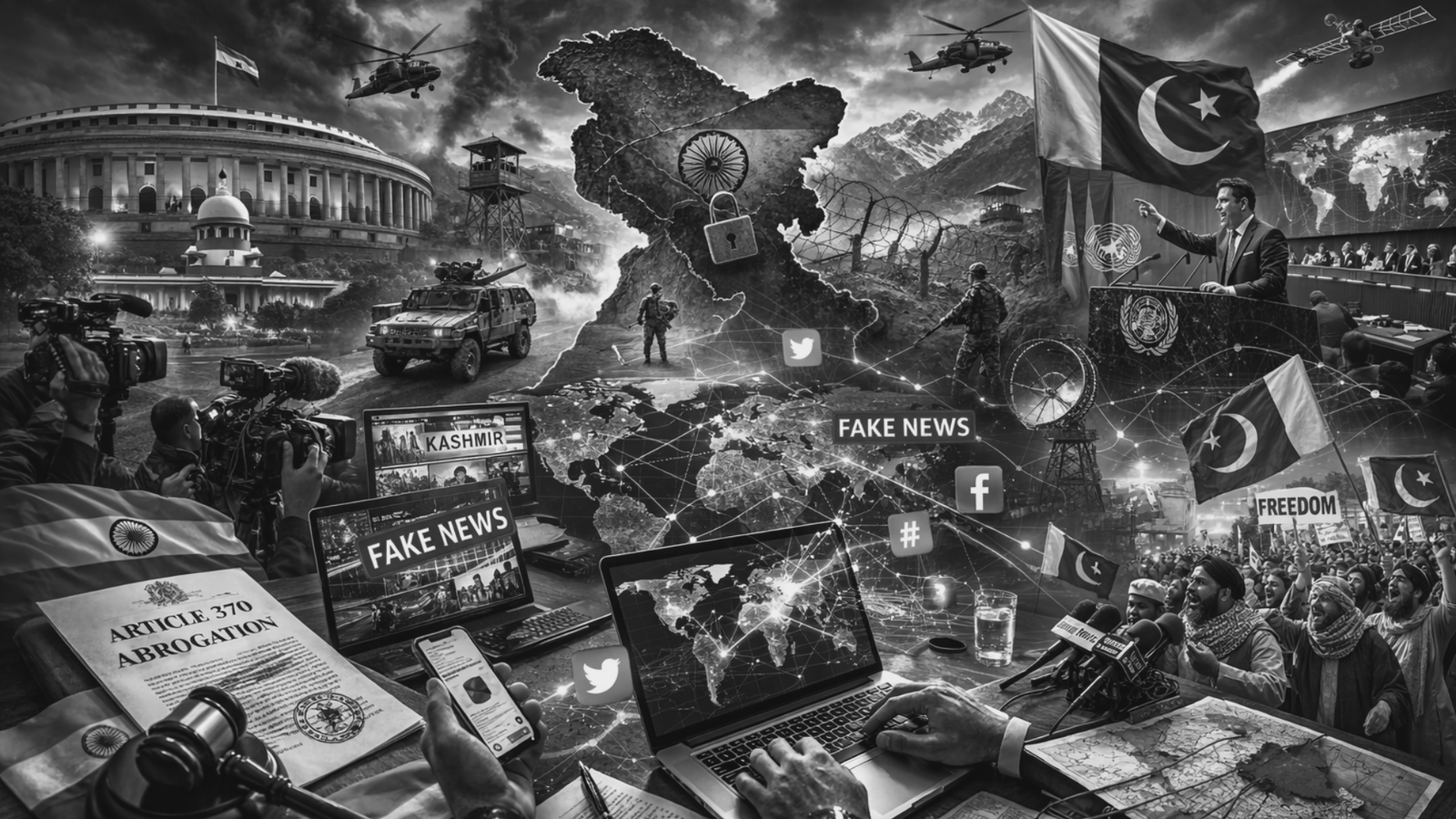
Narrative Warfare After Article 370: A Structured Analysis of Pakistan’s Information Warfare Strategy in Kashmir

Introduction: Conflict in the Age of Perception
The twenty first century is seeing the conflicts not limited to borders, but instead occurring in newsrooms, diplomatic corridors, social media feeds, think tank papers, and algorithm driven echo chambers. The repeal of Article 370 in August 2019 did not simply change the constitutional fabric of Jammu & Kashmir it was a confrontation of information in which perception has become a weapon on its own. It was not that the tanks were driving across borders, but that the stories were like missiles. Having no means of reversing that decision through the tool of military build-up, even the influence of diplomacy, Pakistan brought the war to the sphere of the opinion of the world, to the online mobilisation and symbolic politics. The competition that followed was not just based on who controls the land but as well as the one who has the story of the land.
However, it would be analytically weak to reduce the episode to the one-sided propaganda exercise. The narrative projection by Pakistan was orderly and multi-layered as compared to the counter narrative by India which was marked with the extreme of assertiveness and defensive retaliation. The Post 370 stage is, therefore, an excellent example of narrative warfare where perception, symbolism and information speed is a statecraft. The confrontation is not conceivable without the analysis of the external structures of propaganda, yet internal lapses in communication to which such stories could be unveiled on the international scale.
Understanding Narrative Warfare: The New Theatre of Conflict
Narrative war has ceased to be a by-product of foreign policy, but it is one of the primary tools of strategic influence. A narrative warfare can occur with layer storytelling when compared to the traditional propaganda which is extremely repetitive and unidirectional in delivering a message. It integrates diplomacy, media optics, academician intervention, social media ecosystem, and diaspora interventions, and/or civil society interventions to persuade how events are framed, rather than described. Not only is it directed at informing, but conditioning perception.
With the loss of Article 370, the arena shifted to be psychological but not geographical. The question that never was, now ceased to be, What happened? but became, What is it, and who determines that? This distinction is crucial. The fact that the states are unable to control the interpretation even authoritative policy steps can sound provocative or invalid in the international mind. Narrative war as such is thus a kind of multiplier of limited leverage and an offset of the absence of conventional alternatives. Narrative warfare is particularly strong in such a case as in South Asia, where historical memory, identity politics and media sensationalism are already heavily burdened. A single viral photograph, a trending hashtag or even a well-edited diplomatic sentence can do far more than a cumbersome policy document. In this case the perception is not a by-product of power, but it forms part of power.
Pakistan’s Narrative Architecture: A Structured Propaganda Strategy After Article 370
The post Article 370 narrative plan that was adopted by Pakistan did not occur and was not founded on emotional layers only; it was institutional, multi-layered. It was designed in three overlapping pillars of diplomatic persistence, media amplification and digital mobilisation with the help of the diaspora advocacy, and political symbolic gestures. It was not a short term success strategy, but rather a long term recognition strategy. This is a vital difference. The continuation of the war in the story is more significant than the immediate outcomes.
Diplomatic Persistence as Strategy: There was no vainness in several references of Kashmir at international forums such as the United Nations and Organisation of Islamic Cooperation, bilateral diplomatic negotiations, etc: these guaranteed the discursive relevance. Even when it was impossible to turn to some tangible resolutions despite uncessant appeal to the issue, the narrative closure was not observed. Repeat was ensured in survival of discourse on the world. This approach shows a basic premise in the information strategy visibility first then legitimacy. A problem being constantly discussed acquires a seeming importance, regardless of the immediate impact.
Media Optics and Emotional Framing: Television arguments, editorials, panel discussions and documentary style shows were also force multipliers. The visuals of information conflict generally overwhelm policy language. There will be more impact on the viewer, who is miles away, with horrible photos, the use of barbed wire, the interviews with civilians than the explanation of the constitution of the legal documents. When directed to the uniform repetition, selective emphasis has the effect of establishing a cycle of perception that is stretched far beyond the geographical truth. The use of emotion was also not an accident but a well-calculated measure to ensure that it became viral compared to statistics.
The Digital Domain: Social Media Warfare, Algorithms and Information Manipulation
In the event that diplomacy provided intent and traditional media amplification, social media provided velocity, anonymity and scale all three factors which inherently changed the very nature of post Article 370 contestation of narrative. It was not only the debate through other mediums that crossed into the arena of online but it was the huge arena where perception was made on an hourly or minute-by-minute basis. Digital ecosystems emphasize the use of the immediate versus the traditional diplomacy that is slow and operates in mediated avenues. In the hours following the announcement of the policies, hashtags appeared, the number of threads of influencers grew, and emotionally charged images were shared across the borders without any verification filters.
The algorithmic structure that dictated visibility was what made this domain strategically effective not because of volume of content alone but because of the volume of content. Feeds on websites like X and YouTube suggestions acted as noiseless disseminators that promoted selective information to audiences worldwide irrespective of the level of factuality. Algorithms, in turn, were unknowingly turned into geopolitical participants not by design, but design. The metrics of engagement substituted the diplomatic credibility as a measure of influence. An official policy brief most frequently had less reach than an interactive tweet.
Nevertheless, a very important asymmetry was revealed through the digital strategy. Although, diaspora inspired amplification and influencer centricity of narratives proved to be effective in the early stages by Pakistan, the digital counter narrative of India tended to be seen as institutionally conservative and slow, leaving the opposing interpretation to take the psychological first mover advantage. Timing is not a cosmetic thing in information warfare. The original heavily disseminated reading is often taken as the parameter against which all subsequent descriptions are gauged.
The other characteristic was the blending of feeling with information bits. Short video clips, protest visuals with edits, and selective statistics produced emotive micro narratives that spread quicker than thoroughly developed reports. The fragments themselves did not have to be completely untrue to be helpful, incomplete truths selected selectively were equally convincing. This illustrates a contemporary fact of narrative warfare fake news is not necessarily made up; it is frequently tactically incomplete. But the digital world also proved its own failure. Virality worked temporarily but not on a lasting basis. The trends were evolving within days and sustainable persuasion was a production of content, coordination and narrative continuity that was constant. The digital campaigns were dispersed as a result of the lack of institutional support. Through this, the algorithms were the multipliers of the forces as well as they demanded the consistency and narrative discipline which the parties were not perfect at maintaining in the long-term scale.
In India, this step brought a learning point of an organization to the fore: digital diplomacy can no longer be inter-agency or reactive. The algorithm driven ecosystem narrative defence requires preemptive storytelling, organized visual communication and instantaneous multilingual outreach. The competition post Article 370 proved that agility can be awarded as much in information space as correctness and not even with the aid of digital synchronisation, the powerful policy stands may seem to be softened in the world imagination.
Diaspora Networks and Transnational Advocacy in the Kashmir Information War
Diaspora mobilisation is another aspect of narrative war that is frequently underestimated. The foreign communities have access to the political, media, and academic ecosystems of the influential political organizations. The diaspora networks expand the narrative of a nation by the use of protests, seminars, lobby groups, and opinion writing outside of the official problem-solving channels. Their involvement creates an organic naturalness and lowers the semblance of a state organization. In the context of the Article 370, the activity of the diaspora served as a medium between the national feeling and the discourse of the international arena. It showed the ability of narrative warfare to cross state boundaries and become transnational. When a citizen in a foreign country is involved in making the narratives, it gives the campaign a touch of spontaneous civil action instead of centralised control that gives it greater credibility.
India’s Counter-Narrative Strategy: Diplomatic Strengths and Communication Gaps
The counter-narrative of India in the post Article 370 phase was characterized based on institutional trust and legal clarity but uneven communication structure was evident. In diplomatic arena, India held a strong and constant policy based on constitutional sovereignty and non interference, which appealed to the formal state to state interactions. The victory in narrative warfare is, however, hardly assured by war in conference rooms alone; being fought at the same time over media cycles, digital ecosystems, scholarly forums and civil society. It was in these parallel arenas that the response of India seemed to be considered as good strategy with inconsistency in tactics.
The main strength in the approach of India was the factual positioning and decisiveness in politics. This message was legally sound and was supported by administrative action which gave long term credibility. However, credibility devoid of continued narratives can hardly be converted to real-time perception benefit. Though statements were aggressive and official, during the initial stages of the pandemic, there was no coordinated visual and digital communication strategy, and opposing statements took the seats of the psychological first mover. When there is a conflict of information, the initial interpretation that has gained widespread circulation often forms the prism through which all other elucidations are viewed.
The other disjointed area appeared in the field of the global civil society participation. Governments are not the only ones influencing international discourse as of today, but also universities, human rights organisations, think tanks, and independent journalists. The outreach of India in these circles was there but not in proportion to the size of the narrative contest. The outcome was a reflection of asymmetry of perception, not the absence of arguments in India, but the fact that they were not propagated at the same speed or in the same manner.
Digital sphere also showed structural fragmentation. Interaction of various agencies was going on in parallel but not necessarily integrating in a coordinated attempt to create an impression of dissemination rather than coordination. Narrative war is more consistent and emotional than factual in nature. Even the hours of delay in being able to respond to the viral content may allow opposing explanations to percolate. It did not fail in intention but taught a lesson that modern statecraft must have real time narrative management supplemented by traditional diplomacy.
Notably, the gaps are not disregarding of the strategic advantages in India, but they indicate areas of improvement. This is not to say that the counter narrative was not good, but rather that it was not leveraged. India had legal capability, institutional support, as well as geopolitical alliances, - but the rendition of these resources into persuasive international narrations was sometimes ad hoc rather than ad pro. The episode Article 370 thus highlights a more general point, namely, in perception motivated conflicts, silence is not neutral and delay is not visible. Once lost, narrative space requires an excessive effort to restore.
Domestic Political Consolidation and Strategic Messaging in Hybrid Conflict
Narrative war works only as well. The information contest was a domestic consolidation mechanism to both states. Excessive conflicts with other countries can be used as a unifying icon, and it can shift popular discourse at times of economic or political turmoil. When identity politics is used in accordance with the foreign policy messaging, internal cohesion can be reinforced and external projection can be supported. Therefore, narrative strategies have two purposes international persuasion and domestic stabilisation.
This is two-sidedness that makes narrative war not only a communication strategy but a weapon in politics as well. It facilitates the governments to transform geopolitical modifications to create tools of continuity and legitimacy. Over-internal politicisation can also limit the elasticity of diplomacy; thus the compromise might appear to play an air of feeble negotiating rather than bargaining.
Credibility, Information Ecosystems and the Structural Limits of Propaganda
Constrained as it is, Narrative warfare is, nevertheless, flexible. There is plurality of information ecosystems; counter narratives are highly accessible. Different perceptions, offered by third-party news media, academic research, and competing states, are the ones that water down one-way communication. Moreover, the worldwide audiences are demanding verifiable information that is reducing the long term success of pure emotive rhetoric.
Credibility sustainability is another weakness. Emotional stories draw in very fast but are undermined unless supported with steady facts or diplomatic development. The virality is short-lived; credibility has to be sustained. A headline, a social media trend can be formed by storytelling, but economic alliances, institutional alliances, and realities on the ground cannot be permanently replaced. Credibility is better than virality in the long run.
Regional Security Implications: Hybrid Warfare in South Asian Geopolitics
The episode of Article 370 is an indication of greater change in the paradigms of security in the region. Conflicts are becoming more and more hybrid as they combine both traditional deterrence and information manoeuvres. Narrative warfare does not substitute military or diplomatic strategy, it precedes them, accompanies them and is occasionally longer. It conditions the psychology on which policy decisions will be viewed.
In the case of South Asia in which historical memory and identity politics are extremely powerful, the manifestation of narrative strategy into statecraft is a pointer towards perception centric geopolitics. The new conflict scenarios will be characterised by immediate digital mobilisation, framing fast internationally and a long-term symbolic interaction. The dilemma of states is not how to develop convincing stories but make them believable to a variety of people.
Policy Lessons: Digital Diplomacy, Strategic Communication and Narrative Management
The lessons that the post Article 370 narrative contest has to offer are not limited to one episode in geopolitics. It emphasizes the fact that information warfare is not an interim mechanism of response but a strategic reality. Although India proved to be institutionally resolute, diplomatically articulate, further stages of geopolitical interaction have sometimes indicated the same lapses of communication especially in the context of digital synchronisation, fast reaction, and reaching out to global civil society. These redundancies are not an indication of strategic flaws but it is a consequence of the changing and dynamic nature of information ecosystems where the strategy that was successful yesterday can be exploited in a couple of days.
The main lesson is that institutionalised narrative coordination should be used instead of episodic messaging. The visual storytelling, multilingual outreach, and real time digital diplomacy need to be used concomitant to, not after, traditional statecraft. The response to these international think tanks, academic forums and diasporas networks should be proactive and not reactive. The space of narrative, once lost, however temporarily, requires a disproportionate amount of effort to recapture.
There should be a balance between credibility and assertiveness as well. Emotional amplification can multiply to produce the immediate attention but the overall effect of the policy and transparency of the policies in the long term. It is not merely a PR strategy to reinforce the inter-agency communications infrastructure and invest in narrative infrastructure, but also a long-term security requirement to India. The situation in the case of Pakistan sustained appearance needs to have the backing up with the empirical evidence to avoid losing the credibility within the international discourse.
The future of the road is finally in the smarter rather than the louder messaging, which is consistent, coordinated and credible. Narrative warfare is destined to evolve with technology, but, the principle will remain, which consists of the fact that perception, when not controlled, becomes a strategic disadvantage; when controlled with a sense of organicity and naturalness, strategic capital.
Conclusion: Perception as Strategic Capital in 21st Century Geopolitics
Effects of Article 370 revealed that the geopolitical struggles underway transcend beyond the law-making parliaments and border walls. They are produced in the studios, time periods, conference halls and arenas of diasporas where perception has never been created and spread as rapidly as it is now. The strategy employed by Pakistan was a classic illustration of how narrative war can also serve as a leveller of strategies in situations where the traditional advantage is limiting whereby the expression of communication is turned into power. India showed that policy must be daring but skill in narrating the story had to come with it.
Narrative power is conditional. It can concentrate the attention, command sympathy, and be seen, but it is as long as it is plausible, logical and flexible. In the world where diplomacy is becoming laisses-faire than informatician, where pictures are becoming the order of the day as well as the record, states are becoming increasingly engaged in not only in the possession of location, but in the possession of definition. The Article 370 narrative confrontation contest is one of the defining realities of the twenty first century geopolitics: what is perceived as side is not necessarily the side that is winning in the conflict, but it is certainly a part of the creation of the memory of the conflict, its discussion, and what is elected in politics.
The views expressed are those of the authors and do not represent the views of CNAWS.
ImageSource: ChatGPT


