

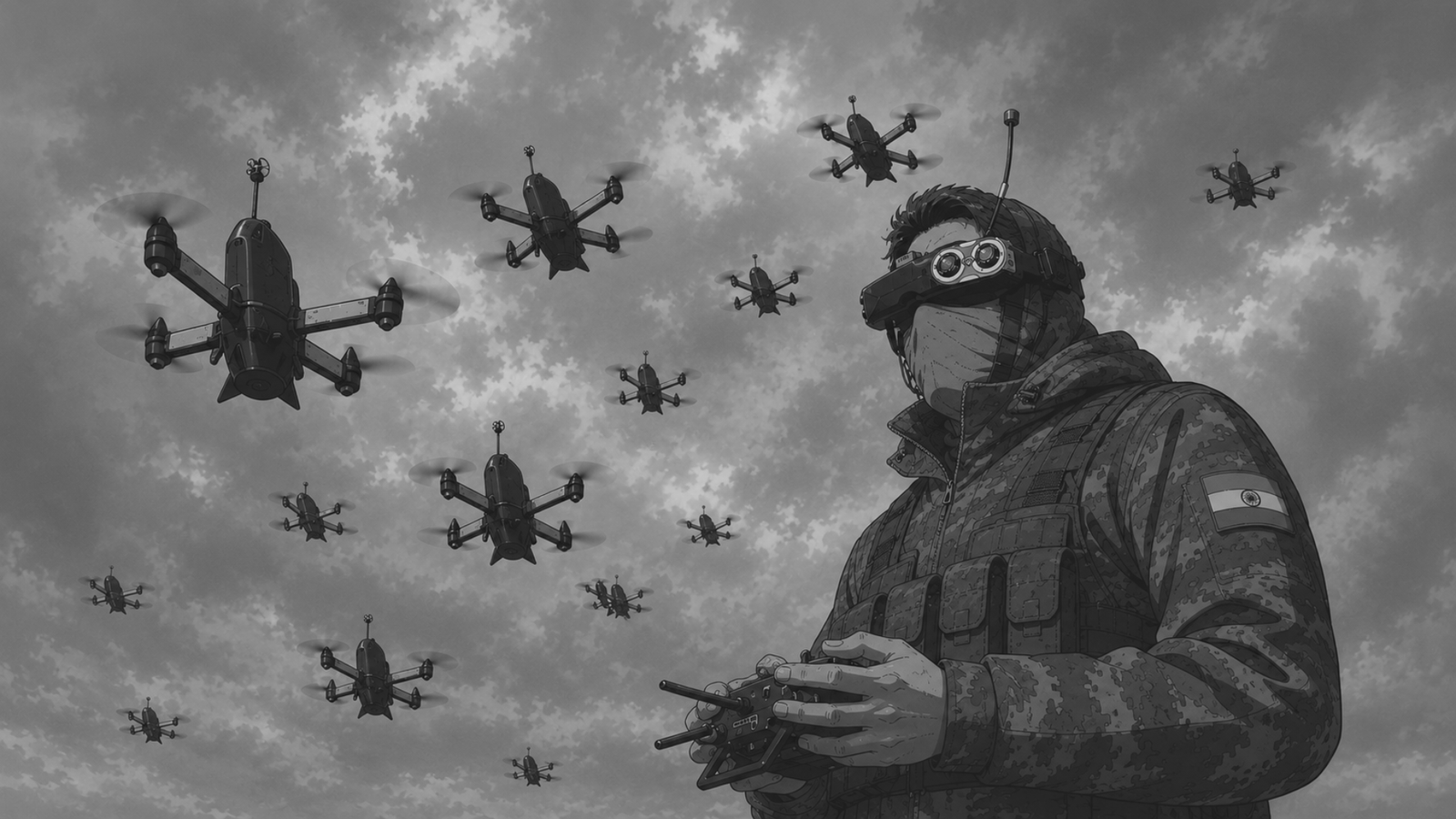
Operation Sindoor and the New Age of Warfare: Lessons from Nagorno-Karabakh, Ukraine and West Asia for India

Operation Sindoor and the Changing Character of Warfare
As India marks one year of Operation Sindoor, the operation continues to occupy a significant place in the country’s evolving national security doctrine. Conducted in response to the Pahalgam terror attack, Operation Sindoor demonstrated India’s willingness to impose costs on cross-border terror infrastructure through calibrated and precise military action. More importantly, it reflected the growing maturity of India’s joint operational capabilities, where air, land, maritime, intelligence, and technological assets operated in close coordination to deliver strategic effects while maintaining escalation control. Official statements and subsequent military assessments highlighted the role of precision targeting, long-range strike capabilities, and tri-service integration in shaping the operation’s success.
Yet even as Operation Sindoor showcased the professionalism and technological sophistication of the Indian Armed Forces, the character of warfare itself is undergoing a profound transformation. Recent conflicts across Nagorno-Karabakh, Ukraine, West Asia particularly the recent US-Iran confrontation have revealed an uncomfortable reality for advanced militaries that the battlefield is no longer defined solely by high-end platforms and expensive precision systems. Increasingly, relatively cheap drones, loitering munitions, and attritable autonomous systems are capable of imposing disproportionate operational and economic costs on technologically superior adversaries. In several theatres, low-cost unmanned systems costing a few thousand dollars have forced the expenditure of interceptor missiles worth hundreds of thousands, and in some cases millions, of dollars.
This emerging “cost asymmetry” is rapidly reshaping military thinking across the world. Iran’s extensive use of inexpensive Shahed-series drones and asymmetric strike systems has demonstrated how weaker powers can exploit affordability, mass production, and battlefield saturation to challenge even the most sophisticated air defence architectures. Analysts studying recent conflicts have increasingly argued that future wars may not simply be won through technological superiority alone, but through the ability to sustain combat at scale and impose economic exhaustion on the adversary.
For India, this presents a critical strategic question. The answer is not to abandon investment in high-end platforms such as next-gen fighter jets, aircraft carriers, submarines, integrated air defence systems, or long-range precision strike capabilities. These assets remain indispensable for deterrence, escalation dominance, and strategic warfare. However, the lessons emerging from modern conflicts suggest that India can no longer afford to build a force structure centred exclusively around a limited number of expensive platforms. The future battlefield will demand a balance between elite high-end systems and affordable mass-produced technologies such as drones, loitering munitions, electronic warfare tools, AI-enabled ISR networks, and autonomous platforms.
Operation Sindoor demonstrated India’s ability to execute precision warfare. The next challenge before Indian military planners is ensuring that such precision can also be sustained in a future battlespace increasingly shaped by attrition, autonomy, and the changing economics of war.
The New Economics of War
The wars of the last decade have fundamentally altered the economics of warfare. From Nagorno-Karabakh and Ukraine to West Asia, recent conflicts have increasingly demonstrated that military effectiveness is no longer determined solely by the sophistication of platforms or the size of defence budgets. Instead, the defining logic of contemporary warfare is increasingly shaped by affordability, scalability, battlefield transparency, and what strategists describe as “cost imposition.” The battlefield is gradually becoming a contest of exchange ratios, where relatively inexpensive systems can force technologically advanced militaries into disproportionately costly defensive responses.
1. How Nagorno-Karabakh Changed Modern Warfare
The 2020 Nagorno-Karabakh conflict served as one of the earliest and clearest demonstrations of this transformation. Azerbaijani forces extensively employed Turkish Bayraktar TB2 drones, Israeli loitering munitions, and integrated ISR-strike networks to systematically target Armenian armour, artillery, logistics nodes, and air defence systems. Analysts at the Royal United Services Institute argued that the conflict illustrated the “democratisation of precision strike,” where capabilities once monopolised by major powers became accessible to middle powers through relatively affordable unmanned systems.
Similarly, the Center for Strategic and International Studies observed that the conflict exposed the growing vulnerability of conventional force structures against integrated drone and missile warfare. Their assessment highlighted how Armenian air defence systems and armoured formations struggled against persistent surveillance and low-cost precision attacks conducted by unmanned platforms.
What made Nagorno-Karabakh strategically significant was not merely the use of drones, but the manner in which low-cost systems generated disproportionate operational effects against expensive conventional assets. Military analysts increasingly concluded that battlefield visibility itself had changed. Persistent drone surveillance reduced concealment, compressed kill chains, and enabled continuous targeting of battlefield assets. As researchers at Royal United Services Institute noted in their analysis of Armenian tank losses, the key lesson was not the obsolescence of armour, but the growing density of sensors on the modern battlefield.
2. Russia-Ukraine War and the Rise of Affordable Mass
The Russia-Ukraine war accelerated this transformation further and institutionalised drones as central instruments of modern warfare rather than supplementary capabilities. Ukrainian forces integrated commercial quadcopters, FPV drones, loitering munitions, and maritime drones into an adaptive battlefield ecosystem supporting reconnaissance, artillery correction, tactical strikes, and deep attacks. Simultaneously, Russia’s use of Iranian-origin Shahed drones demonstrated how relatively inexpensive unmanned systems could compel defenders to expend highly sophisticated and costly interceptor missiles over prolonged periods.
Experts at Center for Strategic and International Studies noted that the war in Ukraine had dramatically compressed research, development, and battlefield adaptation cycles, allowing both sides to innovate rapidly with unmanned systems at scale. Their assessments also highlighted how militaries traditionally focused on small numbers of exquisite platforms were now confronting the operational reality of cheap, attritable, and mass-produced technologies.
3. West Asia and the Cost Asymmetry Problem
The recent Israel-Iran-US confrontation in West Asia further reinforced the changing economics of modern warfare and exposed the growing limitations of relying exclusively on high-end military architectures. While Israel and the United States demonstrated overwhelming superiority in intelligence, precision strike capabilities, electronic warfare, stealth aviation, and integrated air defence systems, the conflict simultaneously revealed how relatively inexpensive drones and mass-produced strike systems can impose significant operational, logistical, and financial pressures even on the world’s most technologically advanced militaries.
Iran’s strategy throughout the conflict was rooted not in achieving conventional military parity with the United States or Israel, but in exploiting asymmetry, endurance, and saturation. Multiple strategic assessments noted that Tehran increasingly relied on large volumes of low-cost drones, one-way attack systems, dispersed missile launches, proxy networks, and layered attritional tactics designed to stretch defensive systems over time rather than defeat them in a single decisive engagement. Analysts at the Atlantic Council argued that the conflict highlighted a major shift in the “cost curve of war,” where cheap drones, open-source technologies, and scalable autonomous systems enable weaker powers to impose disproportionate costs on superior adversaries.
A particularly significant lesson from the conflict was the emerging problem of defensive cost asymmetry. Iranian-origin Shahed drones, estimated by multiple defence analysts to cost between roughly $20,000 and $50,000 per unit, repeatedly forced the use of Patriot, THAAD, and other advanced interceptor systems costing millions of dollars per engagement. Reports carried by Bloomberg, South China Morning Post, and other international publications noted that this mismatch increasingly concerned Western military planners because prolonged drone saturation campaigns could gradually deplete interceptor inventories and strain wartime logistics.
The strategic significance of this trend lies not merely in the physical damage caused by drones, but in the economic and operational burden imposed on defenders. As analysts observed during the conflict, the question was no longer simply whether advanced militaries could intercept incoming drones and missiles. In most cases, they could. The deeper question was whether such interception models were financially and industrially sustainable in prolonged conflicts characterised by persistent low-cost attacks conducted at scale. The war increasingly resembled a contest of endurance and replenishment rather than a short-duration precision campaign.
Yet this does not imply that advanced fighter aircraft, submarines, aircraft carriers, or integrated air defence systems are becoming obsolete. The lesson emerging from recent conflicts is more nuanced. Cheap systems can impose costs, but high-end systems still decide strategic outcomes. The future battlefield will likely reward militaries capable of integrating elite high-end capabilities with low-cost mass-produced systems into a coherent operational architecture.
Why High-End Platform Still Matter
The rise of drones and low-cost autonomous systems has undoubtedly transformed the battlefield, but recent conflicts also demonstrate the danger of drawing overly simplistic conclusions about the decline of high-end military platforms. The wars in Ukraine and West Asia do not suggest that fighter aircraft, integrated air defence systems, submarines, or advanced ISR networks are becoming obsolete. Rather, they reveal that future wars will increasingly be fought through a complex interaction between affordable mass and high-end precision. Cheap systems can impose costs and complicate operations. High-end systems still determine strategic outcomes.
1. Air Superiority, SEAD and the Future Battlefield
The recent Israel-Iran confrontation provides perhaps the clearest example of this reality. Iran and its regional network relied heavily on drones, ballistic missiles, cruise missiles, and saturation attacks designed to stretch Israeli and American defensive systems. The use of large numbers of low-cost drones demonstrated how relatively inexpensive systems could create operational pressure and force repeated defensive responses. Analysts at the Center for Strategic and International Studies observed that modern drone warfare is increasingly driven by scale, affordability, and the ability to exhaust defensive architectures over time rather than by singular battlefield breakthroughs.
Yet the conflict simultaneously demonstrated the enduring importance of advanced airpower and integrated high-end military capabilities. Israel rapidly established operational air superiority over significant parts of Iranian airspace through a combination of stealth aircraft, electronic warfare, intelligence dominance, suppression of enemy air defences (SEAD), destruction of enemy air defences (DEAD), precision stand-off strikes, and network-centric operations. A detailed CSIS assessment comparing the Ukraine and Iran air campaigns concluded that Israel succeeded because of its ability to combine superior intelligence, offensive air doctrine, networked warfare, and advanced combat aviation into a coherent operational architecture.
This distinction is strategically important. Iran’s drones and missiles succeeded in imposing costs and generating disruption, but they could not independently achieve decisive strategic effects against an adversary possessing superior airpower, ISR integration, electronic warfare capabilities, and precision strike systems. In contrast, Israeli airpower retained the ability to penetrate defended airspace, conduct strategic strikes, and shape the overall trajectory of the conflict. The lesson emerging from West Asia is therefore not that drones replace airpower, but that modern warfare increasingly requires a layered interaction between attritable systems and high-end platforms operating inside a networked battlespace.
The Ukraine war also reinforces this conclusion. Drones have transformed tactical warfare by enabling persistent ISR coverage, artillery correction, battlefield transparency, and low-cost precision attacks. However, neither Russia nor Ukraine has been able to dispense with conventional artillery, integrated air defence systems, combat aviation, electronic warfare, long-range missiles, or armoured manoeuvre warfare. Analysts across Western strategic institutions increasingly argue that drones are augmenting rather than replacing traditional military capabilities.
Perhaps the single biggest lesson from Ukraine is the enduring importance of air superiority and electromagnetic dominance. Russia’s inability to establish complete air superiority significantly constrained its operational flexibility, restricted deep manoeuvre operations, complicated close air support missions, and contributed to prolonged attritional warfare. In contrast, whenever either side achieved temporary localised air dominance combined with electronic warfare superiority, battlefield momentum shifted rapidly.
2. Kill Webs and Network-Centric Warfare
This is because modern warfare is increasingly fought through interconnected kill webs rather than isolated platforms. Sensors, satellites, drones, electronic warfare systems, AWACS platforms, cyber capabilities, artillery, and combat aircraft are now integrated into compressed sensor-to-shooter loops capable of identifying and striking targets within minutes or even seconds. High-end platforms remain indispensable because they serve as critical nodes within these kill webs.
Fighter aircraft such as the Rafale are not merely “flying weapons platforms.” They function as multi-role networked combat systems capable of offensive counter-air missions, SEAD/DEAD operations, beyond-visual-range engagements, electronic attack, precision deep strike, and airborne battlespace management. Such missions cannot currently be replicated by low-cost drones alone.
Similarly, airborne early warning and control systems remain central to modern warfare because they provide battlespace awareness, airborne command-and-control, target prioritisation, and airspace management across large operational theatres. In highly contested environments involving drones, cruise missiles, decoys, and electronic warfare, battlespace visibility itself becomes decisive.
The same applies to submarines and aircraft carriers. In an Indo-Pacific environment increasingly shaped by anti-access/area denial (A2/AD) competition, maritime ISR, long-range precision strike, and sea denial operations, submarines remain among the most survivable strategic assets available to modern militaries. Aircraft carriers continue to provide expeditionary airpower, maritime strike capability, sea control, and strategic signalling far beyond the reach of land-based systems.
3. The Growing Importance of Electronic Warfare and Multi-Domain Operations
Equally critical is the role of electronic warfare and electromagnetic spectrum dominance. Future wars are likely to involve extensive jamming, spoofing, cyber-electromagnetic attacks, GPS denial, communications disruption, and degradation of ISR networks. The side capable of maintaining resilient communications and operational networking under contested electromagnetic conditions will possess a major battlefield advantage.
This is precisely why network-centric warfare and multi-domain integration are becoming increasingly central to military doctrine worldwide. Modern conflicts are no longer fought sequentially across land, sea, and air domains. They are fought simultaneously across air, land, maritime, cyber, space, and electromagnetic environments. The military that integrates these domains most effectively gains decision superiority.
For India, these lessons are particularly relevant because of its strategic geography and threat environment. India faces the possibility of high-intensity conflict across multiple domains involving Pakistan and China simultaneously. Future conflict scenarios may involve drone swarms, long-range rocket artillery, hypersonic weapons, cyber-attacks, electronic warfare campaigns, satellite disruption, stand-off precision strikes, and contested maritime environments in the Indian Ocean Region.
In such an environment, high-end platforms remain indispensable not only for warfighting, but for deterrence itself. Strategic deterrence depends not merely on possessing military assets, but on possessing survivable and credible capabilities capable of penetrating contested battlespaces and imposing unacceptable costs on adversaries.
4. Why Survivability in Modern Warfare is Changing
However, recent conflicts also demonstrate that survivability itself is changing. Large static bases, concentrated logistics hubs, and predictable force deployments are becoming increasingly vulnerable to persistent ISR and long-range precision strike systems. As a result, future force structures will likely need to evolve toward distributed operations, hardened infrastructure, mobile logistics, decoy systems, and dispersed kill chains capable of operating even under degraded network conditions.
The real lesson from modern conflicts, therefore, is not that militaries should choose between fighter jets and drones. The future battlefield will reward militaries capable of integrating both into a coherent operational ecosystem. Precision without mass risks strategic exhaustion. Mass without precision risks operational ineffectiveness. Military effectiveness in the coming decades will depend on the ability to combine survivable high-end capabilities with scalable low-cost autonomous systems, resilient industrial production, layered air defences, electronic warfare dominance, AI-enabled decision systems, and network-centric multi-domain operations.
For India, the challenge is not whether to invest in high-end platforms or drones. It is whether the country can build a force structure capable of sustaining strategic precision, battlespace awareness, electromagnetic dominance, and battlefield endurance simultaneously in the wars of the future.
What India should Actually Do – A Roadmap
The central challenge before India is therefore not whether to choose between high-end platforms and low-cost autonomous systems, but how to create a force structure that combines strategic precision with scalable battlefield endurance. Recent conflicts have repeatedly shown that modern warfare rewards militaries capable of integrating survivable high-end assets with affordable mass, resilient industrial ecosystems, and rapid technological adaptation. For India, this requires doctrinal, industrial, and procurement-level transformation rather than incremental adjustments.
1. Building India’s Affordable Mass
The first requirement is the creation of what may be termed “affordable mass.” The Russia-Ukraine war has demonstrated that attritable systems such as FPV drones, loitering munitions, and low-cost ISR platforms are no longer supplementary capabilities operating at the margins of warfare. They are becoming central instruments of battlefield operations. The widespread use of drones has dramatically increased battlefield transparency, shortened targeting cycles, and made concealment and force concentration significantly more difficult.
For India, the implications are substantial. A military structure dependent primarily on limited inventories of expensive precision systems may face severe sustainability challenges during prolonged conflict. India will require the capacity to mass-produce loitering munitions, swarm systems, tactical ISR drones, expendable autonomous platforms, and low-cost precision strike systems at scale. The critical lesson emerging from recent conflicts is that expendability itself has become a battlefield advantage. Militaries capable of rapidly replacing losses and sustaining operational tempo possess greater resilience than forces overly dependent on small numbers of exquisite systems.
2. Countering Affordable Mass Through Economically Sustainable Air Defence
However, the challenge is not limited to building India’s own affordable mass. The equally important task is developing the capacity to neutralise the affordable mass of the adversary. Future battlefields in South Asia are likely to witness large-scale drone swarms, loitering munition attacks, autonomous ISR saturation, and coordinated missile-drone strikes designed to overwhelm conventional air defence architectures through sheer volume and economic asymmetry.
This demands the creation of layered and cost-effective counter-drone ecosystems built around both soft-kill and hard-kill approaches. Soft-kill capabilities such as electronic warfare systems, GPS spoofing, signal jamming, cyber intrusion tools, electromagnetic disruption, and communications denial systems will become increasingly important in degrading or redirecting incoming drones without expending expensive interceptor missiles. At the same time, hard-kill systems including directed-energy weapons, anti-drone guns, interceptor drones, close-in weapon systems, rapid-fire air defence guns, and low-cost kinetic interceptors will be essential for defeating drones that penetrate electronic countermeasures.
India must avoid falling into the same cost asymmetry trap increasingly visible in modern conflicts, where million-dollar interceptor missiles are repeatedly used against drones costing only a few thousand dollars. The future challenge is not merely interception, but economically sustainable interception.
3. Distributed Warfare and Battlefield Survivability
However, recent conflicts also demonstrate that survivability itself is undergoing fundamental transformation. Large static airbases, concentrated logistics hubs, fixed command-and-control centres, ammunition depots, and predictable force deployments are becoming increasingly vulnerable to persistent ISR coverage, satellite surveillance, loitering munitions, and long-range precision strike systems. The proliferation of drones, space-based sensors, electronic intelligence platforms, and AI-enabled targeting architectures has significantly compressed sensor-to-shooter timelines across modern battlefields.
As a result, future force structures will likely need to evolve towards distributed operations, hardened infrastructure, mobile logistics, deception architectures, decoy systems, electromagnetic discipline, and dispersed kill chains capable of functioning even under degraded network conditions. Survivability in future wars will increasingly depend not merely on physical protection, but on mobility, redundancy, signature management, operational dispersion, and the ability to sustain network-centric operations under persistent surveillance and electronic warfare conditions.
4. AI, Sensor Fusion and Network-Centric Air Defence
Equally critical is the integration of India’s entire air defence ecosystem into a network-centric architecture capable of real-time sensor fusion and AI-assisted decision-making. Modern drone warfare unfolds at speeds and scales that exceed traditional human-centric command structures. Future conflicts may involve hundreds of simultaneous aerial objects operating across multiple altitudes and directions. In such an environment, fragmented air defence systems operating in isolation will struggle to respond effectively.
India will increasingly require integrated battle networks linking satellites, airborne early warning systems, ground radars, acoustic sensors, electronic warfare units, air defence batteries, combat aircraft, and autonomous counter-drone systems into a unified operational grid. Artificial intelligence will become central to this architecture by enabling rapid threat classification, prioritisation, sensor fusion, automated interception recommendations, and real-time battlespace management.
Space-based capabilities will also play a critical role. Persistent satellite surveillance, real-time ISR support, secure communications, navigation redundancy, and battlefield data transmission will increasingly determine operational effectiveness in drone-heavy environments. Future wars will not merely be fought through platforms, but through interconnected kill webs integrating space, cyber, air, land, and electronic warfare domains into a single operational ecosystem.
5. Lessons from Ukraine’s Acoustic Detection Networks
The Ukraine war has also highlighted the growing utility of unconventional and low-cost detection systems such as acoustic sensors and acoustic radar networks. Ukraine has increasingly relied on distributed acoustic detection systems capable of identifying incoming drones and low-flying aerial threats through sound signatures, particularly in environments where traditional radar coverage is limited or economically inefficient. Such systems offer an important lesson for India because they provide relatively affordable and scalable methods of enhancing low-altitude airspace awareness against mass drone attacks.
India should therefore explore multi-layered sensor ecosystems combining conventional radars with electro-optical systems, passive sensors, acoustic detection networks, AI-enabled surveillance systems, and distributed battlefield ISR grids. Future air defence effectiveness will depend not only on interceptors, but on the density, survivability, and adaptability of the sensor architecture itself.
6. Layered Force Structures and Strategic Precision
The second requirement is the development of layered force structures capable of balancing cost efficiency with strategic effect. Recent conflicts demonstrate that not every battlefield target requires the deployment of a fighter aircraft sortie or a long-range precision missile. Tactical reconnaissance missions, battlefield logistics disruption, short-range strike operations, and persistent ISR tasks can often be executed more efficiently through low-cost unmanned systems. High-end platforms, by contrast, remain indispensable for strategic strike missions, suppression of enemy air defences, electronic warfare, escalation control, and operations in contested airspace.
This distinction is becoming increasingly important because modern warfare is also becoming economically competitive. Technological sophistication alone is insufficient if operational inventories cannot be replenished rapidly under wartime conditions.
7. Industrial Warfare and Indigenous Defence Manufacturing
This naturally leads to the third requirement i.e., indigenous industrial depth. One of the most important lessons from recent conflicts has been the renewed importance of industrial warfare. Even technologically advanced militaries have encountered difficulties replenishing artillery ammunition, interceptor missiles, drones, and precision-guided munitions at wartime scale.
For India, this means defence preparedness can no longer be viewed solely through the lens of procurement contracts and peacetime acquisitions. Future wars may demand sustained wartime production, distributed manufacturing networks, private-sector integration, dual-use technological ecosystems, and resilient supply chains capable of functioning under disruption. India’s emerging domestic drone ecosystem is an important beginning, but the scale demanded by future conflict environments is likely to be significantly larger than current peacetime assumptions.
8. Rethinking India’s Defence Procurement Philosophy
Finally, India’s procurement philosophy itself requires reassessment. Traditionally, Indian defence procurement has prioritised relatively small numbers of expensive platforms acquired through long acquisition cycles. While such systems remain indispensable for deterrence and strategic warfare, recent conflicts increasingly reward rapid adaptation, scalable production, and technological flexibility. Battlefield technologies today evolve at a pace far faster than traditional procurement structures were designed to accommodate.
Future wars may therefore require militaries capable of fielding thousands of expendable systems while continuously modifying them through battlefield feedback loops. Procurement systems designed primarily for peacetime bureaucratic efficiency may struggle under such conditions. India will likely require faster acquisition pathways, closer integration between the armed forces and private industry, decentralised experimentation, operational flexibility, and doctrinal structures that encourage rapid technological adaptation.
9. Theatreisation and Integrated Multi-Domain Operations
Perhaps the most important reform India requires is a significantly higher degree of interoperability and jointness between the Army, Air Force, and Navy. Future wars will not be fought as isolated service-centric campaigns operating in parallel. They will increasingly unfold as integrated multi-domain operations across land, air, maritime, cyber, space, and electromagnetic environments simultaneously.
Recent conflicts have repeatedly demonstrated the importance of integrated kill chains, real-time data sharing, unified command structures, and coordinated cross-domain operations. Drone warfare, long-range precision strike systems, electronic warfare, cyber operations, and space-enabled ISR architectures have compressed battlefield decision cycles to such an extent that fragmented service-specific operations risk creating operational delays and battlespace inefficiencies.
For India, this makes theatreisation and joint operational structures strategically essential rather than merely organisational reforms. The creation of integrated theatre commands can significantly improve resource optimisation, operational synergy, sensor-to-shooter integration, and real-time battlespace management across theatres. In future conflict scenarios involving China and Pakistan simultaneously, India may require coordinated long-range fires, integrated air defence, maritime denial operations, cyber operations, space-based ISR support, and offensive air campaigns operating under unified operational objectives.
This becomes even more critical in the context of network-centric warfare. A future battlefield may involve Indian Army air defence units, Indian Air Force fighters and AWACS platforms, naval ISR assets, satellites, drones, electronic warfare systems, and cyber capabilities operating inside a single integrated battlespace. The side capable of integrating these systems into a unified operational architecture will possess a decisive advantage in terms of decision superiority, targeting speed, operational flexibility, and survivability.
India has already initiated movement in this direction through the creation of the Chief of Defence Staff, integrated defence structures, and ongoing discussions around integrated theatre commands. However, future warfare may demand even deeper integration involving common operating pictures, unified communications grids, integrated logistics, joint targeting doctrines, tri-service AI-enabled command systems, and seamless interoperability across all domains of warfare. Jointness in modern warfare is no longer merely about coordination between services. It is about creating integrated combat ecosystems capable of functioning at machine speed across highly contested and technologically saturated battlefields.
Conclusion: Balancing Precision with Mass
One of the most important implications of recent conflicts is that India’s future wars may increasingly resemble hybrid and multi-domain campaigns fought below the nuclear threshold rather than conventional full-scale wars aimed at territorial conquest. Operation Sindoor itself demonstrated this evolving reality. The objective was not decisive territorial occupation, but calibrated punishment, escalation control, and the reimposition of deterrence.
Both India and Pakistan are now closely studying the lessons emerging from Operation Sindoor, the Russia-Ukraine war, and the recent conflicts in West Asia. For Pakistan in particular, these wars offer a potential operational template for offsetting India’s conventional military superiority through asymmetric and cost-imposition strategies. Pakistan understands that it cannot match India economically or conventionally in a prolonged attritional conflict. Consequently, future Pakistani military adaptation is likely to focus selectively on affordable technologies capable of imposing disproportionate operational, economic, and psychological costs.
The emerging Iran-style model of warfare is particularly relevant in this context. Recent conflicts have demonstrated how relatively weaker powers can utilise drones, loitering munitions, ground-based missile systems, electronic warfare, cyber operations, proxy networks, and distributed strike architectures to complicate operations for technologically superior adversaries. Rather than seeking outright battlefield victory, such strategies aim to prolong conflict, stretch defensive systems, increase economic costs, and generate political and psychological pressure.
A future India-Pakistan conflict is therefore unlikely to resemble the large-scale conventional wars of the twentieth century. Instead, it may evolve into a prolonged multi-domain confrontation involving high-tempo air and missile campaigns, drone swarms, stand-off precision strikes, cyber-attacks, electronic warfare operations, maritime disruption, and proxy-driven asymmetric escalation occurring simultaneously across multiple theatres.
The air domain is likely to become central from the very opening stages of conflict. Both sides may seek rapid suppression of enemy air defences (SEAD), destruction of enemy air defences (DEAD), offensive counter-air operations, and long-range precision strikes aimed at degrading command-and-control systems, airbases, ISR infrastructure, logistics nodes, and strategic military assets. Unlike previous conflicts, future campaigns may witness the simultaneous employment of fighter aircraft, drones, loitering munitions, cruise missiles, ballistic missiles, cyber capabilities, and electronic warfare systems as part of integrated kill chains rather than sequential operations.
Drone warfare is likely to become particularly significant. Pakistan may increasingly invest in affordable mass including kamikaze drones, swarm systems, decoy drones, and low-cost stand-off strike platforms designed to saturate Indian air defence systems and impose economic asymmetry. Coordinated missile-drone attacks targeting military infrastructure, logistics networks, radar systems, ammunition depots, and civilian economic infrastructure may become central to escalation strategies.
At sea, future conflicts may also extend into the Arabian Sea and the broader Indian Ocean Region. India would likely seek maritime dominance, sea control, and disruption of Pakistani maritime trade and logistics, while Pakistan may increasingly adopt sea denial strategies involving submarines, anti-ship missiles, unmanned maritime systems, and asymmetric naval tactics designed to complicate Indian naval superiority.
Equally important is the likelihood of persistent asymmetric warfare occurring alongside conventional operations. Future conflict scenarios may involve cyber-attacks on critical infrastructure, electronic warfare campaigns, attacks on economic targets, proxy-driven violence, information warfare, and attempts to generate internal instability through non-state actors and autonomous strike systems. The distinction between conventional and asymmetric warfare is therefore likely to blur significantly.
This has important implications for India’s military doctrine. Future conflicts may no longer provide the luxury of gradual escalation or prolonged strategic signalling. The compression of sensor-to-shooter timelines, combined with the speed of drone warfare, missile strikes, and electronic warfare operations, may increasingly favour pre-emptive operational doctrines, rapid mobilisation, integrated theatre responses, and high-tempo multi-domain campaigns executed within compressed timeframes.
At the same time, these conflicts are also likely to remain below the nuclear threshold. This creates a paradoxical reality where limited wars, stand-off precision campaigns, asymmetric escalation, and sustained multi-domain operations become more probable precisely because both sides seek to avoid uncontrolled escalation into full-scale conventional war.
Ultimately, the future battlefield will not belong exclusively to militaries possessing the most expensive platforms, nor to those relying entirely on cheap autonomous systems. It will belong to those capable of integrating strategic precision with affordable mass, technological sophistication with industrial resilience, and high-end deterrence with scalable battlefield endurance. For India, the challenge is no longer merely acquiring advanced weapons. It is building a military ecosystem capable of sustaining modern warfare across prolonged and technologically saturated conflicts.
The views expressed are those of the authors and do not represent the views of CNAWS.
Image Source: ChatGPT


