

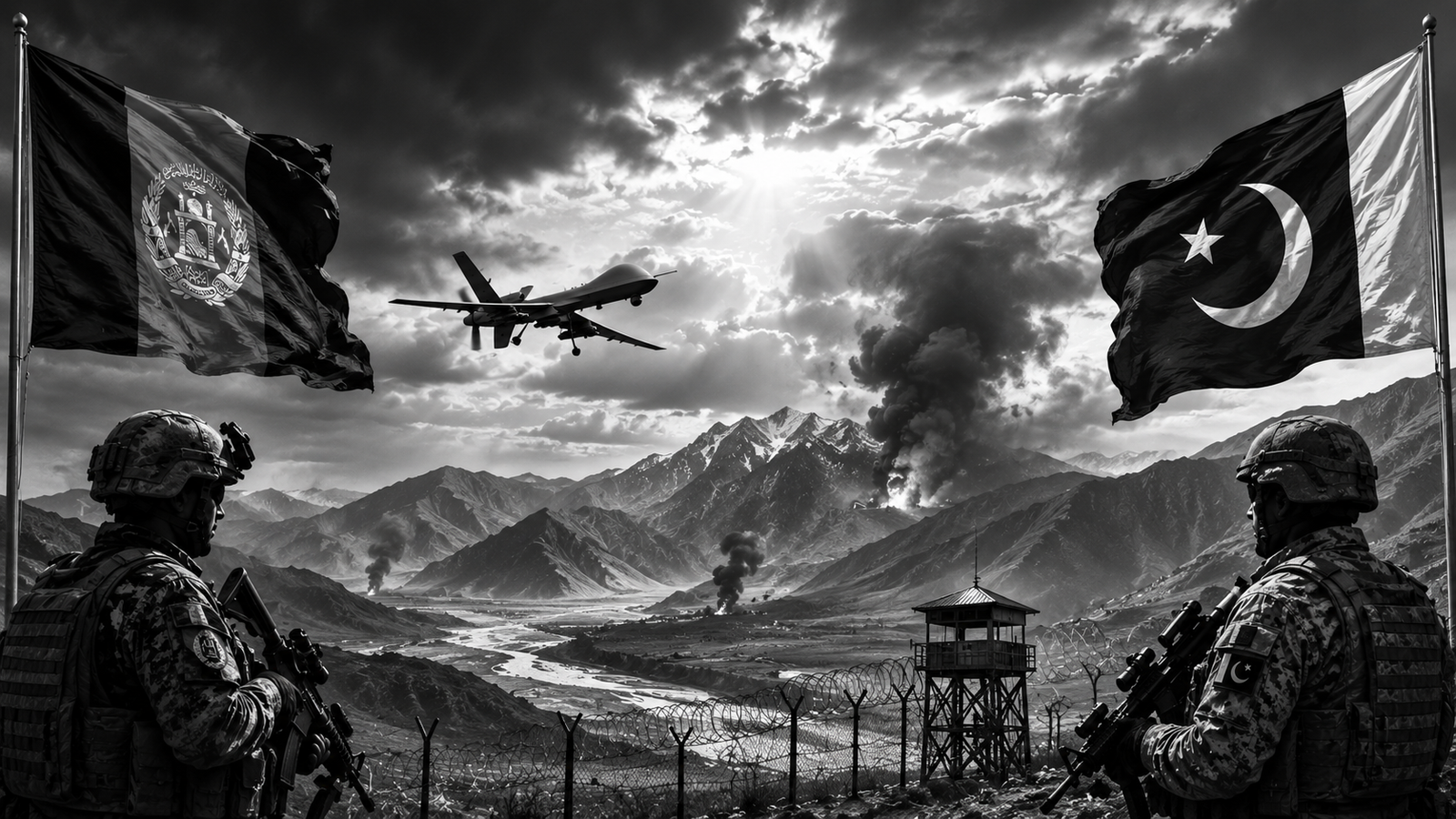
Afghan-Pakistan Tensions Escalate Following Competing Claims Over Cross-Border Strikes

On 19 June, Afghanistan's Ministry of Defense announced that its Air Force had conducted strikes against alleged militant facilities in Pakistan's Balochistan and Khyber Pakhtunkhwa provinces. According to the ministry, the targeted locations included the Gulistan area of Qila Abdullah District, the Shakar Ab Jungle Gardi area of Chagai District, and an alleged ISKP facility in the Qambar Khel area of Khyber District. Afghan authorities claimed that the sites had been used, with the support of unspecified "hostile intelligence circles," to plan and coordinate attacks against Afghanistan. The ministry further stated that all designated targets were successfully struck and reiterated that Afghanistan would no longer tolerate threats to its security and stability.
Additional details were later provided by Taliban-aligned media outlet Al-Mirsaad, which reported that a major ISKP facility in the Qambar Khel area had been destroyed during the operation. According to the report, the site allegedly functioned as a recruitment, training, and operational planning center supporting ISKP activities in the region. Al-Mirsaad claimed that multiple militants were killed or wounded in the strike, although no casualty figures were provided. The outlet further referenced previous reported strikes against alleged ISKP facilities in Jabbar Mela and Shanko, Bara, including a site reportedly operated by Abdul Hakim Tawhidi and Gul Nazim.
Pakistan swiftly rejected Kabul's assertions. In a statement issued through the Ministry of Information's Fact Check Center, Islamabad described the Afghan claims as false and alleged that militant organizations, including ISKP, continue to operate from territory under Taliban control. Pakistani authorities stated that a "rudimentary drone" originating from Afghanistan entered Pakistani airspace near the Shinko area of Khyber District and was subsequently detected and neutralized. The government accused Kabul of using such claims to divert attention from what it described as continued support for militant groups operating across the region.
The episode represents the latest chapter in a deteriorating security relationship between the two neighboring states. Since the Taliban's return to power in August 2021, both governments have repeatedly accused each other of harboring militant organizations responsible for cross-border violence. Pakistan continues to accuse Afghanistan of providing sanctuary to Tehreek-e-Taliban Pakistan (TTP) militants, while Kabul rejects these allegations and maintains that Pakistan's security challenges are primarily domestic in nature.
Recent months have witnessed a significant escalation in military activity along the Afghanistan-Pakistan frontier. The Afghan Taliban recently accused Pakistan of conducting airstrikes that killed at least 13 individuals, including 11 children, and injured 14 others. Islamabad, however, maintained that the operation targeted militant infrastructure and resulted in the deaths of 26 militants. According to United Nations reporting, cross-border violence has continued to impose a significant humanitarian and security burden on populations residing along the frontier.

Why ISKP Remains the Taliban's Primary Security Threat
Understanding the significance of Kabul's claims requires examining the Taliban's long-running conflict with ISKP. Since 2021, ISKP has emerged as the most serious armed challenger to Taliban rule inside Afghanistan. Unlike many militant organizations operating in the region, ISKP does not merely oppose foreign actors or neighboring governments; it rejects the legitimacy of the Taliban's Islamic Emirate itself.
The rivalry is rooted in both ideology and power. The Taliban's political project is centered on governing Afghanistan through the Islamic Emirate, drawing heavily from Deobandi traditions and Afghan nationalist frameworks. ISKP, by contrast, adheres to the Islamic State's Salafi-jihadist doctrine and advocates for a transnational caliphate that transcends national borders. ISKP propaganda routinely portrays the Taliban as insufficiently committed to global jihad and criticizes the movement's engagement with regional and international actors.
This ideological conflict has evolved into a direct security confrontation. Since the Taliban's return to power, ISKP has conducted attacks targeting Taliban officials, security personnel, religious scholars, minority communities, foreign diplomatic missions, and public gatherings. Although Taliban counterterrorism operations have significantly degraded the group's capabilities, international assessments continue to identify ISKP as one of the most capable and resilient terrorist organizations operating in the region.
The Taliban's campaign against ISKP is therefore not solely a counterterrorism effort. It is also a struggle to maintain political legitimacy. Since assuming power, the Taliban has consistently argued that it restored stability after decades of conflict. Every successful ISKP attack undermines this narrative and raises questions regarding the Taliban's ability to govern and provide security.
At the same time, ISKP's ambitions increasingly extend beyond Afghanistan. Security analysts have noted the group's growing interest in external operations and regional attack networks. This evolution has elevated concerns among neighboring states and international security agencies. Consequently, any indication that ISKP maintains logistical infrastructure, training facilities, or operational hubs outside Afghanistan is likely to be viewed by Kabul as a direct threat to regime security.
Strategic Implications
Whether the reported strikes occurred as described remains unclear. Independent verification of the Afghan claims remains unavailable, and Pakistani authorities have categorically rejected the allegations. Nevertheless, the competing narratives themselves are strategically significant.
First, the incident demonstrates the growing importance of drone and stand-off strike capabilities in Afghanistan-Pakistan security dynamics. Second, it highlights the persistence of mutual distrust despite repeated diplomatic engagements and mediation efforts. Third, it illustrates how both governments continue to frame cross-border militancy as originating from the territory of the other.
Perhaps most importantly, the episode reflects the increasingly transnational nature of the ISKP challenge. If militant networks are indeed operating across both sides of the frontier, future counterterrorism efforts are likely to become increasingly entangled with broader Afghanistan-Pakistan geopolitical tensions.
Absent meaningful confidence-building measures, intelligence cooperation, or a mutually accepted framework for addressing cross-border militancy, the risk of further escalation between Kabul and Islamabad is likely to remain elevated. As both states continue to prioritize security concerns and exchange accusations regarding militant sanctuaries, incidents such as the alleged June 2026 strikes may become an increasingly recurring feature of the regional security landscape.
References
[1] Afghanistan Ministry of Defense Statement, 19 June 2026.
[2] Al-Mirsaad, "Major ISIS Center Destroyed in Khyber Drone Strikes."
[3] Lowy Institute, "The Evolving Taliban-ISK Rivalry."
[4] EUAA, "Activities of the Islamic State Khorasan Province (ISKP)."
[6] Washington Institute, "ISKP Goes Global: External Operations from Afghanistan."


