


AQIS, “America First,” and the Persistence of Al-Qaeda’s Anti-American Terrorist Narrative

The newly circulated AQIS publication Sab Se Pehle America! (“America First!”) is best understood as a piece of Al-Qaeda terrorist propaganda designed to reactivate an established anti-American narrative around contemporary grievances. AQIS, or Al-Qaida in the Indian Subcontinent, is designated as a Foreign Terrorist Organization and an Al-Qaeda affiliate established in 2014. The U.S. Department of State designated AQIS as an FTO on July 1, 2016 and identifies its principal area of terrorist activity as Afghanistan, Bangladesh, India and Pakistan. ¹ Circulated on September 10, 2026, through the Nawa-e-Ghazwa-e-Hind media ecosystem, the publication appeared only one day before the twenty-fifth anniversary of the September 11, 2001 terrorist attacks. The timing is analytically significant. The available evidence does not establish that the anniversary determined the publication date, but the proximity is difficult to ignore when considered alongside the publication’s American imagery, its title, its invocation of Osama bin Laden and its repeated effort to connect present grievances with the historical conflict proclaimed by Al-Qaeda after 2001. The White House has formally designated September 11, 2026 as the twenty-fifth anniversary of the September 11 terrorist attacks².
The publication’s attribution to Sheikh Ahsan Aziz is particularly important to understanding its provenance. The document identifies Aziz as the source of its “central idea” and credits Moinuddin Shami with its “new arrangement.” This indicates that the material is being repackaged rather than presented as a newly authored 2026 text. Open-source reporting identified Engineer Ahsan Aziz as a Kashmiri jihadist who subsequently became an Al-Qaeda commander. He was killed on August 18, 2012, in a U.S. drone strike in North Waziristan. Hindustan Times reported that Aziz and his wife were killed in the strike, while Bill Roggio subsequently identified him as an Al-Qaeda commander³. AQIS itself did not exist as a formal organization until 2014, two years after Aziz’s death. The publication is therefore drawing upon the ideological authority of an earlier jihadist figure and recycling that material for a contemporary audience.
That distinction matters because the publication’s principal characteristic is not ideological innovation. It is ideological reactivation. AQIS takes an older Al-Qaeda conception of America as the central enemy and reconstructs it around issues that are politically and emotionally salient in 2026. Gaza provides the immediate grievance. American support for Israel provides the bridge to the United States. The title Sab Se Pehle America! then turns the contemporary American political slogan “America First” into a terrorist declaration that America should occupy the first position among the organization’s enemies. The phrase is strongly associated with Donald Trump’s political identity, allowing AQIS to appropriate a familiar contemporary expression and invert it for its own propaganda purposes.
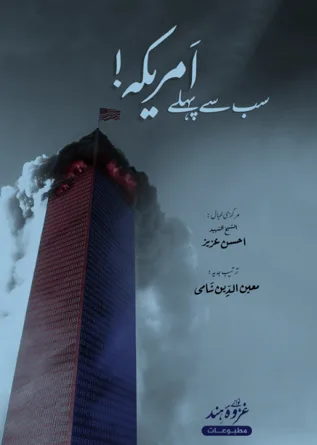
(Disclaimer: This image is for educational and research purposes. We do not endorse terrorist propaganda)
The cover makes the same argument visually. An American flag, a skyscraper and heavy smoke immediately evoke the visual memory of September 11. The image does not need to reproduce the World Trade Centre literally. Its function is more calculated than that. It places the American state, American technological power and the memory of catastrophic vulnerability into a single visual frame. The damaged skyscraper communicates that even a state presented as overwhelmingly powerful can be attacked. In the context of a terrorist publication released on September 10, immediately before the twenty-fifth anniversary of September 11, this imagery carries particular significance.
The publication then begins with Gaza and expands outward until virtually every major category of American power becomes part of the same enemy system. U.S. military activity, economic influence, foreign military training, international institutions, secularism, feminism, popular culture, drugs, pornography, detention facilities and the political leadership of Muslim-majority states are brought into one narrative. The result is not an evidence-based assessment of American foreign policy. It is a deliberately totalizing terrorist worldview in which different political, military, economic and social phenomena are presented as interconnected manifestations of American hostility toward Muslims.
This expansion is one of the most important features of the propaganda. AQIS does not maintain a meaningful distinction between direct American action, allied policy, indirect influence and developments for which it provides no credible evidence of American involvement. Once the United States is established as the principal enemy, almost any grievance can be incorporated into the same explanatory framework. Gaza is therefore not the end of the argument. It is the entry point through which AQIS attempts to connect a current war to an older Al-Qaeda narrative about American power and the supposed failure of the international order.
The section on U.S. military commands illustrates how the organization constructs this narrative. The publication lists AFRICOM, CENTCOM, EUCOM, INDOPACOM, NORTHCOM, SOUTHCOM, SPACECOM, CYBERCOM, SOCOM, TRANSCOM and STRATCOM. The underlying institutional information is factual. The U.S. Department of Defence identifies eleven geographic and functional combatant commands⁴. The propaganda technique lies in what AQIS does with that information. A genuine description of U.S. military organization is presented as evidence of an almost omnipresent American system controlling the world. The existence of eleven combatant commands demonstrates the global reach of U.S. military planning. It does not establish AQIS’s much broader claims of comprehensive American control over political and social affairs.
The same technique appears in its discussion of foreign military training. The United States does conduct military education, training and professional exchanges with foreign armed forces. Such relationships are an established element of international security cooperation. AQIS takes that real phenomenon and places it inside a far more sweeping conspiracy narrative involving political manipulation, bribery, secret societies and control of Muslim military leadership. The publication does not provide evidence sufficient to substantiate those broader allegations. The important analytical point is therefore not that every factual component is fabricated. Rather, AQIS takes genuine mechanisms of international influence and deliberately converts them into evidence for a predetermined terrorist worldview.
The publication applies the same method to cultural and humanitarian activity. Programs involving women’s rights, education, reproductive health and social policy are portrayed as instruments of an American-led campaign to transform Muslim societies. This expands AQIS’s definition of warfare far beyond conventional military confrontation. Soldiers and aircraft are only one part of the supposed enemy. Institutions, social norms, education, popular culture and humanitarian activity are also presented as instruments of hostile power. Such framing serves an important recruitment function because it creates an enemy that can be perceived almost everywhere. A reader does not need to encounter American military personnel to be told that he is already living inside an American campaign against his society.
Historical episodes are similarly repurposed. Iraq, Afghanistan, Guantanamo, Bagram and Abu Ghraib are invoked as evidence of a continuous American campaign against Muslims. These events and facilities have genuine historical significance, and documented abuses associated with some of them are matters of historical record. AQIS, however, does not examine them independently. It places them inside a predetermined narrative in which separate wars, detention programs and abuses become components of one uninterrupted conspiracy. Contested casualty statistics and unsupported allegations are presented alongside documented events, allowing the authority of established facts to reinforce claims that are not established by the available evidence.
The publication becomes considerably more dangerous when it moves from grievance to mobilization. Earlier sections attempt to convince the reader that America is responsible for a broad range of political and social problems. The later sections seek to transform that grievance into religious obligation. References to jihad, divine assistance and reward in Paradise are used to provide theological justification for violent action. The poem near the end of the publication is especially significant because it abandons much of the earlier analytical presentation and moves into direct violent exhortation against American institutions, military assets and people characterized as enemies of Islam. At this stage, the publication is no longer merely arguing that American policy is harmful. It is attempting to legitimize violence as a religiously meaningful response.
The closing invocation of Osama bin Laden reinforces that mobilization message. Bin Laden was the founder and leader of al-Qaeda and directed the organization responsible for the September 11, 2001 terrorist attacks. He was killed on May 2, 2011, during a U.S. special operations raid on his compound in Abbottabad, Pakistan⁵. The quotation reproduced at the end of the AQIS publication comes from his October 7, 2001 statement, delivered after the beginning of the U.S. military campaign in Afghanistan. By placing bin Laden at the conclusion of a 2026 terrorist publication, AQIS connects its present propaganda to the ideological foundation of Al-Qaeda’s campaign against the United States.
That historical continuity is arguably the most important feature of the publication. The chronology is stark: Al-Qaeda carried out the September 11 attacks in 2001; bin Laden was killed by U.S. forces in 2011; AQIS was established in 2014; and in 2026 AQIS is still presenting the United States as the central enemy of its ideological project. The organization has therefore failed to produce a fundamentally new anti-American doctrine because it does not need one. Instead, it is attempting to demonstrate that the grievances used by Al-Qaeda twenty-five years ago remain relevant.
This is also where the September 10 release becomes significant. The publication appeared one day before the twenty-fifth anniversary of September 11. The White House formally identifies September 11, 2026 as the twenty-fifth anniversary of the terrorist attacks and records the deaths of 2,977 people in the attacks². The AQIS publication simultaneously invokes American vulnerability, uses imagery strongly associated with September 11 and closes with the words of the man who founded Al-Qaeda and directed the attacks. It would be premature to state that AQIS deliberately chose September 10 solely because of the anniversary without direct evidence of intent. Nevertheless, the temporal alignment substantially increases the propaganda significance of the release.
The publication should therefore not be interpreted as evidence that AQIS has suddenly acquired a new operational capability. Its significance is primarily ideological and propagandistic. The terrorist organization is attempting to keep an inherited Al-Qaeda worldview relevant by attaching it to a contemporary conflict. Gaza provides the emotional catalyst. “America First” provides the contemporary political hook. The U.S. military command structure provides technical detail and an appearance of institutional authority. Historical grievances provide legitimacy. Religious language converts anger into obligation. Violent poetry provides mobilization. Bin Laden provides ideological lineage.
The principal assessment is consequently straightforward: Sab Se Pehle America! represents ideological reactivation rather than doctrinal innovation. AQIS is recycling an established Al-Qaeda terrorist narrative and adapting its presentation to the political environment of 2026. Its purpose is not simply to criticize the United States. It is to construct America as a comprehensive enemy, connect contemporary grievances to Al-Qaeda’s historical campaign, and preserve the ideological justification for violence after twenty-five years of counterterrorism pressure.
The publication’s real significance therefore lies in what it reveals about AQIS’s propaganda strategy. The organization remains committed to the same fundamental terrorist worldview that placed the United States at the centre of Al-Qaeda’s enemy hierarchy. What has changed is the packaging. AQIS has taken an old war narrative, attached it to Gaza and contemporary American politics, and released it on the eve of the twenty-fifth anniversary of the terrorist attacks that originally defined that narrative for a global audience. In that sense, Sab Se Pehle America! is not a new doctrine. It is an attempt by a persistent Al-Qaeda terrorist organization to make an old war appear current again.
References
U.S. Department of State,“Foreign Terrorist Organizations,” listing Al-Qaida in the Indian Subcontinent (AQIS) as a Foreign Terrorist Organization, designated July 1,2016; see also U.S. Department of State, “State Department Terrorist Designations,” June 30,2016. U.S. Department of State, Foreign Terrorist Organizations and U.S. Department of State, AQIS designation announcement.
The White House, “Patriot Day 2026, The 25th Anniversary of the September 11 Terrorist Attacks,” September 9, 2026. White House source.
Bill Roggio, “Al Qaeda in the Indian Subcontinent Incorporates Regional Jihadist Groups,” FDD’s Long War Journal, September 2014; “Pakistan: US Drone Kills Kashmiri Militant Leader,” Hindustan Times, August 23, 2012. FDD’s Long War Journal and Hindustan Times.
U.S. Department of Defence, Key Officials, April 6, 2026, section XI, “Combatant Commands.” U.S. Department of Defense, Key Officials PDF.
Federal Bureau of Investigation,“Bin Laden Killed,” May 2,2011. FBI, Bin Laden Killed.
Bibliography
Federal Bureau of Investigation. “Bin Laden Killed.” May 2,2011. FBI source.
Hindustan Times. “Pakistan: US Drone Kills Kashmiri Militant Leader.” August 23, 2012. Hindustan Times source.
Roggio, Bill. “Al Qaeda in the Indian Subcontinent Incorporates Regional Jihadist Groups.” FDD’s Long War Journal. September 2014. FDD’s Long War Journal source.
The White House. “Patriot Day 2026, The 25th Anniversary of the September 11 Terrorist Attacks.” September 9, 2026. White House source.
U.S. Department of Defense. Key Officials. April 6, 2026. Department of Defense PDF.
U.S. Department of State. “Foreign Terrorist Organizations.” Al-Qa’ida in the Indian Subcontinent (AQIS), designated July 1, 2016. U.S. Department of State, Foreign Terrorist Organizations.
U.S. Department of State. “State Department Terrorist Designations.” June 30,2016. U.S. Department of State, AQIS designation announcement.


