

Decoding Marka-e-Haq Through the Lens of Information Warfare
Introduction
Marka-e-Haq The Battle of Truth released by Pakistan’s Ministry of Information and Broadcasting and ISPR is not merely a commemorative publication. It is a carefully crafted strategic communication product designed to shape domestic and international perceptions regarding Pakistan’s security posture, India Pakistan conflicts, and the legitimacy of Pakistan’s military doctrine.
At its core, the publication represents a modern information warfare document that blends selective history, emotional nationalism, military glorification, victimhood narratives, and psychological operations into a single state sponsored narrative structure. It attempts to recast Pakistan not as a revisionist actor or exporter of instability, but as a perpetual victim compelled into defensive action by an allegedly expansionist India. For any serious strategic observer, Marka-e-Haq is significant not because of the facts it presents, but because of the narratives it seeks to institutionalize.
Manufacturing Historical Continuity
The first striking aspect of the magazine is its attempt to create historical continuity between the creation of Pakistan in 1947 and contemporary military confrontations with India. The publication frames Pakistan’s birth itself as a response to existential Hindu hostility and ideological incompatibility. This is important because information warfare relies heavily on constructing a civilizational storyline. By beginning with Partition era trauma and repeatedly invoking concepts like Hindu domination, RSS ideology, and Muslim victimhood, the document creates a psychological framework where every future India Pakistan conflict becomes morally pre justified in Pakistani public consciousness.
The publication systematically erases Pakistan’s own internal political failures while externalizing blame onto India across virtually every historical episode from 1947 to East Pakistan, Balochistan, Pulwama, Uri, and contemporary insurgencies. This is classic strategic propaganda methodology where national cohesion is centralized by manufacturing a permanent external enemy.
Pakistan as the Defensive Power
One of the most deliberate themes in the magazine is the repeated portrayal of Pakistan as a restrained and peace seeking nuclear power forced into military responses. The preface repeatedly emphasizes defensive action, strategic restraint, and responsible conduct. This language is carefully chosen. Pakistan’s strategic establishment understands that global opinion increasingly shapes military legitimacy. Therefore, the publication attempts to reposition Pakistan’s military operations within the language of international law, deterrence theory, and defensive realism.
Throughout the publication, India is portrayed as emotional, aggressive, expansionist, and reckless while Pakistan is projected as rational, precise, technologically capable, and morally disciplined. This binary is essential for perception management because it allows Pakistan to justify escalation while simultaneously preserving diplomatic space internationally. The repeated use of phrases such as credible deterrence, strategic precision, whole of the nation response, and mature nuclear power reveals that the intended audience is not merely Pakistani citizens, but also foreign diplomats, academics, think tanks, and international media ecosystems.
Historical Revisionism and Narrative Engineering
Perhaps the most consequential aspect of the magazine is its use of selective historical revisionism. The publication reconstructs almost every India Pakistan conflict through a singular interpretive lens where India is always the aggressor, Pakistan the defender, Kashmir an unfinished issue, and the Pakistan Army the guardian of Muslim resistance.
The 1947 Kashmir conflict is presented as an indigenous uprising supported by tribesmen and Pakistani forces defending Kashmiri Muslims. The 1965 war is framed as an Indian attempt to divert attention from Kashmir.
The 1971 war is perhaps the clearest example of narrative engineering in the entire document. Instead of acknowledging political disenfranchisement, linguistic nationalism, democratic collapse, or military excesses in East Pakistan, the publication reframes Bangladesh’s creation primarily as an Indian proxy war orchestrated through Mukti Bahini and RAW. This reframing serves two purposes. It absolves the Pakistani state of historical accountability and strengthens the contemporary Pakistani security narrative that India weaponizes insurgencies and ethnic grievances. In information warfare, historical memory itself becomes a battlefield and Marka-e-Haq is clearly designed to dominate that battlefield domestically.
Proxy War Narrative and Internal Destabilization
The sections dealing with Balochistan, Sindhudesh, and alleged Indian covert operations reveal Pakistan’s long term effort to institutionalize the idea that all internal instability is externally manufactured.
This narrative is strategically valuable for Pakistan because it delegitimizes indigenous dissent, securitizes political grievances, justifies military control over peripheral regions, and shifts discourse from governance failures to foreign sabotage. The Balochistan section is especially revealing because the document frames separatism almost exclusively as an Indian intelligence project rather than a multidimensional political issue involving resource distribution, militarization, disappearances, and local alienation. This is textbook hybrid warfare counter narrative construction.
False Flag Narratives as Information Warfare Tools
One of the most aggressive aspects of the publication is the repeated labeling of major terror incidents as Indian false flag operations including Chittisinghpura, Samjhauta Express, Uri, Pulwama, and Pahalgam.
This reflects a deliberate information warfare doctrine based on narrative inversion. Instead of merely denying allegations, the publication reverses the accusation itself by suggesting that India manufactures terrorism for political and strategic gains.
This strategy seeks to create doubt, fracture international consensus, activate conspiracy ecosystems, and dilute accountability narratives. In modern information warfare, absolute persuasion is not always necessary because strategic ambiguity itself becomes a weapon. If enough uncertainty is created around responsibility, the information battlespace becomes contested and that alone can be strategically useful.
Militarization of National Identity
Another major theme running through the publication is the fusion of nationalism with military identity. The magazine repeatedly elevates the Pakistan Armed Forces into the symbolic embodiment of the nation itself. Soldiers are not merely defenders of territory. They are portrayed as protectors of ideology, faith, dignity, and civilization.
This civil military fusion is deeply embedded throughout the publication through heroic martyr imagery, emotional battlefield visuals, glorification of sacrifice, religious symbolism, and repeated invocations of unity. Even the title Bunyan um Marsoos carries strong Islamic civilizational undertones referring to an unbreakable wall united in faith and purpose. This symbolic language transforms military confrontation into moral obligation.
Visual Propaganda and Psychological Conditioning
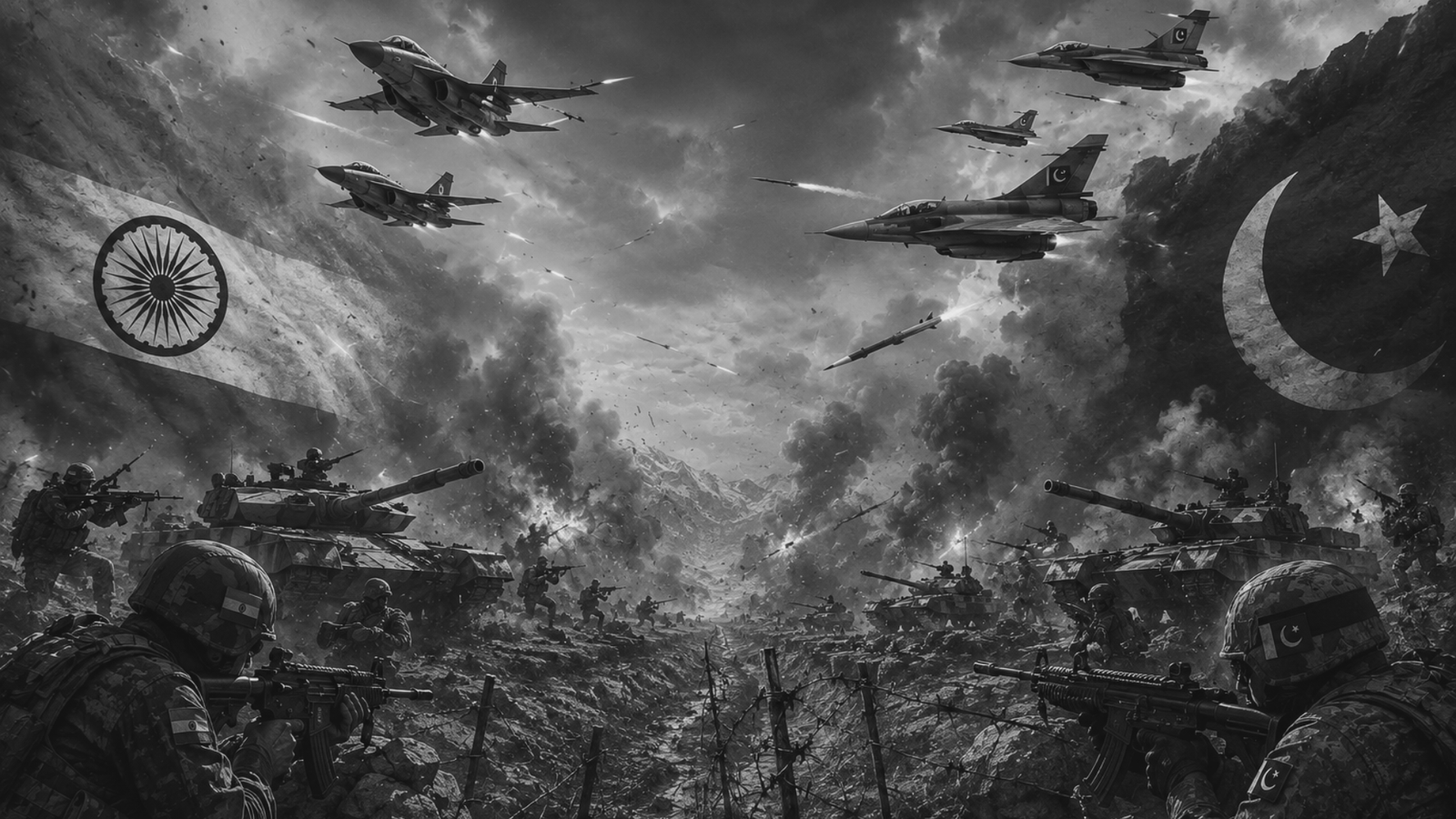
The visual architecture of the magazine itself functions as part of the information operation. The publication uses cinematic battlefield imagery, emotional portraits, destruction visuals, nationalist color palettes, martyr iconography, and heavily curated historical imagery.
These are not decorative elements. They are psychological conditioning tools. The magazine is designed less like a policy document and more like a wartime emotional mobilization manual. Its target is not rational analysis alone. It seeks emotional alignment and national synchronization.
International Signaling and Strategic Messaging
Beyond domestic audiences, the magazine also sends signals externally. It attempts to communicate that Pakistan possesses escalation dominance credibility, that Pakistan’s military modernization remains intact, that the nuclear threshold still constrains India, and that any future conflict will carry unacceptable costs.
The repeated emphasis on precision strikes, technological superiority, and successful deterrence reflects Pakistan’s effort to maintain strategic parity despite India’s growing conventional advantages. In this sense, Marka-e-Haq functions partly as deterrence literature.
Conclusion
Ultimately, Marka-e-Haq should not be read as history. It should be read as doctrine. It is a sophisticated state sponsored information warfare product designed to consolidate domestic nationalism, reinforce military legitimacy, reframe Pakistan’s strategic image internationally, externalize internal instability, and psychologically prepare audiences for prolonged confrontation with India.
The publication reflects how modern conflicts are no longer fought only through kinetic force, but through narratives, memory, symbolism, emotional mobilization, and digital perception management. The real battlefield today is not merely territory. It is legitimacy. Marka-e-Haq is Pakistan’s attempt to fight that battle through narrative supremacy.
The views expressed are those of the authors and do not represent the views of CNAWS.
Image Source: ChatGPT


