

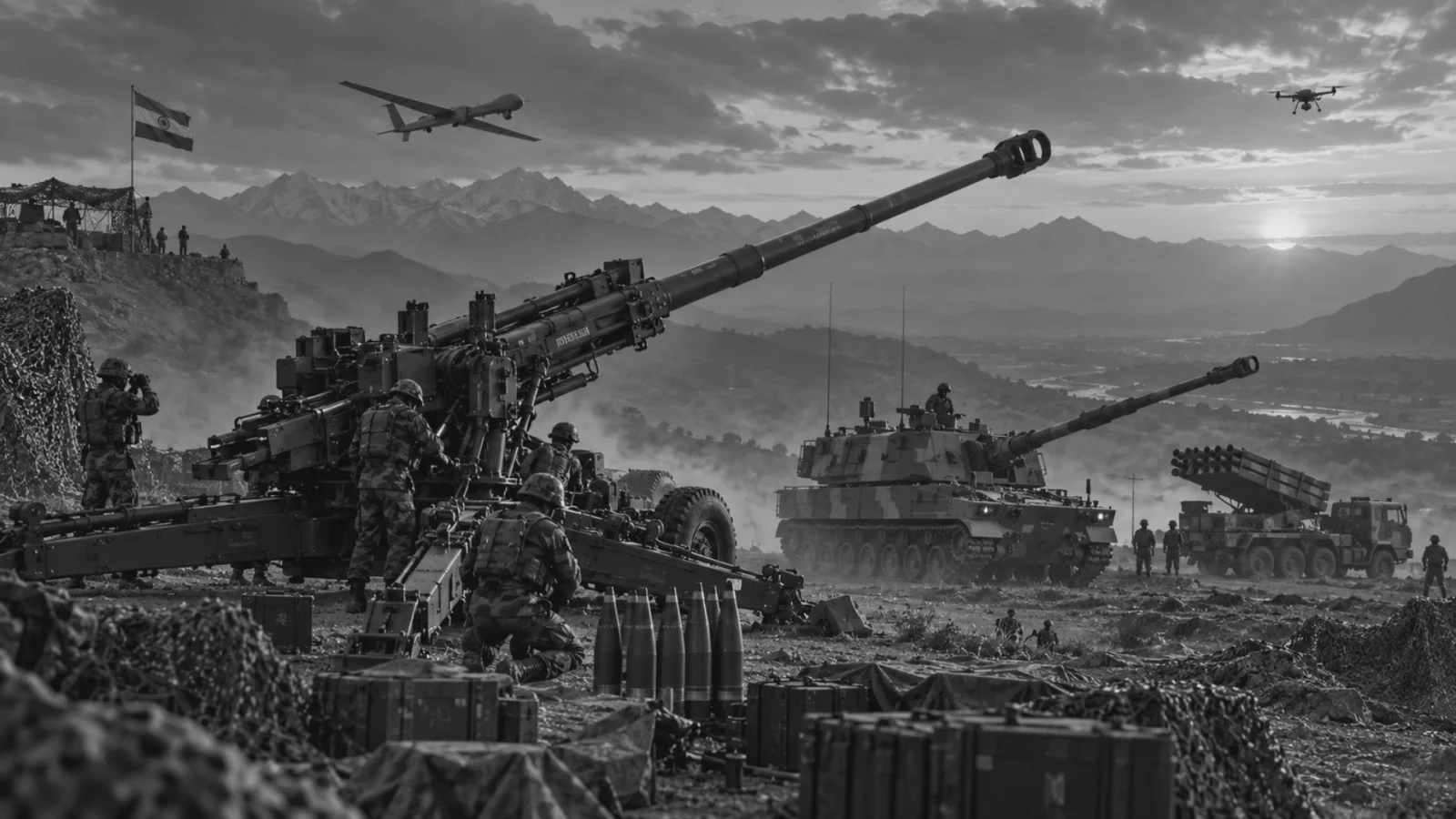
India’s Artillery Reset: What the Army Chief’s Russia Visit Signals About the Next Generation of Long-Range Fires

More Than a Diplomatic Visit
General Dhiraj Seth's Russia visit was the first by a serving Indian Army Chief in nearly eight years. The Ministry of Defence stated that the purpose was to strengthen military-to-military cooperation and exchange perspectives on contemporary military developments.¹ His itinerary is revealing. In Moscow, General Seth held discussions with senior Russian military leadership and visited the National Defence Control Centre. He also interacted with Russian Deputy Defence Minister Vasily Osmakov, whose responsibilities include defence industry and procurement. In Saint Petersburg, the Army Chief visited the Mikhailovskaya Military Artillery Academy and interacted with its leadership and faculty. Subsequent reporting indicated that discussions included artillery modernisation, capability development, training exchanges and the sharing of operational experience.²
None of this confirms a new weapons purchase. It does, however, indicate that artillery and land warfare have emerged as meaningful areas of professional engagement at precisely the moment when India is restructuring its own long-range firepower. That distinction matters. India does not need to reproduce the Russian Army's force structure. Nor should lessons from Ukraine be transplanted mechanically onto the Indian battlefield. India's operational environments range from high-altitude confrontation along the Line of Actual Control to deserts and plains opposite Pakistan. What Russia possesses today, however, is something few militaries can offer in comparable depth: recent experience operating large artillery, missile, drone and electronic-warfare formations under sustained combat conditions against a technologically capable opponent.
India's Artillery Transformation Is Already Underway
The Indian Army's modernisation programme increasingly suggests that artillery is once again becoming a central component of conventional deterrence. In March 2025, the Ministry of Defence signed contracts worth approximately ₹6,900 crore for the 155 mm/52 calibre Advanced Towed Artillery Gun System and associated high-mobility vehicles. The government described ATAGS as a replacement for older and smaller-calibre guns and emphasised its ability to conduct precise long-range strikes.³ ATAGS is more than another conventional howitzer. The indigenous system incorporates an integrated fire-control architecture, automatic gun alignment and positioning, muzzle-velocity radar and a ballistic computer. DRDO is also integrating the gun with the Artillery Combat Command and Control System.⁴ The implication is that future artillery modernisation increasingly concerns the network surrounding the weapon rather than simply barrel length or maximum range.
A similar transformation is visible in tracked artillery. India signed a ₹7,628.70 crore contract in December 2024 for an additional batch of K9 Vajra-T 155 mm/52 calibre self-propelled guns. The system provides mechanised formations with mobile, protected artillery capable of rapidly firing and relocating.⁵ Further expansion has also been reported. In June 2026, Indian media reported that the Army was pursuing approximately 300 additional K9 Vajra systems in what could become a major expansion of the self-propelled gun fleet. Any final numbers remain dependent on the procurement process, but the direction is evident. Mobility has become increasingly important because a gun that remains stationary after firing is becoming progressively easier to locate.
Pinaka Is Moving From Rocket Artillery to Precision Deep Fires
The evolution of Pinaka may be even more consequential. In December 2025, DRDO successfully conducted the maiden flight test of the Pinaka Long Range Guided Rocket at its maximum range of 120 kilometres. Significantly, the weapon was fired from an existing Pinaka launcher, demonstrating that the Army can expand engagement range without developing an entirely new launcher fleet.⁶ This fundamentally changes the role of Pinaka. Traditional multiple-launch rocket systems were predominantly associated with saturation fires against concentrations of troops, logistics areas and defensive positions. Guided rockets increasingly allow the same launcher family to participate in precision attacks against command centres, air-defence nodes, artillery positions and other high-value targets. India is therefore developing an artillery capability that begins to overlap with missions previously assigned primarily to aircraft or larger missile systems.
A 120-kilometre rocket does not replace BrahMos, Pralay or air-delivered stand-off weapons. Its warhead, range and target set are different. But its economics are important. A commander able to engage operational targets using relatively numerous guided rockets does not need to employ an expensive cruise missile against every target. This creates a layered strike architecture in which conventional artillery, guided rockets, loitering munitions and missiles can each be assigned targets according to range, value and desired effect. That architecture is particularly relevant after Operation Sindoor. The increasing emphasis on conventional precision strike means future Indian operations may require large numbers of affordable weapons capable of engaging targets across the tactical and operational depth of the battlefield.
The Drone Has Become Part of the Artillery Battery
The most important transformation visible in Ukraine has not necessarily been the artillery gun. It has been the sensor above it. Small UAVs have dramatically shortened the time required to identify targets, transmit coordinates, correct artillery fire and conduct battle-damage assessment. Modern artillery can increasingly be understood as part of a continuous reconnaissance-strike loop. The Indian Army appears to be responding to this trend.
On 14 August 2026, the Ministry of Defence signed contracts worth approximately ₹1,577 crore with Tata Advanced Systems and NIBE for loitering munition systems. The government specifically stated that the systems were being procured to enhance the capabilities of Army artillery regiments.⁷ That wording is significant. Loitering munitions are no longer being treated exclusively as specialised drone weapons separate from traditional fires. They are becoming part of the artillery ecosystem. A future artillery formation may therefore possess several methods of attacking a target. Tube artillery can provide sustained fire. Pinaka can deliver rockets at greater depth. Loitering munitions can search for mobile targets and attack them when located. Surveillance UAVs can maintain persistent observation. Counter-battery radar can identify enemy gun positions. Once these systems are connected digitally, the decisive factor becomes how rapidly information travels from sensor to shooter.
What Russia's Ukraine Experience Actually Offers
Russia's experience in Ukraine has been costly, uneven and characterised by substantial failures as well as adaptation. It should therefore not be treated as a catalogue of automatically successful Russian methods. Nevertheless, several battlefield trends have direct relevance to India's artillery transformation. The first is the integration of UAV reconnaissance with artillery and other fires. RUSI assessments of the war describe Russian formations increasingly using UAVs to locate command posts, electronic-warfare systems, artillery positions, radar sites and hardened positions before engaging them through combinations of artillery, multiple-launch rocket systems, glide bombs and drones.⁸
The second lesson is survivability. Modern surveillance makes large stationary headquarters, ammunition depots and artillery concentrations increasingly vulnerable. Guns must fire and relocate quickly. Command posts must become smaller and more distributed. Ammunition must be dispersed. Communications must remain functional even when portions of the network are jammed or destroyed. The traditional artillery sequence of locating a firing position, establishing communications and remaining there for prolonged periods is increasingly dangerous.
The third lesson is electronic warfare. Ukraine has demonstrated that precision warfare is inseparable from control of the electromagnetic spectrum. GPS-dependent weapons can be degraded. UAV control links can be jammed. Command networks can be detected. Drone operators themselves can become targets. CSIS assessments of the conflict emphasise that both Russia and Ukraine operate in a heavily contested electromagnetic environment in which communications, navigation and unmanned systems are continuously disrupted and adapted.⁹ For India, this means artillery modernisation cannot be separated from electronic warfare. A 120-kilometre precision rocket is only useful if targeting coordinates can be generated and transmitted reliably. A surveillance drone provides little value if its control link is immediately neutralised. A digitally networked battery becomes vulnerable if its transmissions reveal its location.
The fourth lesson concerns ammunition. High-intensity land warfare consumes enormous quantities of artillery shells, rockets, drones and spare components. Precision weapons remain important, but they do not eliminate the requirement for mass. The ability to manufacture and replenish munitions therefore becomes an operational capability in its own right.
Russia May Matter More for Experience Than Hardware
India-Russia defence cooperation is itself undergoing a transition. At the December 2025 India-Russia summit, both governments explicitly stated that military-technical cooperation was moving toward joint research, development, co-development and co-production. They also agreed to expand manufacturing in India of spare parts and components required to sustain Russian-origin equipment.¹⁰ This is important because a large segment of India's land warfare inventory remains of Soviet or Russian origin. T-90 tanks, earlier-generation air-defence systems, infantry combat vehicles and other platforms will remain in Indian service for years. Improving availability, domestic repair capability and access to components therefore has direct implications for wartime endurance. The Army Chief's meeting with a Russian deputy defence minister responsible for industry and procurement should be considered within this wider framework.
But the larger opportunity may lie elsewhere. India already possesses an indigenous artillery manufacturing base. ATAGS, Dhanush and Pinaka demonstrate that the country is increasingly capable of designing and producing its own major artillery systems. The more valuable relationship with Russia could therefore move from buying complete weapons toward examining operational experience, maintaining legacy equipment and selectively absorbing technologies relevant to future warfare. This would be consistent with India's broader Aatmanirbhar Bharat approach rather than contradicting it.
Counter-Battery Warfare Will Become More Difficult
Traditional counter-battery warfare relied heavily on detecting artillery projectiles through radar, calculating their launch point and rapidly engaging the opposing battery. That cycle still matters. But drones and loitering munitions are changing it. Artillery formations can increasingly be detected before they fire. Vehicle movement, thermal signatures, communication emissions, ammunition resupply and gun positions can all contribute to identification. Conversely, enemy artillery may deliberately operate in smaller groups, relocate frequently, employ decoys or use electronic warfare to disrupt reconnaissance. Future counter-battery warfare will therefore involve far more than radar-versus-gun engagements. The successful force will combine counter-battery radar, UAVs, electronic intelligence, satellite imagery, acoustic sensors and other surveillance systems into a common operational picture. Once detected, the target might be engaged by another gun battery, Pinaka, a loitering munition, an attack helicopter, an aircraft or a missile. This is where command architecture becomes decisive. The side capable of completing the detection-to-engagement cycle fastest gains an increasingly disproportionate advantage.
The Pakistan and China Context
India's artillery transformation must ultimately be understood against two very different operational theatres. Along the western front, Pakistan is expanding its own rocket and missile capabilities and has established a dedicated Army Rocket Force Command. The Fatah family of precision systems is designed to give Pakistan increasingly deep conventional strike options. Indian formations will therefore need to locate and neutralise mobile launchers while protecting headquarters, ammunition areas, airfields and logistics nodes against Pakistani precision fire. Along the northern frontier, the challenge is different. Terrain, altitude, dispersed infrastructure and the depth of Chinese sensor and rocket capabilities place extraordinary demands on logistics and long-range fires. China's PLA Rocket Force and extensive use of unmanned surveillance create an environment in which large concentrations of artillery could become particularly vulnerable. India consequently requires artillery that is not merely longer ranged but more mobile, networked and survivable. The ability of systems such as K9 Vajra to operate in high-altitude areas, the increasing reach of Pinaka, lightweight artillery such as the M777 and expanding drone reconnaissance must therefore be understood as components of a wider firepower architecture.
Strategic Assessment
General Dhiraj Seth's Russia visit should not be interpreted as evidence that India intends to return to a Russian-centric procurement model. India's artillery trajectory points in the opposite direction. ATAGS is indigenous. Pinaka is indigenous. The latest loitering munition procurement is from Indian industry. Domestic production and technology absorption remain central to defence policy. What Russia can potentially provide is a different commodity: operational experience. The Ukraine battlefield has compressed decades of artillery evolution into a few years. Guns have become closely connected to UAVs. UAV operators have become targets. Electronic warfare influences precision. Ammunition production has become strategic. Command posts must disperse. Artillery batteries must move continuously. Cheap drones can destroy equipment worth millions of dollars.
India does not need to copy the Russian response to these challenges. It does need to understand them. The visit to the Mikhailovskaya Military Artillery Academy is therefore significant because the future of Indian artillery is increasingly about doctrine, training and integration rather than simply procuring another 155 mm gun. India's emerging artillery architecture is beginning to combine traditional tube artillery, self-propelled guns, extended-range Pinaka rockets, loitering munitions, UAV reconnaissance and digital command systems. The next stage will be to connect them more effectively. That requires resilient communications, battlefield surveillance, electronic-warfare protection, rapid target acquisition and an industrial base capable of sustaining prolonged ammunition expenditure.
The central lesson from Ukraine is therefore straightforward. The gun remains important, but the artillery battery is no longer just the gun. The effective weapon is the entire network that detects the target, identifies it, transmits its coordinates, selects the appropriate munition, conducts the strike and immediately relocates before the enemy can respond. General Seth's Russia visit comes precisely as the Indian Army is building that network. The real artillery reset is consequently not about replacing one weapon with another. It is about transforming Indian long-range fires from collections of platforms into a connected reconnaissance-strike system capable of surviving and delivering precision fire in a battlefield saturated with drones, sensors and electronic warfare.
References
Ministry of Defence, Government of India, “COAS General Dhiraj Seth Embarks on an Official Visit to Russia,” September 16, 2026. Press Information Bureau
Times of India, “Army Chief’s Military Talks in Russia Focus on Artillery Modernisation, Capability Development,” September 20, 2026. Times of India report
Ministry of Defence, Government of India, “Aatmanirbhar Bharat: MoD Inks Rs 6,900 Crore Contracts for 155mm/52 Calibre Advanced Towed Artillery Gun Systems & High Mobility Vehicle 6x6 Gun Towing Vehicles,” March 26, 2025. Press Information Bureau
Defence Research and Development Organisation, “Advanced Towed Artillery Gun System (ATAGS).” DRDO ATAGS profile
Ministry of Defence, Government of India, “MoD Inks Rs 7,629 Crore Contract with L&T for K9 VAJRA-T Self-Propelled Tracked Artillery Guns,” December 20, 2024. Press Information Bureau
Ministry of Defence, Government of India, “DRDO Successfully Conducts Maiden Flight Test of Pinaka Long Range Guided Rocket,” December 29, 2025. Press Information Bureau
Ministry of Defence, Government of India, “Aatmanirbhar Bharat: MoD Inks Rs 1,577 Crore Contracts for Loiter Munition Systems for Indian Army,” August 14, 2026. Press Information Bureau
Jack Watling and Oleksandr V. Danylyuk, “Emergent Approaches to Combined Arms Manoeuvre in Ukraine,” Royal United Services Institute, 2025. RUSI analysis
Matthew Slusher, “Lessons from the Ukraine Conflict: Modern Warfare in the Age of Autonomy, Information, and Resilience,” Center for Strategic and International Studies, May 2, 2025. CSIS report
Government of India, “Joint Statement Following the 23rd India-Russia Annual Summit,” December 2025. Official India-Russia joint statement


