

Pakistan’s Post-Sindoor Air Defence Reset: Can HQ-17AE and KORKUT Stop the Next Indian Strike?

What Pakistan Has Revealed
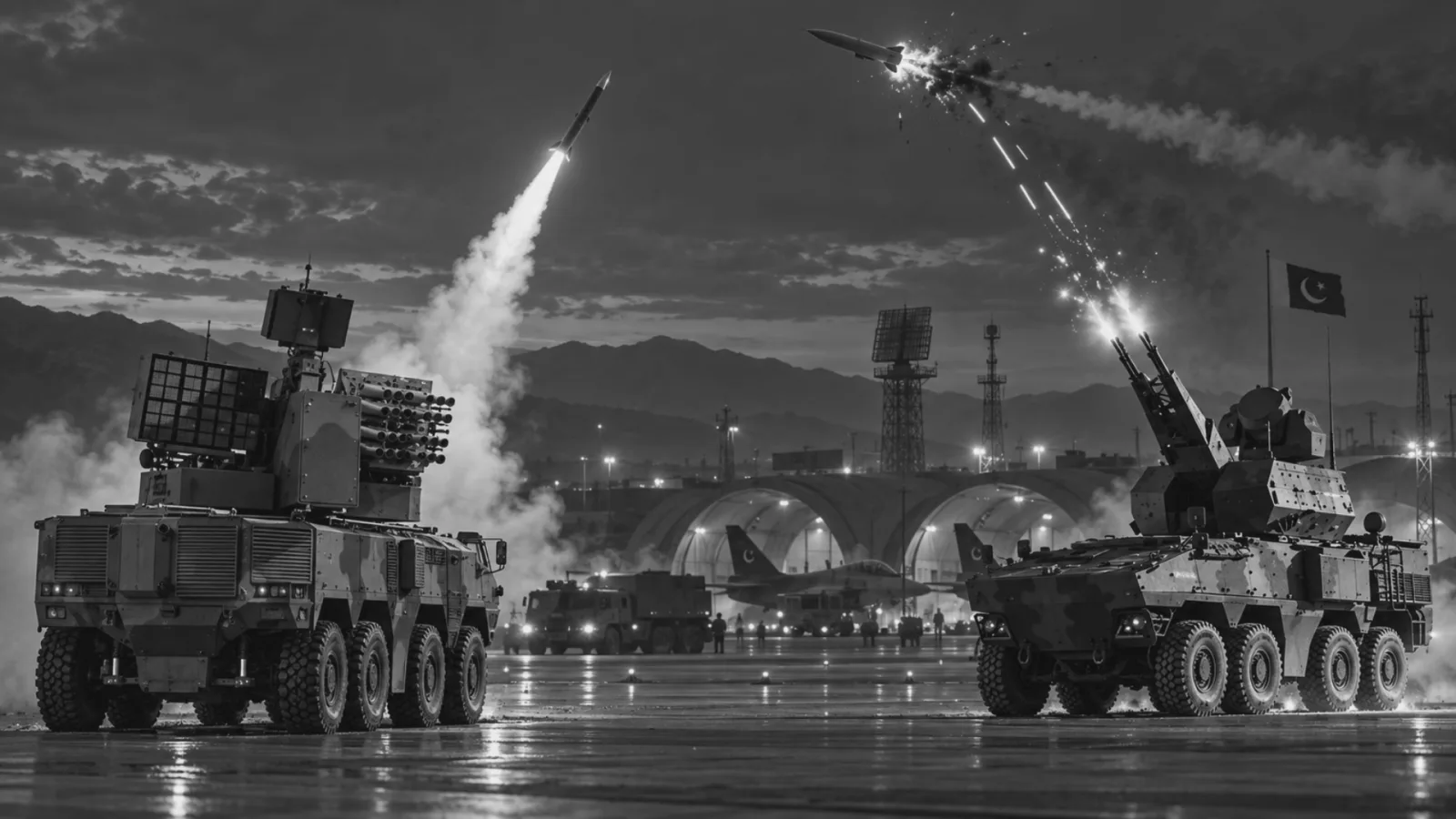
On 6 and 7 September 2026, a Pakistan Air Force promotional release provided the clearest indication yet that the service has acquired a new group of short-range air-defence systems. Open-source identification of the footage pointed to China’s HQ-17AE and Turkish KORKUT and ŞAHİN systems. Chinese state media subsequently reported that Pakistan had deployed the HQ-17AE, confirming the country as a foreign operator of the Chinese system.4
The HQ-17AE is the export derivative of China’s HQ-17A family. It combines its own phased-array radar, fire-control equipment and eight vertically launched missiles on a highly mobile wheeled vehicle. Chinese sources describe an engagement range of roughly 15 to 20 kilometres against fighter-sized targets, while other published specifications place its overall engagement envelope at approximately 1.5 to 20 kilometres and up to 10 kilometres in altitude. A single vehicle can reportedly engage several targets simultaneously and is designed to search for targets while moving.5
This gives Pakistan something particularly useful around vulnerable military infrastructure. Unlike a strategic long-range SAM battery, HQ-17AE can be moved rapidly, dispersed and employed as a local protective layer for air bases, command facilities, radar sites or manoeuvring formations.
KORKUT addresses a different part of the problem. ASELSAN describes the system as a very-short-range air-defence weapon built around twin 35 mm cannon, radar and electro-optical tracking. Its published effective range is approximately four kilometres, with a combined rate of fire of around 1,100 rounds per minute. More importantly, KORKUT uses programmable ATOM airburst ammunition designed for targets including UAVs, cruise missiles and air-to-ground weapons. A standard configuration consists of three gun vehicles supported by a command-and-control vehicle.6
ŞAHİN sits still closer to the defended asset. The 40 mm system uses programmable airburst ammunition and is specifically designed to defeat mini and micro UAVs.7
Together, these systems indicate that Pakistan is attempting to create several engagement opportunities inside a relatively compressed defensive zone. A threat surviving the missile layer could encounter radar-directed 35 mm fire and, closer to the protected installation, another counter-UAS layer.
The Operation Sindoor Lesson
Pakistan already possessed a layered air-defence architecture before Operation Sindoor. The Pakistan Army inducted the Chinese LY-80 low-to-medium-altitude air-defence system in 2017 and the HQ-9/P high-to-medium-altitude system in 2021. At the time of the HQ-9/P induction, Pakistan explicitly described its objective as establishing a Comprehensive Layered Integrated Air Defence shield.8
The May 2025 confrontation nevertheless demonstrated that possessing long- and medium-range SAMs does not guarantee the protection of strategic infrastructure. On 8 May, India stated that its forces had attacked Pakistani air-defence radars and systems and had neutralised an air-defence system at Lahore. On the night of 9 to 10 May, Indian forces subsequently struck military targets at Rafiqui, Murid, Chaklala, Rahim Yar Khan, Sukkur and Chunian, while radar sites at Pasrur and Sialkot were also targeted.9
Those claims were not based solely on Indian battle-damage assessments. A Washington Post analysis of commercial satellite imagery found damage at six Pakistani airfields, including damage to hangars, runways and mobile air-force-related assets. Reuters separately reported the attack on Nur Khan and cited Pakistani security officials describing damage there. Reuters also reported that sources from both sides said BrahMos missiles were used during the May 10 exchange.10 11
The operational lesson for Pakistan was therefore not simply that it needed another long-range missile. The vulnerability existed at the other end of the engagement chain. Once an attacking weapon penetrated or bypassed the outer air-defence network, important military installations required a much denser terminal shield.
Why the New Layer Matters
The first improvement is engagement depth. A precision weapon heading towards a protected installation may now have to survive an additional missile engagement from HQ-17AE before entering the KORKUT gun envelope. Smaller drones that would be economically inefficient to engage with expensive surface-to-air missiles can instead be assigned to gun-based systems.
The second advantage is mobility. Fixed or predictable radar and missile sites are vulnerable to geolocation and targeting during a suppression campaign. HQ-17AE and KORKUT can relocate, complicating the adversary’s target picture and allowing defensive layouts to change.
The third advantage is ammunition economics. Modern air-defence networks face an unfavourable cost exchange when expensive interceptors are used against inexpensive one-way attack drones. KORKUT and ŞAHİN do not eliminate the saturation problem, but gun-based interception allows missile stocks to be conserved for faster or more dangerous threats.
There is also a potentially important organisational shift. Pakistan’s older strategic ground-based air-defence systems, including LY-80 and HQ-9/P, were publicly inducted through the Pakistan Army Air Defence. The September 2026 systems have instead been showcased through the Pakistan Air Force. If the PAF is directly operating or controlling this new point-defence layer, it could provide air bases with a more organic terminal-defence capability. The precise command relationship, however, remains unclear from public information.
Can It Stop BrahMos?
The answer is more complicated than either side’s public messaging suggests. HQ-17AE was designed to engage cruise missiles and precision-guided weapons, so it cannot simply be dismissed against BrahMos. But the engagement geometry is demanding. A supersonic cruise missile gives a short-range defence system limited time between detection, classification, tracking, engagement authorisation and interception. Low-altitude flight can further reduce detection distance because of terrain and the radar horizon.
KORKUT provides another terminal engagement opportunity, but its approximately four-kilometre published effective range makes it a last-ditch layer rather than a wide defensive umbrella. Successful interception would depend on early warning, cueing, sensor quality and the incoming weapon entering the gun system’s engagement basket under favourable conditions.
More importantly, future Indian operations are unlikely to resemble a laboratory contest between one BrahMos and one HQ-17AE battery. The relevant contest is between an offensive package and an air-defence network.
Decoys, electronic attack, anti-radiation weapons, loitering munitions, unmanned systems and stand-off missiles can be combined to force radars to radiate, consume interceptors, generate false tracks or attack air-defence components themselves. India officially stated after Operation Sindoor that Pakistani Chinese-supplied air-defence systems were bypassed and jammed during the operation.12
Pakistan’s central challenge is therefore integration. HQ-17AE, KORKUT and ŞAHİN may each be capable systems, but their combined effectiveness depends on whether surveillance radars, airborne early-warning assets, local sensors, Army air-defence units and PAF command networks can maintain a reliable common air picture while subjected to electronic attack and physical strikes.
CNAWS Assessment
Pakistan’s new short-range air-defence layer should be taken seriously. It directly addresses vulnerabilities demonstrated during Operation Sindoor and could increase the survivability of selected air bases, command nodes, radar facilities and other critical military infrastructure. It may also increase the number and variety of weapons required to reliably defeat a heavily protected target.
Yet the development should not be interpreted as a BrahMos-proof shield. The engagement ranges are limited, and the number of systems Pakistan has obtained remains unknown. Unless Islamabad has acquired them in substantial quantities, commanders will have to prioritise a finite number of high-value installations. Protecting one cluster of strategic facilities more heavily inevitably leaves others with thinner coverage.
Nor do additional interceptors solve the problem of command-and-control resilience. Operation Sindoor demonstrated the importance of attacking not merely launchers but the radars, communications and command infrastructure that allow an integrated air-defence system to function.
The larger question is therefore whether Pakistan is repairing a tactical vulnerability or redesigning its entire integrated air-defence architecture. The September reveal suggests the latter may have begun, but there is not yet sufficient evidence to demonstrate a nationwide transformation.
For India, the appearance of HQ-17AE and KORKUT means that the air-defence environment around important Pakistani targets is likely to become denser, particularly at low altitude and during the terminal phase of an attack.
For Pakistan, however, the fundamental problem remains unchanged. Intercepting the incoming weapon is only one part of air defence. The harder task is keeping the sensors, communications, command centres and interceptors connected and functioning after the first wave has begun attacking the network itself.
Indicators to Watch
CNAWS assesses four developments as particularly important over the coming months. The first is evidence revealing the actual number of HQ-17AE, KORKUT and ŞAHİN systems fielded. The second is sustained deployment around major PAF and other strategic facilities. The third is exercises demonstrating integration between Pakistan Army and PAF air-defence networks. The fourth is additional procurement intended to strengthen the layer between short-range point defence and strategic systems such as HQ-9/P.
If these indicators begin appearing together, Pakistan’s September reveal will represent more than a post-Sindoor procurement response. It will mark the beginning of a deeper restructuring of Pakistan’s air-defence architecture.
References
The Washington Post. “Indian Strikes on Pakistan Damaged Six Airfields, Post Analysis Finds.” May 14, 2025. Source
Janes. “China Clears HQ-17AE Air-Defence System for Export.” March 8, 2021. Source
ASELSAN. KORKUT 150/35 Very Short Range Air Defense System. Product brochure, June 2025. Source
Zhao Lei. “Pakistani Air Force Deploys China-Made Air-Defense System.” China Daily, September 8, 2026. Source
Deng Xiaoci and Liu Xuanzun. “China’s Advanced Field Air Defense Missile HQ-17AE Cleared for Export.” Global Times, March 7, 2021. Source
ASELSAN. KORKUT 150/35 Very Short Range Air Defense System. June 2025. Source
ASELSAN. ŞAHİN 130/40GL 40 mm Hard-Kill System. 2026. Source
Dawn. “New Air Defence System Commissioned into Army.” October 15, 2021. Source
Ministry of External Affairs, Government of India. “Transcript of Special Briefing on Operation Sindoor, May 10, 2025.” May 10, 2025. Source
The Washington Post. “Indian Strikes on Pakistan Damaged Six Airfields, Post Analysis Finds.” May 14, 2025. Source
Gibran Naiyyar Peshimam, Shivam Patel, Charlotte Greenfield, and Aftab Ahmed. “How India and Pakistan Pulled Back from the Brink with US-Brokered Ceasefire.” Reuters, May 14, 2025. Source
Press Information Bureau, Government of India. “Operation SINDOOR: The Rise of Aatmanirbhar Innovation in National Security.” May 14, 2025. Source


