

SITREP: Protests in Pakistan-Occupied Jammu & Kashmir

1. Timeline of Events
- May 2023–2024: JAAC evolved from local protests over wheat subsidies, electricity tariffs, elite privileges, and governance grievances into a region-wide mobilization network involving traders, transporters, lawyers, students, and civic groups. Freedom House notes that 2024 protests saw tear gas, internet blackouts, arrests, and gunfire, followed by concessions on wheat/electricity prices and elite privileges.
- Sep–Oct 2025: JAAC broadened its charter to 38/39 points, including legislative reform and abolition of refugee-reserved seats. Reuters reported deadly unrest, phone/internet shutdowns, and a 4 October 2025 agreement under which the government pledged development and electricity-system commitments.
- Late May–3 June 2026: Talks failed over the 12 refugee seats. An all-parties conference in Muzaffarabad rejected extra-constitutional abolition of the seats; JAAC boycotted and reiterated its June 9 protest call.
- 5–7 June 2026: AJK authorities banned JAAC under the PoJK Anti-Terrorism Act, issued a travel advisory for 5–20 June, deployed additional security, and sealed JAAC’s office. Radio Pakistan reported police recovered weapons during the office raid; JAAC rejected the ban as an attempt to silence a rights movement.
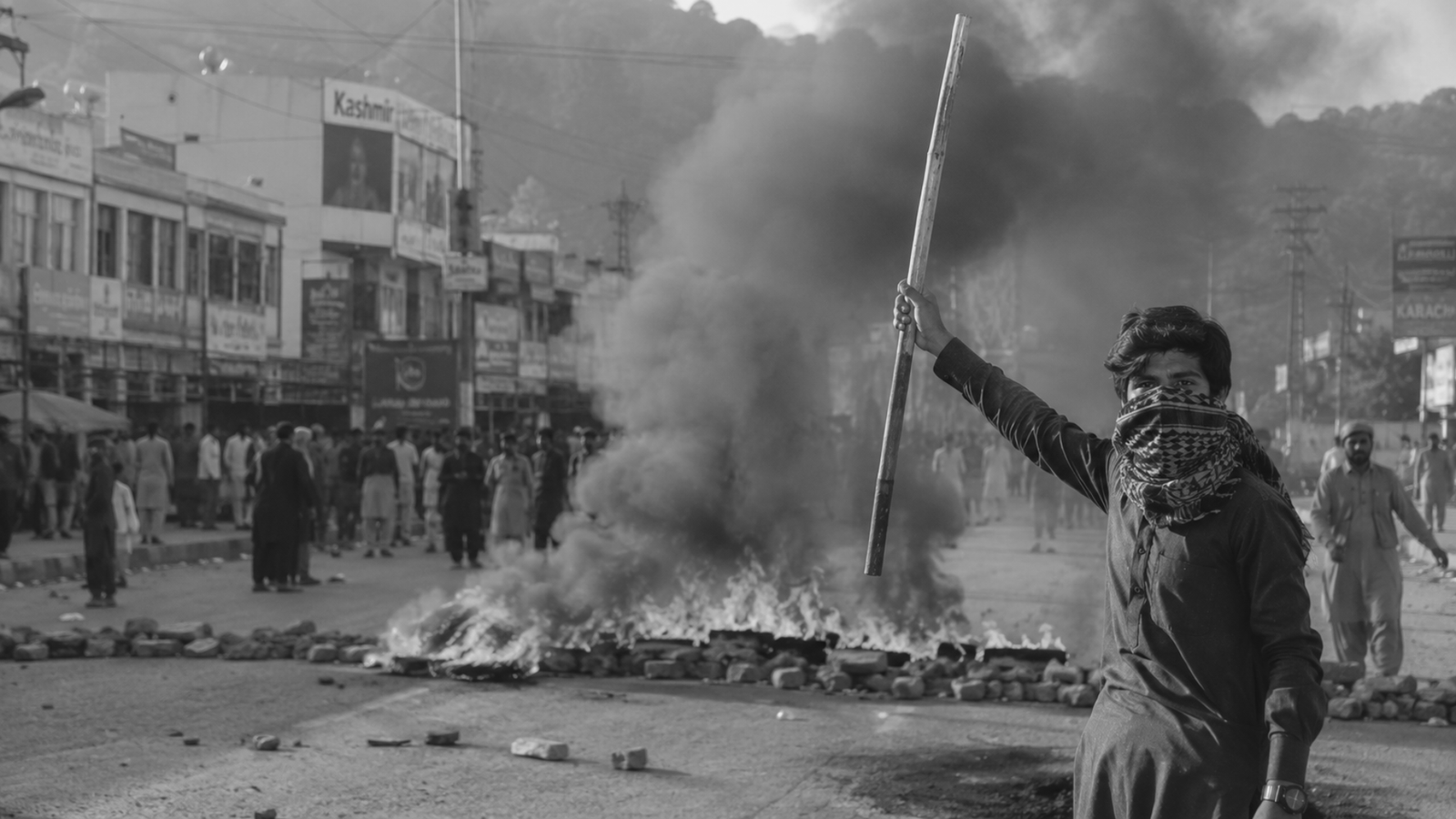
- 8–9 June 2026: Rawalakot/Poonch clashes produced the highest casualties. Reuters reported 11 killed and 70+ injured; Dawn confirmed seven civilians and four law-enforcement personnel killed; AP/AFP earlier reported seven killed. The 9 June strike shut businesses and transport across several areas, with Muzaffarabad heavily affected and Mirpur witnessing large mobilization.
- 10–11 June 2026: A Pakistan Army Mi-17 crashed near Muzaffarabad amid heightened security deployments; Reuters and AP report the military attributed it to technical fault and did not link it to protests. Reuters later reported 22 personnel killed.
2. Who Is Protesting?
JAAC/JKJAAC is a broad civil-society coalition rather than a conventional party. Its base includes traders, transporters, lawyers, students, local activists, and civic networks; analysts and local reporting describe it as having expanded from economic protests into a larger social force challenging governance and representation arrangements.
Identified leaders/spokespersons in current reporting include Shaukat Nawaz Mir, Mehran Arshad Khawaja, Umar Nazir Kashmiri, and other core members. JAAC statements quoted by The Express Tribune and Voicepk say the June 9 call represents “people from every city, town and village,” while the PoJK government describes JAAC as coercive and disruptive.
3. Drivers of the Protests
- Economic grievances: Protesters cite electricity tariffs, wheat/flour subsidies, inflation, and public-service failures. AP reports the 38-point charter included subsidized wheat and electricity; Freedom House and The Diplomat note that earlier mobilization centered on wheat/electricity prices and elite privileges.
- Political grievances: The immediate trigger is the demand to abolish 12 seats reserved for refugees from "Indian-administered Kashmir" living elsewhere in Pakistan. JAAC argues these seats allow Pakistan-based parties to influence PoJK government formation; PoJK authorities and the PoJK Supreme Court position the seats as constitutionally protected and not removable without formal amendment.
- Security/human-rights concerns: Amnesty reports internet/mobile restrictions, arbitrary arrests, deadly force allegations, and the proscription of JKJAAC as disproportionate. Authorities allege weapons, violence, attacks on police, and attempts to disrupt public order; protesters deny the government’s allegations and allege excessive force.
4. Geographic Spread

5. Government Response
The PoJK government has proscribed JAAC under anti-terror law, sealed offices, arrested supporters, sought sedition cases and arrest bounties against leaders, deployed police/paramilitary forces, imposed travel restrictions, and restricted internet/mobile connectivity.
The official narrative frames JAAC as violent, coercive, and a threat to state writ; Radio Pakistan reported weapons recovered from JAAC premises and later claimed PoJK residents rejected the protest call. The PoJK prime minister has also invited renewed talks, saying the refugee-seat issue is not “more important than human lives,” while insisting constitutional limits apply.
6. Casualty and Arrest Tracker

7. Information Environment
The information space is polarized. Government-aligned sources emphasize “terrorism,” weapons recovery, normalcy, and foreign-linked disruption; protest-linked messaging frames the crackdown as collective punishment against rights-seeking citizens. Reuters quoted a Muzaffarabad resident saying protesters are “not against Pakistan” but seeking rights, while Amnesty warns that internet shutdowns restrict independent verification.
Unverified or exaggerated claims are circulating, including inflated death tolls and highly specific victim categories in some Indian/social-media accounts; these are not corroborated by Reuters, AP, Dawn, AFP, or Amnesty. Confidence in verified casualty figures remains Medium, not High, because access restrictions and communications shutdowns limit independent confirmation.
8. Analytical Assessment
- Primary driver: The movement is best assessed as a rights-and-governance protest with economic roots, now politicized by the refugee-seat dispute and the upcoming July 27 election. It is not primarily anti-state in its mainstream public demands, but state proscription and sedition framing risk pushing parts of the movement into harder opposition. Confidence: Medium-High.
- Escalation likelihood: Medium-High. Triggers include leader arrests, funerals, renewed internet shutdowns, election nomination disputes, or another lethal encounter. The government has coercive capacity, but JAAC has demonstrated cross-district mobilization and social legitimacy among non-party networks.
- Implications: For Pakistan, prolonged unrest complicates internal stability, elections, and the Kashmir narrative. For the Kashmir issue, the refugee-seat debate exposes a sensitive contradiction: local demands for representation versus Pakistan’s claim to speak for the wider disputed territory.
9. Outlook: Next 30 Days
- Most likely: Security restrictions continue, limited talks resume, protests fluctuate between shutdowns and localized clashes.
- Best case: AJK/federal negotiators create a time-bound constitutional committee on refugee seats, lift communications restrictions, and release nonviolent detainees.
- Worst case: Arrest or death of a senior JAAC figure triggers renewed mass mobilization, broader shutdowns, and further lethal clashes before the July 27 election.
- Indicators to monitor: internet restoration by 12 June, status of sedition FIRs/bounties, funerals and mourning rallies, JAAC leadership visibility, Mirpur-Rawalakot-Muzaffarabad mobilization routes, and whether elections proceed on schedule.
Source Annex
- Reuters, 8 June 2026, Rawalakot clashes and casualty figures. https://www.reuters.com/world/asia-pacific/clashes-pakistan-administered-kashmir-kill-11-ahead-protest-2026-06-08/
- Reuters, 9 June 2026, strike, sedition cases, bounties, shutdown impact. https://www.reuters.com/world/asia-pacific/protesters-clash-with-police-pakistani-kashmir-strike-shutters-cities-2026-06-09
- Reuters, 11 June 2026, military helicopter crash amid security restrictions. https://www.reuters.com/world/asia-pacific/military-helicopter-crash-pakistani-kashmir-killed-22-security-sources-say-2026-06-11
- Associated Press, 6 June 2026, arrests before rally and 38-point demands. https://apnews.com/article/006859907010f8f66cf4fb5ceb2ec6cb
- Associated Press, 9 June 2026, region-wide strike and refugee-seat ruling. https://apnews.com/article/7b4f5e038abd227415dd0aeb32e5ebe3
- AFP via Arab News, 8 June 2026, early casualty/arrest count. https://www.arabnews.com/node/2646355/world
- Al Jazeera, 9 June 2026, explainer on trigger and internet restrictions. https://www.aljazeera.com/news/2026/6/9/deadly-protests-in-pakistan-administered-kashmir-whats-going-on
- Dawn, 8 June 2026, seven civilian deaths and police casualties. https://www.dawn.com/news/2006082
- Dawn, 8 June 2026, Rawalakot clash details and AJK Supreme Court opinion. https://www.dawn.com/news/2006025
- The Express Tribune, 3 June 2026, APC, JAAC boycott, AJK PM position. https://tribune.com.pk/story/2611292/jaac-boycotts-apc-as-parties-reject-refugee-seats-proposal-for-ajk-assembly
- The Express Tribune, 7 June 2026, 72 arrests and police allegations. https://tribune.com.pk/story/2611764/72-held-in-ajk-crackdown-as-govt-defends-jaac-ban
- Amnesty International, 9 June 2026, human-rights concerns, internet shutdown, arrests, deadly force. https://www.amnesty.org/en/latest/news/2026/06/pakistan-terrorism-designation-of-protest-movement-marks-dangerous-escalation-in-jammu-and-kashmir-crackdown/
- Radio Pakistan, 7–10 June 2026, official/state narrative on office sealing and normalcy. https://www.radio.gov.pk/07-06-2026/ajk-police-seal-head-office-of-banned-joint-awami-action-committee
- Voicepk.net, June 2026, human-rights/legal reporting and JAAC statement excerpts. https://voicepk.net/2026/06/ajk-bans-jaac-under-anti-terrorism-law-as-pm-warns-against-mob-rule-committee-says-june-9-protest-will-go-ahead/
- Freedom House, 2025, governance/civic-space background. https://www.ecoi.net/en/document/2129094.html
- Kashmir Times, 29 July 2025, movement evolution and social base. https://kashmirtimes.com/opinion/comment-articles/azad-kashmirs-awakening-assessing-two-years-of-the-joint-awami-action-committee


