

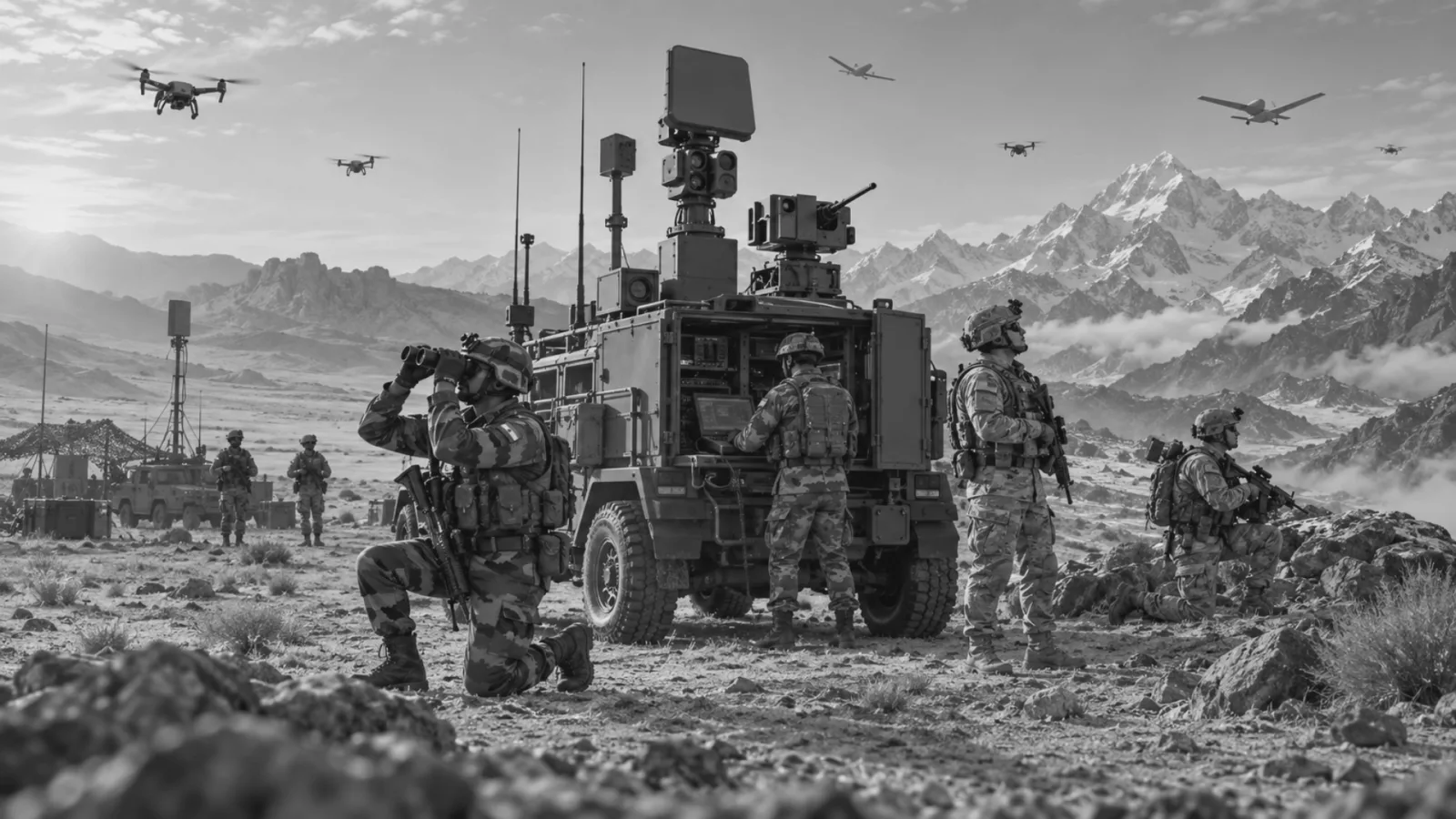
Yudh Abhyas 2026 and the Counter-Drone Challenge Across Deserts and Mountains

Reporting identifies Bikaner in Rajasthan and Auli in Uttarakhand as the exercise locations. These environments give the bilateral engagement relevance to different demands on Indian land forces, including movement across extensive desert terrain and operations in mountainous areas. However, the available announcements do not establish which counter-drone components will operate at each location. The geographical spread should therefore be understood as the scope of the exercise, without assuming that every participating system will undergo identical trials in both settings.2
The counter-drone component also requires a precise historical distinction. Yudh Abhyas already included training involving unmanned aircraft and countermeasures in 2022. A participant’s account published by Army University Press described a dedicated module through which the two armies examined their systems and discussed approaches to countering hostile drones. The development in 2026 is the announced deployment of MLIDS within an expanded exercise framework. Describing this as the first time the armies have addressed drone defence would obscure the continuity of their earlier work.3
MLIDS illustrates an approach built around several complementary functions. Published US Army descriptions of the LIDS family identify radar and other sensors, command-and-control software, electronic countermeasures and weapons capable of physically intercepting drones. The mobile version has incorporated these functions on protected vehicles. Its relevance comes from connecting detection, identification and engagement within an organised defensive system. The published architecture provides context for understanding the exercise, although it does not establish the exact equipment configuration brought to India in 2026.4
For an army, the drone threat extends beyond the damage caused by an explosive payload. Surveillance drones can expose movement and positions, creating opportunities for subsequent attacks. US officers drawing on deployments in Iraq and Syria have documented how inexpensive unmanned systems challenge both force protection and conventional training assumptions. Their account also identifies difficulties in detecting low-flying threats when terrain or other obstructions interrupt a sensor’s view. These problems make drone defence relevant to the movement and sustainment of entire formations.5
CNAWS assesses that the desert component offers particular value for examining protection during movement. Units operating over substantial distances must consider whether defensive coverage can accompany manoeuvre and support the vehicles, communications and supplies on which operations depend. A system that performs effectively at a prepared position may impose different demands when the protected force changes location. The useful training question is whether commanders can sustain their intended activity while accounting for drone threats throughout the movement.
The mountain component introduces a different combination of constraints. Ridges and valleys can interrupt observation and communications, while restricted movement makes the placement and support of equipment more demanding. Applying the lessons identified in American counter-drone reporting, CNAWS assesses that mountainous training should help expose differences between a system’s nominal capabilities and the coverage available in a particular landscape. A successful demonstration in open terrain cannot, by itself, establish how that system will support dispersed forces in the Himalayas.
Auli also offers an established setting for learning from Indian experience at altitude. The published account of Yudh Abhyas 2022 describes Indian instruction on acclimatisation, high-altitude illnesses and mountain survival. This matters because personnel readiness and sustainment affect the practical availability of sophisticated equipment. Training with Arctic-experienced American soldiers provides a basis for exchange, while Indian experience contributes knowledge specific to operating at Himalayan elevations. The value of this interaction includes the human and logistical demands that determine whether a capability remains usable over time.6
Command arrangements deserve as much attention as the equipment. In a 2024 Military Review article, Joel B. Vowell and Anthony R. Padalino identified operator workload, sequential manual engagements and incompatible networks as significant counter-drone problems. Their argument was that defensive performance depends partly on how quickly information becomes an actionable decision, especially when several threats appear together. This experience gives the bilateral exercise a practical learning agenda involving information exchange, identification and the division of responsibilities between operators and commanders.7
The official exercise programme includes command-post and field training, followed by a planned combined live-fire demonstration involving digital integration of American and Indian precision fires and rocket systems. As of 11 September, these remain announced activities, with their results still to be established.8 CNAWS assesses that placing drone defence alongside this training raises an important coordination problem. Friendly surveillance aircraft, defensive sensors and artillery all contribute to the same operation, but their activities must be understood across participating units. Greater firepower produces limited benefit if coordination problems prevent forces from using it effectively.
For India, this emphasis connects with the experience of Operation Sindoor and the subsequent attention given to integrated air defence. An official account published in May 2025 described Akashteer as an automated air-defence control and reporting system that combines sensor inputs and provides a common air picture. Its significance for the present exercise is the emphasis on connecting information and decisions across different elements of a defensive network.9 CNAWS assesses that lessons from Yudh Abhyas should be evaluated against India’s existing systems, communications arrangements and operational requirements.
That evaluation should include the cost of maintaining protection. Procurement is only one part of a counter-drone capability. Crews require training, equipment needs maintenance, and defensive weapons need replenishment. Where relatively inexpensive drones can impose repeated demands on defenders, affordability affects how extensively protection can be provided. For India, the relevant question is how different systems can support a sustainable force-wide approach, taking account of the number and variety of locations and formations requiring coverage.
Training institutions will also determine whether lessons persist after the visiting contingents depart. American officers examining their Middle East deployments described a need to adjust training rapidly when counter-drone protection became central to their mission. Infantry, artillery and reconnaissance personnel assumed responsibilities that demanded additional preparation. Their experience underlines the importance of incorporating drone threats into routine unit training and maintaining proficiency across a broader group of soldiers.10 For the Indian Army, a valuable outcome would be lessons that can be absorbed by formations beyond the participating contingent.
The geographical choice gives the exercise relevance to Indian planning concerning both Pakistan and China. Desert training can inform thinking about protecting mobile forces, while mountainous training can contribute to understanding surveillance, communications and sustainment under terrain constraints. These are analytical implications of the locations and capabilities involved. The public announcements do not establish a country-specific combat scenario, and participation in a bilateral exercise does not create an American commitment to intervene in an Indian border conflict.
The most useful indicators will emerge from the training results. Subsequent official reporting may clarify the equipment employed, the extent of information exchange and the tasks completed during the final demonstration. Evidence of revised procedures, sustained operator training and lessons incorporated into later exercises would carry greater analytical weight than the presence of a particular platform alone.
CNAWS assesses that Yudh Abhyas 2026 is likely to deliver its most immediate benefits through improved familiarity with systems, clearer coordination procedures and a better appreciation of operating constraints. Its longer-term value will depend on whether both armies translate that experience into changes in training and force protection. For India, the enduring requirement is to preserve the ability of ground forces to move, communicate and sustain operations as unmanned threats become a routine feature of the battlefield.
Endnotes
Ian Roth, “U.S., Indian Armies to Kick Off 22nd Iteration of India’s Largest Bilateral Exercise, Yudh Abhyas,” 11th Airborne Division, Defense Visual Information Distribution Service, posted September 10, 2026.
Surendra Singh, “US and Indian Armies Kick Off ‘Yudh Abhyas 2026’ …,” Times of India, September 11, 2026.
Jake A. Hughes, “Strategic Partnership in the Himalayan Mountains: Yudh Abhyas 2022,” Military Review, January–February 2024, 149–57.
Meghan E. Hall, “Innovation Draws International Interest,” Army AL&T, December 20, 2021.
Andrew M. Poller and Brandon Toum, “C-UAS Operations,” Military Review, online exclusive, July 2024.
Hughes, “Strategic Partnership in the Himalayan Mountains,” 151–52.
Joel B. Vowell and Anthony R. Padalino, “Advancing the U.S. Army’s Counter-UAS Mission Command Systems to Keep Pace with Modern Warfare,” Military Review, May–June 2024.
Press Information Bureau, Government of India, “Akashteer: The Unseen Force Behind India’s New War Capability,” May 16, 2025.
Poller and Toum, “C-UAS Operations.”


